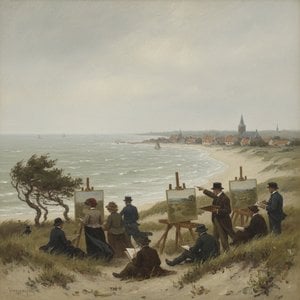
Een leven gegrift in licht: De wereld van António Xavier Trindade
António Xavier Trindade, een naam die met een stille kracht resoneert in de annalen van de Indiase kunstgeschiedenis, was meer dan slechts een schilder; hij was een culturele brug. Geboren in Sanguem, Goa, in 1870 uit een katholiek gezin, begon zijn reis te midden van de weelderige landschappen en het complexe koloniale weefsel van Portugees-Indië. Deze vormende omgeving zou zijn artistieke visie onuitwisbaar hebben gevormende, door een unieke versmelting te creëren van westerse academische training met een intrinsiek begrip van het Indiase leven en karakter. Trindades vroege veelbelovendheid leidde hem naar de prestigieuze Sir Jamsetjee Jeejeebhoy School of Art in Bombay, een cruciale instelling die hem blootstelde aan het Europees naturalisme, terwijl het tegelijkertijd een groeiende generatie Indiase kunstenaars voedde. Het was hier, binnen die gewijde hallen, dat hij zijn vaardigheden verfijnde en technieken meester werd die later zijn kenmerkende stijl zouden definiëren en hem onderscheidingen zouden opleveren, zoals de Mayo Silver Medal voor artistieke verdienste in 1892—een getuigenis van zijn ontluikende talent.
De Bombay School en een opkomende ster
Trindades opmars binnen de kunstscene van Bombay was snel en zelfverzekerd. Na zijn aanstelling als docent tekenen en schilderen aan de Sir J.J. School of Art in 1898, droeg hij niet alleen bij aan de opleiding van toekomstige generaties, maar verstevigde hij ook zijn positie als een leidende figuur binnen de opkomende Bombay School. Later, in zijn rol als directeur van de Reay Workshop of Art van 1ym14 tot 1926, oefende hij nog meer invloed uit op de artistieke productie en pedagogiek. Het was echter niet enkel institutionele erkenning die zijn succes markeerde; het was de betoverende kwaliteit van zijn werk zelf. Hoewel hij zich aanvankelijk richtte op traditionele portretkunst en landschappen, ontwikkelde Trindade geleidelijk een stijl die werd gekenmerkt door haar realisme, gevoeligheid voor licht en het vermogen om de psychologische diepgang van zijn onderwerpen vast te leggen. Hij werd bekend om zijn portretten van Indiase vrouwen met een waardigheid en intimiteit die zelden werd gezien in de kunst uit het koloniale tijdperk, waarmee hij blikken wierp op hun levens voorbij de grenzen van maatschappelijke verwachtingen. Dit leverde hem de liefkozende titel “Rembrandt van het Oosten” op, een erkenning van zowel zijn technische meesterschap als zijn diepgaande begrip van menselijke emotie.
Thema's en technieken: Een synthese van werelden
De jaren twintig getuigden van een rijping in Trindades artistieke expressie, gekenmerkt door een toenemende focus op portretten, landschappen en stillevens. Zijn doeken werden vensters naar het leven van zijn tijdgenoten—rijke patroons, familieleden en alledaagse individuen—elk met minutieuze details weergegeven en voorzien van een subtiele maar krachtige emotionele resonantie.
Dolce Far Niente (Flora of Rustende Moeder), bekroond met de gouden medaille van de Bombay Art Society in 1920, is exemplarisch voor deze periode; het is niet louter een afbeelding van een rustende vrouw, maar een verkenning van moederschap, sereniteit en de stille schoonheid van het huiselijke leven. Evenzo tonen
New Year’s Song (1ym28) en
Hindu Girl (1930), ontvangers van de Governor’s Prize, zijn vermogen om culturele nuances en individuele persoonlijkheden met opmerkelijke gevoeligheid te vangen. De techniek van Trindade was geworteld in westerse academische principes—een beheersing van chiaroscuro, precies handschrift en een verfijnd begrip van kleurtheorie—maar hij injecteerde deze elementen met een Indiase sensibiliteit, waardoor hij een unieke visuele taal creëerde die stilistische grenzen oversteeg. Hij kopieerde niet simpelweg wat hij had geleerd; hij transformeerde het en bezielde het met de geest van zijn vaderland.
Nalatenschap en blijvende invloed
Ondanks persoonlijke uitdagingen—waaronder een achteruitgaande gezondheid en uiteindelijke blindheid in zijn latere jaren—bleef Trindade schilderen, gesteund door zijn dochter Ângela Trindade, zelf een getalenteerd kunstenaar die de nalatenschap van haar vader voortzette. Zijn werk kreeg verdere erkenning met een tentoonstelling tijdens het Festival of the Empire in Wembley, Londen, in 1934, waardoor zijn kunst een internationaal publiek bereikte. Vandaag de dag zijn de schilderijen van António Xavier Trindade kostbare bezittingen van zowel musea als particuliere verzamelaars, met name vertegenwoordigd door een belangrijke collectie in de Fundação Oriente in Goa. De permanente tentoonstellingen die daar zijn ingesteld—inclusief een speciale showcase ter ere van zijn 150ste geboortedag in 2021—zorgen ervoor dat zijn artistieke visie generaties lang zal blijven inspireren en boeien. Zijn invloed reikt verder dan louter esthetische waardering; hij vertegenwoordigt een cruciaal moment in de Indiase kunstgeschiedenis, een tijd waarin kunstenaars begonnen hun eigen identiteit te smeden door traditie met moderniteit te verweven en de heersende koloniale blik uit te dagen. Het leven en werk van Trindade staan als een testament voor de kracht van artistieke expressie om culturele grenzen te overstijgen en de gedeelde menselijke ervaring te verlichten.
Opmerkelijke werken
- Dolce Far Niente (Flora of Rustende Moeder) – Bombay Art Society Gold Medal, 1920.
- New Year’s Song – Governor’s Prize, 1928.
- Hindu Girl – Governor’s Prize, 1930.
- Girl with a Vase - National Gallery of Modern Art, New Delhi.
- Self-portrait in Green - Fundação Oriente.



 Bekijk op ware grootte
 Koop handgeschilderd kunstwerk
 Verstuur
 Delen
Delen
 Details bekijken
 Gids
Gids

 Download
 Vergelijkbare items
 Röntgenonderzoek
 Diavoorstelling
 Statistieken


 Lees meer






































 De optie voor glas is alleen beschikbaar bij een formaat kleiner dan 110 cm.