Dome of the Rock: An Echo of Faith and Geometry
Anthony Whishaw’s ‘Dome of the Rock’ isn't merely a depiction of Jerusalem’s Temple Mount; it’s an invitation to contemplate the profound intersection of history, spirituality, and artistic vision. This striking oil painting captures the essence of one of Islam’s holiest sites—a testament to centuries of devotion and architectural grandeur.
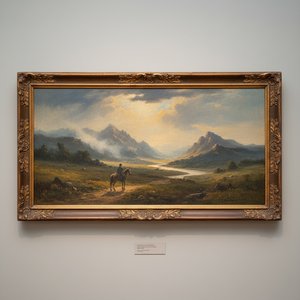
The composition immediately draws the eye upwards towards the monumental dome, rendered in shades of ochre and beige that convey both warmth and solidity. Thick brushstrokes dominate the surface, creating a textured landscape that speaks to Whishaw’s deliberate rejection of photographic realism. Instead, he prioritizes conveying atmosphere and emotion through expressive mark-making—a hallmark of Post-Impressionism.
Stylistic Influences: Expressionist Resonance
Whishaw's artistic approach aligns closely with Expressionist principles. Like artists such as Edvard Munch and Ernst Ludwig Kirchner, he eschews meticulous detail in favor of conveying inner feeling. The loose application of paint—particularly noticeable around the edges of buildings—suggests a dynamic energy that resists static representation. This stylistic choice isn’t accidental; it reflects Whishaw's belief that “each painting and work on paper makes its own separate demands,” urging him to respond intuitively to the canvas itself.
Technique: Impasto and Layered Color
The artist skillfully employs impasto—thickly applied paint—to sculpt the surface of the canvas, enhancing textural contrast and amplifying visual impact. Layers of color blend subtly yet powerfully, creating depth and luminosity that illuminate the architectural forms. The palette is predominantly earthy, dominated by browns, beige, gray and muted ochre tones – colors chosen to evoke a sense of timelessness and solemn reverence.
Symbolism: Sacred Geometry and Remembrance
Beyond its visual beauty, ‘Dome of the Rock’ carries significant symbolic weight. The dome itself embodies geometric perfection—a deliberate reference to Islamic cosmology and divine order. Situated at the heart of Jerusalem's Temple Mount, a site revered by Judaism and Christianity as well, it represents continuity across faiths and underscores the enduring legacy of religious pilgrimage.
A Reflection on Artistic Vision
Anthony Whishaw’s ‘Dome of the Rock’ transcends mere visual reproduction; it embodies an artist’s commitment to capturing not just what is seen but how it feels. It's a piece that invites contemplation—a reminder that art can illuminate the complexities of human experience and honor the traditions of our past.
Veelgestelde vragen
Hoe is de kleurcompositie van "Qubbat aṣ-Ṣaḵra" door Anthony Whishaw opgebouwd?
In "Qubbat aṣ-Ṣaḵra" wordt een Krachtig contrast gecombineerd met een Sterke kleurharmonie harmonie.
Is de afbeelding van "Qubbat aṣ-Ṣaḵra" door Anthony Whishaw vrij van auteursrecht?
Wat betreft het auteursrecht valt "Qubbat aṣ-Ṣaḵra" onder nog steeds auteursrechtelijk beschermd.
Waar kan ik handgeschilderde reproducties van "Qubbat aṣ-Ṣaḵra" door Anthony Whishaw kopen?
"Qubbat aṣ-Ṣaḵra" is verkrijgbaar als een met de hand geschilderde olieverfreproductie op linnen canvas. U kunt uw bestelling plaatsen op de Handgeschilderde reproductie pagina, met een keuze uit verschillende formaten.



 Voorvertoning
 Bestel handgeschilderde reproductie
 Verstuur
 Delen
Delen
 Details bekijken
 Gids
Gids

 Download
 Vergelijkbare items
 Röntgenonderzoek
 Diavoorstelling
 Q&A
Q&A Statistieken


 Lees meer






































 De optie voor glas is alleen beschikbaar bij een formaat kleiner dan 110 cm.