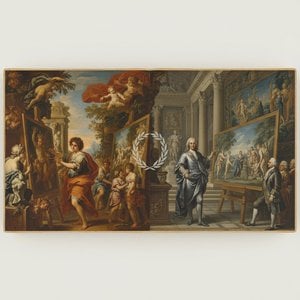
The Majesty Embodied: Alexandre Cabanel’s ‘Emperor Napoleon III’
Alexandre Cabanel's “Emperor Napoleon III” is more than just a portrait; it’s a meticulously crafted tableau of imperial authority and subtle introspection. Painted in 1865, this monumental work—measuring an impressive 238 x 170 cm—captures the essence of a man grappling with the weight of his reign and the legacy of his predecessor. Commissioned by Napoleon III himself, it stands as a testament to Cabanel’s mastery of academic painting, showcasing a profound understanding of light, texture, and the psychological nuances of portraiture.
Cabanel, a leading figure in the French Salon movement, was renowned for his ability to render the human form with breathtaking realism and an almost sculptural quality. He achieved this through painstaking observation and a rigorous adherence to classical principles—a discipline instilled within him at the École des Beaux-Arts. “Emperor Napoleon III” exemplifies this approach; every detail, from the rich velvet of the emperor’s attire to the delicate folds of his drapery, is rendered with exquisite precision. The painting isn't merely a likeness but an embodiment of power and dignity, reflecting the carefully constructed image Napoleon III sought to project.
A Symphony of Light and Symbolism
The composition immediately draws the eye to the central figure – Napoleon III himself. He stands in a commanding pose, his gaze direct and unwavering, projecting an aura of self-assurance. However, it’s not simply a display of strength; Cabanel subtly introduces elements of contemplation. The emperor's hand rests lightly on his hip, suggesting both control and a certain weariness—a quiet acknowledgment of the burdens of leadership. The inclusion of a crown resting upon a table, alongside an open book, is laden with symbolism. The crown represents imperial authority, while the book hints at Napoleon III’s intellectual pursuits and desire to be perceived as more than just a military leader.
Cabanel masterfully employs chiaroscuro—the dramatic contrast between light and shadow—to heighten the sense of drama and depth. Light falls primarily upon the emperor's face and upper body, drawing attention to his features while leaving the background in relative darkness. This technique not only creates a visually striking image but also serves to emphasize Napoleon III’s importance within the scene. The subtle use of color further enhances this effect; rich reds and deep blues dominate the palette, evoking a sense of grandeur and formality.
Historical Context and Artistic Legacy
“Emperor Napoleon III” was created during a pivotal moment in French history—the Second Empire (1852-1870). Under Napoleon III’s rule, France experienced significant economic growth, modernization, and territorial expansion. However, the era was also marked by political tensions and ultimately culminated in the Franco-Prussian War of 1870. The portrait reflects this complex period, capturing the emperor's ambition and authority while subtly hinting at the challenges he faced.
Cabanel’s work is considered a quintessential example of academic painting—a style characterized by its realism, meticulous detail, and adherence to classical conventions. His influence extended far beyond his own lifetime, shaping the artistic landscape of 19th-century France. “Emperor Napoleon III” stands as a powerful testament to Cabanel’s skill and artistry, offering a captivating glimpse into the world of imperial France and the complex personality of its ruler. It remains a significant work in the collection of the Musée National du Château de Compiegne, inviting viewers to contemplate the enduring legacy of this remarkable portrait.



 Voorvertoning
 Bestel handgeschilderde reproductie
 Verstuur
 Delen
Delen
 Details bekijken

 Download
 Vergelijkbare items
 Röntgenonderzoek
 Diavoorstelling
 Statistieken


 Lees meer






































 De optie voor glas is alleen beschikbaar bij een formaat kleiner dan 110 cm.