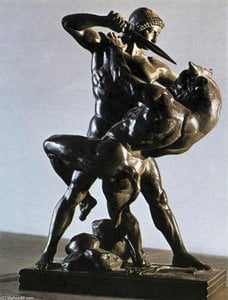
A Testament to Youthful Grace: Exploring Thorvaldsen’s Hebe Sculpture
The sculpture of Hebe by Albert Bertel Thorvaldsen stands as an enduring emblem of Neoclassical elegance and the pursuit of idealized beauty—a testament to a pivotal moment in artistic history. Crafted from pristine marble around 1806, this masterpiece captures not merely a figure but embodies the very essence of youthful vigor and divine grace, resonating powerfully with viewers centuries later.
The Sculptor’s Vision: Thorvaldsen's Roman Influence
Thorvaldsen’s artistic journey began in Copenhagen, fueled by an innate talent nurtured within the Royal Danish Academy. However, it was his relocation to Rome in 1797 that truly cemented his legacy as a sculptor of unparalleled distinction. Recognizing the transformative power of classical antiquity—specifically the sculptures of Michelangelo and Canova—Thorvaldsen dedicated himself to replicating these monumental forms with meticulous precision. This immersion in Roman artistic tradition profoundly shaped his style, prioritizing clarity of form, harmonious proportions, and an unwavering commitment to capturing idealized human beauty. He sought to emulate the grandeur and serenity of the Roman temples and gardens, reflecting a broader cultural fascination with reviving Greco-Roman ideals.
A Study in Marble: Technique and Craftsmanship
The sculpture’s remarkable smoothness and polished surface speak volumes about Thorvaldsen's mastery of marble carving technique. Employing chisels and hammers with unwavering patience and skill, he painstakingly sculpted the figure from a single block of Carrara marble—renowned for its purity and translucency. The sculptor skillfully utilized subtle gradations of shading to create realistic textures, capturing the folds of drapery and the contours of Hebe’s body with breathtaking accuracy. This meticulous attention to detail underscores Thorvaldsen's dedication to achieving an unparalleled level of realism within the confines of Neoclassical aesthetics—a stylistic choice that prioritized conveying emotion through form rather than overt ornamentation.
Mythological Symbolism: Hebe and the Ambrosia Offering
Hebe, in Greek mythology, represents youthful immortality and divine nourishment – specifically the nectar and ambrosia consumed by gods to sustain their eternal life force. Thorvaldsen’s depiction of Hebe embodies this symbolic significance through her posture and gesture. Holding an amphora aloft, she symbolizes the provision of sustenance—the offering of nectar and ambrosia—essential for preserving divine vitality. The upward gaze conveys a sense of aspiration and serenity, reflecting the goddess's noble character and embodying the ideals of beauty and grace championed by Neoclassical art. This careful selection of iconography reinforces the sculpture’s overarching message: an affirmation of youthful vigor and spiritual transcendence.
Emotional Resonance: Capturing Ideal Beauty
More than just a representation of a mythological figure, Thorvaldsen's Hebe transcends mere visual depiction to evoke profound emotional resonance. The sculpture’s serene countenance and graceful posture inspire contemplation—a reminder of the pursuit of perfection and the celebration of human beauty. Its timeless appeal lies in its ability to communicate universal themes of youthfulness, purity, and divine grace—values that continue to captivate audiences across cultures and eras. As a reproduction, this artwork offers an opportunity to bring forth the grandeur and serenity of classical art into any interior space, fostering appreciation for artistic excellence and celebrating the enduring legacy of Albert Bertel Thorvaldsen’s genius.
Vragen & Antwoorden
Welke sfeer zou een reproductie van "Hebe" door Bertel Thorvaldsen in een kamer brengen?
De Elegant sfeer van "Hebe" door Bertel Thorvaldsen past perfect bij de aanbevolen ruimte: een Living Room.
Hoe kan "Hebe" door Bertel Thorvaldsen worden gebruikt in interieurdecoratie?
"Hebe" wordt aanbevolen voor Accent, en de ideale ruimte hiervoor is een Living Room.
Behoort "Hebe" door Bertel Thorvaldsen tot de meest gezochte kunstwerken binnen de Neoclassical Style-stroming?
Binnen de Neoclassical Style-stroming heeft "Hebe" een Recognized populariteitsniveau.
Welke kunstenaar en welke stijl staan achter "Hebe"?
Achter "Hebe" staan Bertel Thorvaldsen en de Neoclassical Style-stroming.
Wordt "Hebe" bewaard in het land van de maker?
Ja - het kunstwerk wordt bewaard in het land van herkomst van de kunstenaar. De maker werd geboren in Denemarken; het originele werk bevindt zich in Denemarken.
Wat is het formaat van "Hebe"?
"Hebe" door Bertel Thorvaldsen is een Tall compositie. Het is raadzaam de verhoudingen te controleren voordat u een afmeting voor de print kiest.
Kan "Hebe" door Bertel Thorvaldsen, onderdeel van de collectie van Thorvaldsens Museum, op legale wijze worden gereproduceerd?
"Hebe" door Bertel Thorvaldsen, onderdeel van de collectie van Thorvaldsens Museum, is bevindt zich in het publiek domein - de auteursrechten zijn verlopen. Deze status bepaalt of er reproducties van de afbeelding mogen worden gemaakt.
Wanneer werd "Hebe" gemaakt en tot welke stroming behoort het?
"Hebe" werd gemaakt in 1806, binnen de Neoclassical Style-stroming.



 Koop handgeschilderd kunstwerk
 Verstuur
 Delen
Delen
 Details bekijken
 Gids voor studentenkunstwerken

 Download
 Vergelijkbare items
 Diavoorstelling
 Statistieken


 Lees meer






































 De optie voor glas is alleen beschikbaar bij een formaat kleiner dan 110 cm.