x
VoorvertoningVoorvertoning Bekijk in ARBekijk in AR Bestel handgeschilderde reproductie Bestel handgeschilderde reproductieKoop afbeelding Koop afbeelding VerstuurVerstuur
Details bekijkenDetails bekijken Toevoegen aan favorieten Toevoegen aan favorieten DownloadDownload Vergelijkbare itemsVergelijkbare items RöntgenonderzoekRöntgenonderzoek DiavoorstellingDiavoorstelling

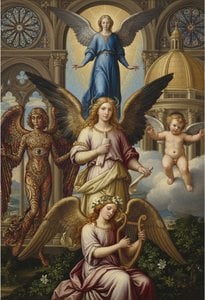
Vault decoration

Marvel at Agnolo Bronzino's 'Vault Decoration,' a stunning Renaissance fresco from Florence’s Palazzo Vecchio. Witness intricate figures, golden light, and classical beauty in this masterpiece of Mannerism.

Agnolo Bronzino (1503-1572) was een invloedrijke Italiaanse Mannerist schilder, beroemd om zijn elegante en statige portretten van de Medici-familie. Zijn werk kenmerkt zich door een koele compositie en verfijnde details, wat hem tot een belangrijk kunstenaar van de Renaissance maakt.

Giclée / Kunstafdrukken

Giclée- of canvasafdruk van museumkwaliteit met een snelle productie en flexibele afwerkingsmogelijkheden. (Bestel handgeschilderde reproductie Bestel handgeschilderde reproductieKoop afbeelding Koop afbeelding)

P118B $10
P118H $10
P118W $10
P438Z $10
P508JH $12
P508YH $12
P805H $10
P805Z $10
P919BZ $10
P919G $10
P919XJ $10
P959ZH $10
P968JZ $12
W106C $8
W218G $10
W218JH $8
W218Y $10
W307PJ $10
W316G $10
W316PJ $8
W316Y $10
W398PJ $8
W4111J $10
W500HY $15
W500JH $15
W692G $12
W849H $8
W940BG $15
W953PJ $8

Standaardformaat
op maat gemaakt
CM
INCH

Kies uit onze vooraf ingestelde maten die overeenkomen met de originele verhoudingen van het kunstwerk.

breedte
hoogte

U kunt uw eigen afmetingen opgeven om in een specifieke lijst of ruimte te passen. Als de door u gekozen maat niet overeenkomt met de proporties van het originele kunstwerk, zullen wij de afbeelding bijsnijden of uitbreiden met een gespiegelde of effen rand. Een digitaal mockup wordt ter goedkeuring naar u verzonden voordat de productie begint.
Houd er rekening mee dat de preview op het scherm de werkelijke bijsneding of uitbreiding niet weergeeft. Alleen de mockup toont de uiteindelijke compositie nauwkeurig.
Hoewel aangepaste maten beschikbaar zijn, raden wij aan een afmeting uit de vooraf bepaalde lijst te kiezen om de originele proporties te behouden.

Wereldwijde levering () binnen 2 weken in plaats van de standaard 4/5 weken. (1 september)

why_choose_icon
Gratis wereldwijde expressverzending
why_choose_icon
Hoogwaardig linnen canvas
why_choose_icon
Volledige verzendverzekering
why_choose_icon
Garantie op terugbetaling van invoerrechten
why_choose_icon
Garantie op exacte kleurweergave
why_choose_icon
Retourbeleid van 60 dagen (alleen bij defecten)
why_choose_icon
100% Geld-terug-garantie
why_choose_icon
Korting bij meerdere afnames

Totaalprijs

$ 69

reproduction

Vault decoration

Giclée / Kunstafdrukken

Afmetingen reproductie

-

Eindtotaal

$ 69

Snelle feiten

  • Movement: Mannerism
  • Medium: Fresco
  • Year: 1541
  • Artist: Agnolo Bronzino
  • Subject or theme: Religious & Myth.
  • Artistic style: Reserved elegance
  • Location: Palazzo Vecchio, Florence

Kunstquiz

Er is slechts één goed antwoord op elke vraag.

Vraag 1:
What is the primary subject depicted in Agnolo Bronzino’s ‘Vault Decoration’?
Vraag 2:
The ‘Vault Decoration’ is located in which Florentine palace?
Vraag 3:
Which artistic movement is most closely associated with Agnolo Bronzino’s style, as evidenced by the ‘Vault Decoration’?
Vraag 4:
What is a prominent feature of the fresco’s composition, contributing to its overall effect?
Vraag 5:
When was the ‘Vault Decoration’ created?

A Glimpse of Celestial Grace: Agnolo Bronzino’s “Vault Decoration”

Within the opulent Palazzo Vecchio in Florence resides a breathtaking fresco—Agnolo Bronzino's "Vault Decoration," completed in 1541 for Duchess Eleonora di Toledo. More than just a decorative scheme, this monumental work offers a profound meditation on divine order, classical beauty, and the burgeoning complexities of Renaissance courtly life. It’s a visual symphony that invites contemplation, revealing layers of symbolism woven into its meticulously rendered figures and vibrant palette.

Bronzino, a master of Mannerism, eschewed the dramatic emotionality favored by his predecessors like Pontormo in favor of a refined elegance and controlled composition. His style is characterized by elongated forms, subtle distortions, and an almost disconcerting stillness—a deliberate departure from the dynamism of earlier Renaissance painting. “Vault Decoration” exemplifies this perfectly; each figure possesses a serene composure, their gazes fixed with an unnerving intensity that draws the viewer into a world both familiar and subtly unsettling.

A Tapestry of Myth and Religion

The fresco’s central theme is deeply rooted in biblical narrative and classical mythology. The vault itself depicts a celestial scene, dominated by St. Michael, St. John the Evangelist, St. Jerome, and St. Francis—figures representing key virtues and patrons of the Medici court. Below them unfolds a series of allegorical scenes: “Moses Striking the Rock,” illustrating the miraculous parting of the Red Sea; “Moses Gathering Manna,” depicting God’s provision for his people in the wilderness; and “Crossing of the Red Sea.” These stories, rendered with exquisite detail and bathed in a rich, jewel-toned palette of reds, blues, and golds, speak to themes of faith, obedience, and divine guidance.

However, Bronzino doesn’t simply present these narratives as straightforward accounts. He imbues them with a distinctly Mannerist sensibility—figures are often idealized, their bodies rendered with an almost sculptural quality, reminiscent of ancient Greek sculpture. The drapery is voluminous and complex, creating intricate patterns that seem to shimmer with light. The use of gold leaf further enhances the sense of opulence and divinity, transforming the vault into a veritable temple of beauty.

Symbolism and Courtly Intrigue

Beyond the readily apparent religious iconography, “Vault Decoration” is laden with subtle symbolic meaning. The placement of each figure—their gestures, their attire—holds significance within the context of Renaissance courtly life. The Duchess herself, Eleonora di Toledo, was a woman of considerable influence and intelligence; her presence in this grand design underscores the power and sophistication of the Medici court.

Furthermore, the fresco’s meticulous detail suggests an underlying concern with status and prestige—a reflection of the patronage system that fueled Renaissance art. Bronzino's skill was highly sought after by wealthy families and powerful figures, and this work stands as a testament to his ability to fulfill their desires for artistic expression and social affirmation.

A Legacy of Elegance

“Vault Decoration” remains a pivotal masterpiece in the history of Renaissance art. It showcases Bronzino’s mastery of technique, his profound understanding of classical ideals, and his unique Mannerist vision. The fresco's enduring appeal lies not only in its technical brilliance but also in its ability to evoke a sense of awe and wonder—a reminder of the beauty, complexity, and spiritual depth that characterized the High Renaissance.

Today, reproductions of this extraordinary work continue to captivate audiences worldwide. Its timeless elegance and profound symbolism make it an ideal addition to any discerning collection or a stunning focal point for interior design, transporting viewers to a world of celestial grace and courtly splendor.


Biografie van de kunstenaar

Agnolo Bronzino: The Sculptor's Touch in Florentine Portraiture

Agnolo di Cosimo, known to history as Bronzino, emerged from the vibrant artistic landscape of Renaissance Florence in 1503, a period already brimming with genius. Born the son of a butcher, his path diverged sharply from familial trade, guided instead by an innate talent that would see him become one of the most sought-after portraitists of his era and a defining figure of Mannerism. His early training began with Raffaellino del Garbo, but it was under the tutelage of Jacopo da Pontormo that Bronzino’s artistic sensibilities truly took shape. While absorbing Pontormo's innovative style—characterized by expressive distortions and dramatic lighting—he ultimately forged his own distinct voice—one characterized by a cool composure and refined detail markedly different from his teacher’s often emotionally charged works. This early period was also influenced by studies with Andrea del Sarto, exposing him to the legacies of Michelangelo and Leonardo da Vinci, foundational influences that would subtly permeate his mature style. The young Bronzino quickly demonstrated an aptitude for capturing not just physical likeness but a certain psychological depth, even in his earliest commissions.

Early Influences and Artistic Formation

Pontormo’s impact on Bronzino's artistic development was profound. Recognizing Pontormo’s pioneering use of expressive distortion—a technique that would become synonymous with Mannerism—Bronzino skillfully adapted it to create a brilliant, precisely linear style of his own. This stylistic choice wasn’t merely an imitation; it represented a deliberate rejection of the prevailing humanist aesthetic of the High Renaissance, favoring instead a more cerebral and emotionally restrained approach. Furthermore, Bronzino's exposure to Michelangelo’s monumental sculptures—particularly *David*—and Leonardo da Vinci’s meticulous anatomical studies instilled in him a deep understanding of human form and perspective. These influences shaped his artistic vision and informed his technique throughout his career. He wasn’t interested in portraying emotion; rather, he sought to convey an idealized sense of dignity and composure—a hallmark of Mannerist portraiture.

The Medici Patronage and Artistic Flourishing

Bronzino's ascent to prominence coincided with the ascendancy of Cosimo I de’ Medici, Duke of Tuscany, who recognized his exceptional talent and bestowed upon him the prestigious role of court painter. This patronage provided Bronzino with unparalleled access to resources and opportunities—allowing him to undertake ambitious commissions that solidified his reputation as Florence’s foremost artistic innovator. The wedding celebrations of Cosimo and Eleonora di Toledo in 1539 served as a catalyst for Bronzino's creative output, resulting in lavish decorations that showcased his mastery of fresco painting and sculptural modeling. These projects demanded meticulous attention to detail—reflecting Bronzino’s unwavering commitment to stylistic perfection. He skillfully employed Pontormo’s expressive distortions alongside Leonardo da Vinci’s anatomical precision—creating a visual language that was both intellectually stimulating and aesthetically captivating.

Venus, Cupid, Folly & Time: A Symbol of Florentine Idealism

Perhaps Bronzino's most iconic work is *Venus, Cupid, Folly and Time* (c. 1544–45), now housed in London’s National Gallery. This allegorical masterpiece exemplifies the core tenets of Mannerist art—characterized by stylized poses, flattened perspective, and a deliberate avoidance of naturalistic representation. Bronzino skillfully employed Pontormo's expressive distortions to convey an idealized vision of beauty and desire—a reflection of Florentine humanist ideals during Cosimo’s reign. The painting’s composition is meticulously balanced—creating a harmonious visual experience despite its inherent complexity. Furthermore, the incorporation of mythological symbolism—drawing upon classical traditions—elevates *Venus, Cupid, Folly & Time* beyond mere portraiture—transforming it into a profound meditation on human nature and artistic aspiration.

Legacy and Enduring Influence

Bronzino’s influence extended far beyond his own lifetime, shaping the trajectory of European art for decades to come. His cool composure and refined technique became models for subsequent generations of portraitists—establishing Mannerist aesthetics as dominant in aristocratic circles across Europe. He championed a stylistic approach that prioritized intellectual rigor over emotional expression—challenging the prevailing humanist conventions of the time. Despite criticisms leveled against Mannerism during the Romantic era, Bronzino’s work has experienced a resurgence in appreciation in recent decades—scholars recognizing his innovative technique and profound artistic vision. His legacy as Florence's premier portraitist continues to inspire artists today—demonstrating the enduring power of stylistic refinement and intellectual complexity. He passed away in Florence in 1572, leaving behind a body of work that embodies the spirit of Mannerism—a testament to his singular genius and lasting contribution to art history.
Agnolo Bronzino

Agnolo Bronzino

1503 - 1572 , Italie

Belangrijkste feiten

  • Artistic Movement Or Style: Manierisme
  • Artists Who Influenced This Artist:
    • Jacopo da Pontormo
    • Michelangelo
    • Leonardo da Vinci
  • Date Of Birth: November 17, 1503
  • Date Of Death: November 23, 1572
  • Full Name: Agnolo di Cosimo
  • Nationality: Italiaans
  • Notable Artworks:
    • Venus, Cupid en Tijd
    • *Portret van Guidobaldo della Rovere*
    • *Het Heilige Familie*
  • Place Of Birth: Florence, Italy
Ontdek kunstwerken georganiseerd op thema, stijl en kenmerk.