Théodore Géricault, 1791 – 1824

The 100 Most Famous Paintings by Théodore Géricault

The painting that made Théodore Géricault famous is Laivo Medūzos ištekėjimas (1818); it hangs in the Liuvro muziejus, Paryžius. Nymph and Satyr (Jupiter and Antiope) (1820) and The Oath of Brutus after the Death of Lucretia (1815) follow it in the hearts of collectors and museum visitors. Of the 183 works by Théodore Géricault in our catalogue, these 100 are the most admired, each presented with its date, its museum and what sets it apart.

Rangos vieta nulegiama pagal mūsų populiarumumo balas, kurį sudaro kiekvieno kūrinio paieškos, apsilankėjimai ir užsakėjimai. Atnaujinta spalis 2026. Every masterpiece on this page can be ordered as a museum-quality, hand-painted oil reproduction or a fine art print, at the size you choose.

Théodore Géricault portretas
Théodore Géricault · 1791 – 1824
Gedė · mirė
1791 – 1824, Ruanas
Judėjimas
Romanticism
Darbai mūsų kataloge
183
Labiausiai žinomi
Laivo Medūzos ištekėjimas (1818)
Daugiausia darbų yra
Liuvro muziejus

Théodore Géricault: the ten masterpieces

Laivo Medūzos ištekėjimas (1818) aut. Théodore Géricault
1

Laivo Medūzos ištekėjimas

1818 · Aliejus ant drobės · Liuvro muziejus, Paryžius

Jean-Louis André Théodore Géricault meno monumentali meistriškė yra ne tik jūros katastrofos vaizdas; tai visceralus žmogaus nevilties, politinių skandalų ir aukštosios gamtos galios tyrimas. Susikūręs 1819 metais, šis viršįnesnį už tikrąjį dydį paveikslas (491 x 716 cm) įamžino šiurpų 1816 metų prancūziškos fregatos Méduse lūžį – tragediją, įvykdusią dėl nekompetencijos ir korupcijos, kuri sukrėtė visą Prancūziją.

Nymph and Satyr (Jupiter and Antiope) (1820) aut. Théodore Géricault
2

Nymph and Satyr (Jupiter and Antiope)

1820 · Acrylic On Canvas · Musée des Beaux-Arts et de la Céramique, Ruanas

The Allure of the Divine Encounter: Géricault’s *Nymph and Satyr* Jean-Louis André Théodore Géricault's *Nymph and Satyr*, painted in 1819, isn’t merely a depiction of a mythological scene; it’s a profound exploration of desire, transgression, and the inherent tension between innocence and primal instinct. Born amidst the tumultuous backdrop of post-revolutionary France, Géricault, already recognized for his dramatic intensity, sought to capture not just a narrative but an emotional truth—a…

Lions in a Mountainous Landscape (1818) aut. Théodore Géricault
4

Lions in a Mountainous Landscape

1818 · Acrylic On Canvas · Metropolitano meno muziejus, Niujorkas

This vigorous painting of six lions in a remote, spectrally illuminated lair—possibly intended to evoke the Atlas Mountains of Morocco—is an extraordinary example of Gericault’s spontaneous handling of paint. Rather than applying finishing touches to make a polished cabinet picture, the artist left the painting in a state known as an esquisse, or sketch, a work prized by fellow artists for its strength of directly capturing a subject or effect.…

The Kiss (1822) aut. Théodore Géricault
5

The Kiss

1822 · Acrylic On Canvas · Thyssen-Bornemisza muziejus, Madridas

Théodore Géricault's "The Kiss," painted in 1816, isn’t merely a depiction of lovers entwined; it’s a visceral embodiment of the burgeoning Romantic movement’s fascination with raw emotion, dramatic intensity, and the sublime. This arresting work, housed within the Thyssen-Bornemisza Museum in Madrid, transcends simple representation to become a profound meditation on passion, vulnerability, and the very essence of human connection. Géricault, already a figure known for his unflinching portrayals of…

Wounded Soldiers Retrating from Russia (1814) aut. Théodore Géricault
6

Wounded Soldiers Retrating from Russia

1814 · Acrylic On Canvas · Musée des Beaux-Arts, Ruanas

A Symphony of Suffering: Géricault’s “Wounded Soldiers Retrating from Russia” Jean-Louis André Théodore Géricault's "Wounded Soldiers Retrating from Russia" is not merely a painting; it’s a visceral embodiment of the horrors and human cost of war, rendered with an unprecedented level of realism and emotional intensity for its time. Completed in 1814, this monumental canvas—measuring a commanding 250 x 206 cm—captures a pivotal moment during Napoleon's disastrous invasion of Russia,…

Study of Feet and Hands (1818) aut. Théodore Géricault
7

Study of Feet and Hands

1818 · Oil On Canvas · Musée Fabre, Montpeljė

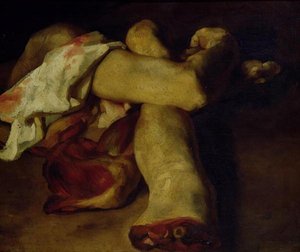
Jean-Louis André Théodore Géricault's "Study of Feet and Hands," painted in 1818, isn’t a grand statement of Romantic drama like his monumental “The Raft of the Medusa.” Instead, it offers a profoundly intimate glimpse into the artist’s meticulous process and a poignant meditation on the human form. This unassuming oil painting—measuring a modest 52 x 64 cm—is far more than just a preparatory sketch; it's a concentrated distillation of Géricault’s…

The Raft of the Medusa (detail) (1818) aut. Théodore Géricault
8

The Raft of the Medusa (detail)

1818 · Oil On Canvas · Liuvro muziejus, Paryžius

Jean-Louis André Théodore Géricault's "The Raft of the Medusa," a monumental detail from his 1818 painting, isn’t merely a depiction of shipwreck; it’s a visceral plunge into the depths of human suffering and political indictment. The scene, rendered with a dramatic intensity characteristic of Romanticism, captures the harrowing aftermath of the French frigate *Medusa*'s wreck off the coast of Mauritania in 1816. This disaster, largely attributed to the incompetence and…

The Wreck (1821) aut. Théodore Géricault
10

The Wreck

1821 · Oil On Canvas · Liuvro muziejus, Paryžius

Théodore Géricault's "The Wreck," painted in 1821, isn’t merely a seascape; it’s a visceral confrontation with the sublime—a raw depiction of humanity’s vulnerability against the overwhelming force of nature. Born amidst the turbulent currents of post-revolutionary France, Géricault, a figure both lauded and controversial within the burgeoning Romantic movement, channeled his own anxieties and the era's fascination with dramatic events into this monumental canvas. The painting immediately commands attention not…

More Théodore Géricault masterpieces, 11 to 100

The Horse Race (1816) aut. Théodore Géricault
#11

The Horse Race

1816 · Thyssen-Bornemisza muziejus

Jean-Louis André Théodore Géricault's "The Horse Race," painted in 1816, isn’t merely a depiction of a sporting event; it’s a visceral embodiment of Romanticism’s core tenets – passion,…

Bring it home →
Swiss Guard and Wounded Veteran (1819) aut. Théodore Géricault
#12

Swiss Guard and Wounded Veteran

1819 · Liuvro muziejus

Jean-Louis André Théodore Géricault's "Swiss Guard and Wounded Veteran," painted in 1819, is not merely a historical depiction; it’s a profound meditation on duty, sacrifice, and the lingering…

Order a reproduction →
Mazeppa (1823) aut. Théodore Géricault
#13

Mazeppa

1823 · Château de Chantilly

Théodore Géricault's "Mazeppa," painted in 1823, isn’t merely a depiction of a dramatic legend; it’s a visceral embodiment of Romantic turmoil—a raw exploration of suffering, resilience, and the…

Bring it home →
Two Horses (1809) aut. Théodore Géricault
#14

Two Horses

1809 · The Phillips Collection

Jean-Louis André Théodore Géricault's "Two Horses," painted in 1808-1809, isn’t merely a depiction of two magnificent animals; it’s a visceral exploration of movement, power, and the fleeting nature…

Bring it home →
A Turk (Mustapha) (1820) aut. Théodore Géricault
#15

A Turk (Mustapha)

1820 · Liuvro muziejus

Jean-Louis André Théodore Géricault's "A Turk (Mustapha)," painted in 1820, is not merely a portrait; it’s a carefully constructed tableau of exoticism, melancholy, and the burgeoning Romantic sensibility…

Order a reproduction →
A Carabinier with his Horse (1814) aut. Théodore Géricault
#16

A Carabinier with his Horse

1814 · Musée des Beaux-Arts

In the quiet intensity of Jean-Louis André Théodore Géricault’s 1814 masterpiece, "A Carabinier with His Horse," we encounter more than a mere military portrait; we witness a profound…

Order a reproduction →
Riderless Horse Races (detail) (1817) aut. Théodore Géricault
#17

Riderless Horse Races (detail)

1817 · Liuvro muziejus

A Moment Frozen in Time: Géricault’s “Riderless Horse Races” Jean-Louis André Théodore Géricault's "Riderless Horse Races (detail)" is not merely a depiction of a sporting event; it’s a…

Bring it home →
Boxers (1818) aut. Théodore Géricault
#18

Boxers

1818 · Château de Chantilly

A Tempestuous Vision: Géricault’s “Boxers” Jean-Louis André Théodore Géricault's "Boxers," completed in 1818, isn’t merely a depiction of a boxing match; it’s a visceral embodiment of Romanticism’s fascination…

Order a reproduction →
The Epsom Derby (1821) aut. Théodore Géricault
#20

The Epsom Derby

1821 · Liuvro muziejus

Jean-Louis André Théodore Géricault's "The Epsom Derby," painted in 1821, isn’t merely a depiction of horse racing; it’s a visceral embodiment of Romanticism’s fascination with drama, movement, and…

Bring it home →
Three Lovers (1817) aut. Théodore Géricault
#22

Three Lovers

1817 · J. Paul Getty muziejus

Théodore Géricault captured a private, feverish moment in Three Lovers. This small oil sketch, created about 1817–1820, offers a rare glimpse into the artist's more intimate preoccupations. It…

Order a reproduction →
Lion devouring a horse aut. Théodore Géricault
#26

Lion devouring a horse

Château de Chantilly

Théodore Géricault's "Lion Devouring a Horse," painted in 1819, isn’t merely a depiction of predatory action; it’s a visceral exploration of power, mortality, and the primal instincts that…

Bring it home →
Untitled (ARJCHM) aut. Théodore Géricault
#28

Untitled (ARJCHM)

Liuvro muziejus

In the annals of art history, few works command the room with such visceral intensity as Théodore Géricault’s The Raft of the Medusa. This monumental oil on canvas…

Bring it home →
Portrait of a Young Man (1818) aut. Théodore Géricault
#32

Portrait of a Young Man

1818 · Minneapolis Institute of Art

A young man emerges from a deep, indistinct darkness, his presence felt through the sudden, sharp clarity of light hitting his features. He sits in a quiet, intimate…

Order a reproduction →
A study for a nude. (1801) aut. Théodore Géricault
#33

A study for a nude.

1801 · Nacionalinis muziejus Varšuvoje

A study for a nude. emerges from the shadows as a powerful presence by Théodore Géricault. Created about 1801, this oil on canvas captures a singular moment of…

Bring it home →
Study of a Model (1818) aut. Théodore Géricault
#34

Study of a Model

1818 · J. Paul Getty muziejus

This oil on canvas portrait study presents a close-up, three-quarter view of a Black man's head and shoulders. The subject is positioned slightly off-center, looking toward the viewer…

Commission a hand-painted copy →
The Martyrdom of Saint Peter (1814) aut. Théodore Géricault
#35

The Martyrdom of Saint Peter

1814 · Kunstmuseum Basel

The Martyrdom of Saint Peter is an oil on canvas by Théodore Géricault. Created about 1814, the work captures a moment of profound tension. The physical presence of…

Bring it home →
The Wreck (1824) aut. Théodore Géricault
#36

The Wreck

1824 · Liuvro muziejus

In the annals of French Romanticism, few works command the visceral attention of Théodore Géricault’s The Wreck as profoundly as this haunting seascape. Painted in 1824, a year…

Commission a hand-painted copy →
Mater dolorosa, Copy after Ribera (1811) aut. Théodore Géricault
#38

Mater dolorosa, Copy after Ribera

1811 · Kunstmuseum Basel

Mater dolorosa, Copy after Ribera is a religious oil painting by the French artist Théodore Géricault. Created about 1811–1815, the work reflects the artist's engagement with the traditions…

Bring it home →
Lion in Repose aut. Théodore Géricault
#39

Lion in Repose

Walters Art Museum

Jean-Louis André Théodore Géricault’s “Lion in Repose,” painted circa 1820-1823, isn’t merely a depiction of an animal; it’s a profound meditation on power, vulnerability, and the very nature…

Order a reproduction →
Portrait of a Negro (1800) aut. Théodore Géricault
#71

Portrait of a Negro

1800 · Palácio Nacional da Ajuda

Dating from 1800, Jean-Louis André Théodore Géricault’s “Portrait of a Negro” is more than just a depiction of an individual; it’s a poignant statement born from the turbulent…

Bring it home →
Portrait d'homme (1825) aut. Théodore Géricault
#73

Portrait d'homme

1825 · Musée Fabre

Portrait d'homme is an oil on canvas work attributed to the French Romantic painter Théodore Géricault. While historically categorized under various titles, including a mistaken identification as a…

Commission a hand-painted copy →
Horses of the Auvergne (1822) aut. Théodore Géricault
#76

Horses of the Auvergne

1822 · Mičiganio universiteto meno muziejus

In the quiet, monochromatic depths of Théodore Géricault’s 1822 lithograph, Horses of the Auvergne, we are transported to a rugged, mist-shrouded corner of France. This evocative work serves…

Commission a hand-painted copy →
A Prancing Grey Horse (1812) aut. Théodore Géricault
#77

A Prancing Grey Horse

1812 · Burrell Collection

A single light grey horse occupies the center of this oil painting, captured in a rearing pose. The animal's body is angled vertically, its muscular flanks and neck…

Bring it home →
Sheet of Figure Studies (1818) aut. Théodore Géricault
#78

Sheet of Figure Studies

1818 · Courtauld Gallery

To gaze upon Jean-Louis André Théodore Géricault’s "Sheet of Figure Studies" is not merely to look at painted forms; it is to witness the very act of human…

Bring it home →
Portrait of an Artist in His Studio (1820) aut. Théodore Géricault
#79

Portrait of an Artist in His Studio

1820 · Liuvro muziejus

Jean-Louis André Théodore Géricault's “Portrait of an Artist in His Studio,” completed in 1820, is more than a simple depiction of a young man seated before his easel;…

Bring it home →
The Plaster Kiln (1823) aut. Théodore Géricault
#82

The Plaster Kiln

1823 · Liuvro muziejus

In the quiet, brooding landscapes of nineteenth-century France, few works capture the raw, unvarnished essence of pastoral life as poignantly as Théodore Géricault’s “The Plaster Kiln.” Completed in…

Order a reproduction →

Théodore Géricault's paintings by period

The subjects Théodore Géricault painted most

The four subjects that return most often among these masterpieces, with the finest example of each.

Where to see Théodore Géricault's paintings

8 muziejai, kuriuose saugoma daugiausia šioje pusėje esamų paveikslų.

Muzejaus Miestas Théodore Géricault darbai Šiojo sąrašo paveikslai
Liuvro muziejus, ParyžiusLiuvro muziejus Paryžius 20 Laivo Medūzos ištekėjimas, The Raft of the Medusa (detail), Leda and the Swan
Château de Chantilly, ChantillyChâteau de Chantilly Chantilly 6 Mazeppa, Boxers, Lion devouring a horse
J. Paul Getty muziejus, Los AndželisJ. Paul Getty muziejus Los Andželis 3 Three Lovers, Study of a Model, The Race of the Riderless Horses
Nacionalinis muziejus Varšuvoje, VaršuvaNacionalinis muziejus Varšuvoje Varšuva 3 Equestrian portrait of Wincenty Krasiński., A study for a nude., Study of a nude man
Burrell Collection, GlavasBurrell Collection Glavas 8 The Trumpeter of the Lancers of the Guard, A Prancing Grey Horse
Musée Fabre, MontpeljėMusée Fabre Montpeljė 4 Study of Feet and Hands, Portrait d'homme
Petit Palais, ParisPetit Palais Paris 3 The Scotsman, Italian Landscape with Tomb
Thyssen-Bornemisza muziejus, MadridasThyssen-Bornemisza muziejus Madridas 2 The Kiss, The Horse Race

Théodore Géricault, decade by decade: the defining painting of each

  1. 1800s
    Two Horses (1809) aut. Théodore Géricault
    Rank 14 / 100

    Two Horses

    Amžius 9 – 18 · The Phillips Collection

    Jean-Louis André Théodore Géricault's "Two Horses," painted in 1808-1809, isn’t merely a depiction of two magnificent animals; it’s a visceral exploration of movement, power, and the fleeting nature…

  2. 1810s
    Laivo Medūzos ištekėjimas (1818) aut. Théodore Géricault
    No. 1 of 100

    Laivo Medūzos ištekėjimas

    Amžius 19 – 28 · Liuvro muziejus

    Jean-Louis André Théodore Géricault meno monumentali meistriškė yra ne tik jūros katastrofos vaizdas; tai visceralus žmogaus nevilties, politinių skandalų ir aukštosios gamtos galios tyrimas. Susikūręs 1819 metais, šis…

  3. 1820s
    Nymph and Satyr (Jupiter and Antiope) (1820) aut. Théodore Géricault
    #2 of 100

    Nymph and Satyr (Jupiter and Antiope)

    Amžius 29 – 33 · Musée des Beaux-Arts et de la Céramique

    The Allure of the Divine Encounter: Géricault’s *Nymph and Satyr* Jean-Louis André Théodore Géricault's *Nymph and Satyr*, painted in 1819, isn’t merely a depiction of a mythological scene;…

Théodore Géricault's masterpieces: questions and answers

Which painting is Théodore Géricault best known for?Show the answer

Laivo Medūzos ištekėjimas (1818), Liuvro muziejus, Paryžius. Next come Nymph and Satyr (Jupiter and Antiope) (1820) and The Oath of Brutus after the Death of Lucretia (1815).

How old was Théodore Géricault when painting Laivo Medūzos ištekėjimas?Show the answer

27 years old: Laivo Medūzos ištekėjimas dates from 1818 and Théodore Géricault was born in 1791.

What are Théodore Géricault's ten greatest paintings?Show the answer

Laivo Medūzos ištekėjimas, Nymph and Satyr (Jupiter and Antiope), The Oath of Brutus after the Death of Lucretia, Lions in a Mountainous Landscape, The Kiss, Wounded Soldiers Retrating from Russia, Study of Feet and Hands, The Raft of the Medusa (detail), Leda and the Swan ir The Wreck. The ranking above gives the year and the museum of each.

How many works did Théodore Géricault paint?Show the answer

Our catalogue lists 183 works by Théodore Géricault, dated from 1800 to 1824.

In which museums can I see Théodore Géricault's masterpieces?Show the answer

Most of them are in Liuvro muziejus (Paryžius), Château de Chantilly (Chantilly) ir J. Paul Getty muziejus (Los Andželis). The table above lists the museums one by one.

When did Théodore Géricault paint the masterpieces?Show the answer

In 1810s: 67 of the 100 works on this page date from then, among them Laivo Medūzos ištekėjimas.

What are the first and last famous paintings of Théodore Géricault?Show the answer

The earliest on this page is Portrait of a Negro (1800), the latest The Wreck (1824).

What were Théodore Géricault's favourite subjects?Show the answer

Man (12), Portrait (9) ir Horse (8), among the 100 works on this page.

Which technique did Théodore Géricault favour?Show the answer

Oil On Canvas: 25 of the 100 works on this page.

What art movement is Théodore Géricault part of?Show the answer

Romanticism, as the paintings on this page show.

Which masterpieces by Théodore Géricault hang at the Liuvro muziejus?Show the answer

Laivo Medūzos ištekėjimas, The Raft of the Medusa (detail) ir Leda and the Swan are among the 14 works on this page held by the Liuvro muziejus, Paryžius.

Can I own a reproduction of a Théodore Géricault masterpiece?Show the answer

Yes. Every painting on this page can be ordered as a museum-quality, hand-painted oil reproduction or a fine art print, in the size you choose, from the painting's own page.

The life of Théodore Géricault

Gyvenimo Ugnis: Žano Liui Andrė Teodoro Žeriko (Jean-Louis André Théodore Géricault) Kelias

Žanas Liuis Andrė Teodoras Žerikas, vardas, skambantis prancūzų romantizmo pradžioje, gimė permainų slenkstyje. 1791 metais Ruene (Prancūzija) atsiradęs menininkas augo revoliucijos aido ir Napoleono ambicijų bangose. Nors paveldėjo komfortišką gyvenimą iš šeimos teisinių verslų – įskaitant tabako prekybą, – Žeriko likimas nebuvo teisėje ar komercijoje, o meno srityje. Pradiniai mokymai pas Karlą Vernė (Carle Vernet), anglų sporto tapybos meistrą, suteikė jam aštrų anatomijos ir judesio supratimą, ypač pastebimą jo arklių vaizduose. Tačiau vėlesnės studijos su Pjeru-Narcisu Gerenu (Pierre-Narcisse Guérin) padėjo klasikinės kompozicijos pagrindus, nors Žeriko nerami dvasia netrukus nuvedė jį į Louvro šventoves ieškoti savarankiškų žinių.

Louvras – Akademija: Dialogas su Meistrais

Nuo 1810 iki 1815 metų Louvras tapo Žeriko tikrąja akademija. Jis pasinėrė į senųjų meistrų darbus – Rubenso, Titiano, Velaskeso ir Rembrandto – ne tik kopijuodamas jų techniką, bet ir užmegzdamas gilų dialogą su jų menine filosofija. Šis laikotarpis buvo lemiamas formuojant jo savitą stilių, pasižymintį dramatišku šviesos šešėlių kontrastu (chiaroscuro), dinamiška kompozicija ir intensyviu emocionalumu, kuris atskyrė jį nuo bendraamžių. Jis tiesiog nekopijavo; jis įsisavino šių meistrų esmę, internalizavo jų požiūrius į šviesą, šešėlį ir žmogaus formą. Švietimas savarankiškai ugdė unikalų meninį balsą, kuris netrukus iššūkį metė vyraujančioms neoklasikinėms konvencijoms. Jo ankstyvieji darbai, tokie kaip Šturmuojantis medžiotojas (1812), jau rodė šią besiformuojančią jautrumą, demonstruodami drąsų įgyvendymą ir aistrą judesiui, primenančią Rubenso energingus paveikslus. Jis tęsė tyrinėdamas arklių temas, tobulindamas savo įgūdžius vaizduojant arklio galią ir eleganciją – temą, kuri išliko nuolatinis motyvas visoje jo karjeroje.

Medūzos Barža: Paminklas Žmogiškajam Kančiam

Žeriko vardas neatsiejamai susietas su Medūzos barža (1818–1819), monumentaliu paveikslu, kuris viršija gryną istorinį vaizdavimą ir tampa skaudžiu kaltinimu žmogaus klaidingumui ir visuomenės neteisybei. Įkvėptas siaubingos tikrosios prancūzų fregatos Méduze katastrofos 1816 metais, kai aplaidumas ir nekompetencija sukėlė nesuvokiamą kančią jos keleiviams, paveikslas yra įtaikus desperatiškumo, vilties ir nevilties portretas. Žerikas atliko kruopščius tyrimus, apklausė išgyvenusiuosius, studijavo lavonus ligoninėse ir net pastatė baržos modelį, kad užtikrintų tikslumą. Rezultatas – ne tik tragedijos vaizdavimas; tai įtraukianti patirtis, kuri susiduria su žiūrovais su žmogiškos kančios realybe. Kompozicija, pastatyta ant dviejų piramidžių struktūrų – vienos atstovaujančios neviltį ir mirtį, kitos įkūnijančios viltį ir galimą išgelbėjimą – sukuria dinamišką įtampą, kuri traukia akį per paveikslą. Medūzos barža sukėlė kontroversijų Salonuose 1819 metais, paskatino politines diskusijas ir sustiprino Žeriko reputaciją kaip drąsaus ir netradicinio menininko. Paveikslo poveikis apėjo meno pasaulį ir tapo simboliu vyriausybės nekompetencijos ir žmogaus atsparumo nepaisant nesuvokiamo sunkumo.

Už Tragedijos Ribų: Karinės Temos ir Meninis Palikimas

Nors Medūzos barža išlieka jo garsiausiu pasiekimu, Žeriko meninė kūryba apėjo šį vienintelį šedevrą. Jis nuolat grįždavo prie karinių temų, akivaizdu darbuose, tokiuose kaip Sužeistas kirasieris (1814) ir Epsomo derbis (1821), demonstruodamas aistrą dramai ir ekspresyviai jėgai. Šie paveikslai atskleidžia jo nuolatinį žmogaus emocijų tyrinėjimą esant spaudimui, dažnai sutelkiant dėmesį į konfliktų fizinį ir psichologinį mokestį. Jis taip pat ėjo portreto ir litografijos keliu, toliau plečiant savo meninę repertuarą. Deja, Žeriko gyvenimas nutrūko dėl ligos būdamas vos 32 metų amžiaus 1824 metais po daugelio metų kentėjus nuo jojimo nelaimingų atsitikimų ir lėtinės tuberkuliozės infekcijos. Jo ankstyva mirtis apirobė meno pasaulį didelio talento, tačiau jo įtaka vėlesniam kartoms – ypač Ženui Delakrua (Eugène Delacroix) – buvo gili. Jis prisimintas kaip romantizmo pradininkas, menininkas, kuris išdrįso susidurti su sunkiomis tiesomis ir įkviepti savo darbus stipria emocine rezonansu, kuri ir šiandien žavi publiką. Jo bronzinė figūra atsipalaiduoja, teptukas rankoje, ant jo kapo Pjero Lašezo kapinėse Paryžiuje, virš žemo reljefo skydelio, vaizduojančio siaubingą sceną iš Medūzos baržos, tinkamas atidus menininkui, kuris paskyrė savo gyvenimą žmogaus būklės sudėtingumui ir prieštaravimams užfiksuoti.

Pagrindinės Charakteristikos Ir Įtakos

  • Romantizmas: Žerikas laikomas vienu iš pirmųjų prancūzų romantikų, atsisakant neoklasikinio idealo link emocinio intensyvumo ir dramatiškos ekspresijos.
  • Dramatiška Kompozicija: Jo paveikslai žinomi dėl savo dinamiškos kompozicijos, dažnai naudojant įstrižines linijas ir kontrastuojančią šviesą bei šešėlį judesio ir įtampos jausmui sukurti.
  • Realizmas Ir Tyrimai: Žerikas buvo įsipareigojęs realizmui, atlikdamas išsamius tyrimus – įskaitant lavonų studijas ir apklausas su išgyvenusiaisiais – užtikrindamas savo darbų tikslumą ir emocinį poveikį.
  • Senųjų Meistrų Įtaka: Jis semėsi įkvėpimo iš baroko meistrų, tokių kaip Rubenso, Titiano ir Velaskeso, pasitelkdamas jų techniką dramatiškam apšvietimui ir ekspresyviam teptuko darbui.
  • Dėmesys Žmogiškajam Kančiam: Jo menas dažnai vaizduoja tragedijos,

Visi 183 Théodore Géricault darbai →