Henri Lebasque, 1865 – 1937

Henri Lebasque: 100 garsiausi paveikslai

Street by the Port at Collioure (1921) yra garsiausias Henri Lebasque paveikslas. Young woman on a hammock (1923) ir On the Beach (1921) yra kitos dvi labiausiai žinomos pasaulyje kūrybosios darbai. Iš 539 Henri Lebasque darbų mūsų kataloge – štai 100 dažniausiai analizuojami kolekcionerių bei lankytojų muziejų, su informacija apie metus, muziejų bei kiekvieno kūrinio istoriją.

Rangos vieta nulegiama pagal mūsų populiarumumo balas, kurį sudaro kiekvieno kūrinio paieškos, apsilankėjimai ir užsakėjimai. Atnaujinta spalis 2026. Kiekvieną šio puslapio šedevrą galite užsisakyti kaip muziejoriaus kokybės rankų darbo alievinę reprodukciją arba aukščiausios kokybės meninį spausdiną jūsų pasirinktu dydžiu.

Henri Lebasque portretas
Henri Lebasque · 1865 – 1937
Gedė · mirė
1865 – 1937, Champigné
Judėjimas
Post-impressionism
Darbai mūsų kataloge
539
Labiausiai žinomi
Street by the Port at Collioure (1921)
Daugiausia darbų yra
Wallraf-Richartzas Muziejus

Top 10: žymiausi Henri Lebasque tapiai

Street by the Port at Collioure (1921) aut. Henri Lebasque
1

Street by the Port at Collioure

1921 · Oil

In this 1921 work, we find ourselves standing at the edge of a quiet harbor, looking out toward the water. The scene captures a narrow street leading down to the port, where the architecture of the town meets the movement of the sea. Several boats are scattered throughout the harbor, their forms resting upon the water, while small figures move along the waterfront. There is a sense of a lived-in…

Young woman on a hammock (1923) aut. Henri Lebasque
2

Young woman on a hammock

1923 · Oil On Canvas

Sunlight filters through a dense canopy of leaves, casting dappled patterns across a secluded garden. In the center of this lush sanctuary, a young woman reclines within the gentle embrace of a hammock. The fabric, marked by distinct stripes of red, yellow, and blue, sways almost imperceptibly between two sturdy trees. She rests in a state of profound contentment, her body softly contoured by the weight of her repose. Around…

On the Beach (1921) aut. Henri Lebasque
3

On the Beach

1921 · Oil On Canvas

On the Beach is an oil on canvas by the French artist Henri Lebasque. Created about 1921, the work reflects the artist's established interest in the interplay of light and leisure. Lebasque, born in Champigné, France, developed a style characterized by a natural brush-stroke and a focus on the serene atmosphere of the outdoors.

Girls in the Garden (1905) aut. Henri Lebasque
4

Girls in the Garden

1905 · Oil

Two young figures occupy a sun-dappled garden, their presence framed by the protective canopy of a large tree. One girl finds balance atop a fence, while her companion sits nearby on the ground. A handbag rests on the earth, a small, domestic detail that anchors the scene in a specific, unscripted moment of childhood. Throughout the composition, birds move through the foliage, adding a sense of life to the stillness.…

In the Flowers (1903) aut. Henri Lebasque
5

In the Flowers

1903 · Oil

In this 1903 composition, we find ourselves drawn into a quiet, sun-drenched corner of a garden. Three women inhabit this lush space, their presence felt through a soft, intimate arrangement of figures and flora. On the left, a woman in a white dress leans down to kiss a child, a gesture of tenderness that anchors the scene in a sense of domestic peace. Behind her, another figure in white observes…

bather (1910) aut. Henri Lebasque
6

bather

1910 · Oil

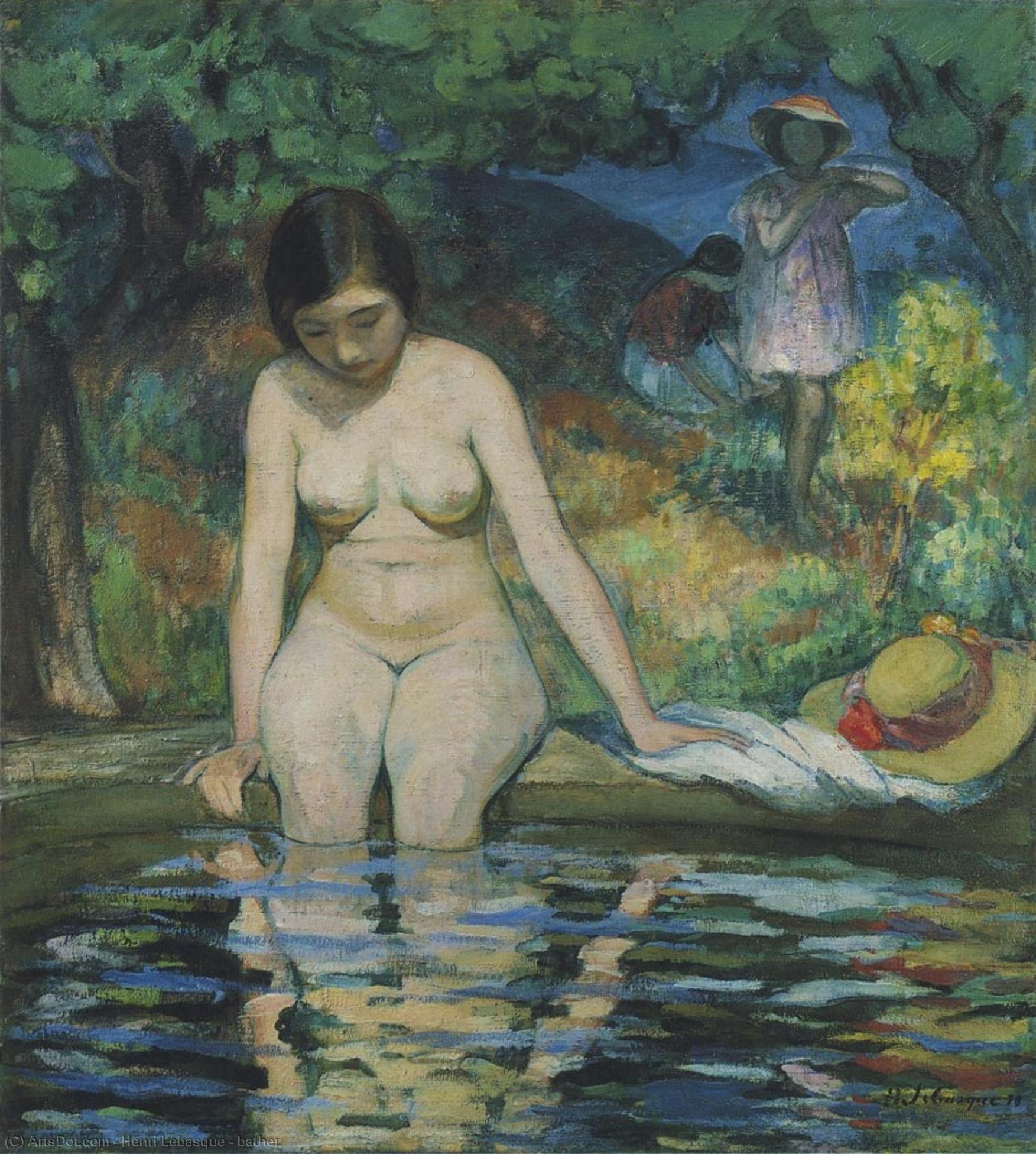
Created about 1910, bather by Henri Lebasque captures a moment of leisure at the water's edge. The central figure is a woman positioned in the water, appearing to sit upon a bench. Her presence establishes a sense of quietude amidst a lively setting. Around her, several other people are gathered, some standing and others seated, observing or interacting within the shared space.

Summer Afternoon at Frejus (1906) aut. Henri Lebasque
7

Summer Afternoon at Frejus

1906 · Oil

Summer Afternoon at Frejus, painted in 1906, captures a peaceful outdoor scene set near a body of water, such as a lake or the ocean. The composition centers on a woman sitting in the grass, appearing to enjoy her time in nature. The landscape is lush, featuring several trees and bushes that contribute to the tranquil atmosphere.

Bathers at a fountain in Saint Tropez (1906) aut. Henri Lebasque
8

Bathers at a fountain in Saint Tropez

1906 · Oil On Canvas

In this 1906 work, we find ourselves in a secluded corner of a forest, where the heat of the day seems to soften against the cool presence of a stone fountain. Two women, stripped of the complexities of social life, stand near the water, their forms integrated into the lush surroundings. One figure is positioned toward the left, while the other occupies the right, both seemingly lost in a shared,…

Likę Henri Lebasque reitingo vietos, nuo 11 iki 100

Garden with Urn (1913) aut. Henri Lebasque
#39

Garden with Urn

1913

To gaze upon Henri Lebasque’s Garden with Urn is to step through a veil and into a moment of perfect, sun-drenched tranquility. This painting, executed in 1913, is…

Atneškite į savo namus →

Henri Lebasque tapų skirstymas pagal laikotarpius

Daugiausiai temų, kurių vaizdė Henri Lebasque

Keturi populiariausi temų motyvai tarp šių šedevrų, su geriausiais kiekvieno pavyzdžiais.

Kur galima pamatyti Henri Lebasque paveikslus

2 muziejai, kuriuose saugoma daugiausia šioje pusėje esamų paveikslų.

Muzejaus Miestas Henri Lebasque darbai Šiojo sąrašo paveikslai
Wallraf-Richartzas Muziejus, KölnWallraf-Richartzas Muziejus Köln 3 Village of Champigne
Museo de Arte de Ponce, PonceMuseo de Arte de Ponce Ponce 1 Young Girls in a Wood

Henri Lebasque per dešimtmečius: po šedevrį kiekvienam laikotarpiui

  1. 1880s
  2. 1890s
  3. 1900s
    Girls in the Garden (1905) aut. Henri Lebasque
    4 iš 100

    Girls in the Garden

    Amžius 35 – 44

    Two young figures occupy a sun-dappled garden, their presence framed by the protective canopy of a large tree. One girl finds balance atop a fence, while her companion…

  4. 1910s
    bather (1910) aut. Henri Lebasque
    Vieta 6 iš 100

    bather

    Amžius 45 – 54

    Created about 1910, bather by Henri Lebasque captures a moment of leisure at the water's edge. The central figure is a woman positioned in the water, appearing to…

  5. 1920s
    Street by the Port at Collioure (1921) aut. Henri Lebasque
    #1 iš 100

    Street by the Port at Collioure

    Amžius 55 – 64

    In this 1921 work, we find ourselves standing at the edge of a quiet harbor, looking out toward the water. The scene captures a narrow street leading down…

Henri Lebasque tapų dažniausiai užduodami klausimai

Kuri Henri Lebasque tapioja yra pati garsiausia?Rodyti atsakymą

Street by the Port at Collioure (1921). Toliau eina Young woman on a hammock (1923) ir On the Beach (1921).

Kuriuo amžiaus atσταση Henri Lebasque nupiešė kūrinį Street by the Port at Collioure?Rodyti atsakymą

56 metų amžiaus: Street by the Port at Collioure sukurta 1921 m. ir Henri Lebasque gimė 1865.

Kuriose yra 10 garsiausių Henri Lebasque paveikslų?Rodyti atsakymą

Street by the Port at Collioure, Young woman on a hammock, On the Beach, Girls in the Garden, In the Flowers, bather, Summer Afternoon at Frejus, Bathers at a fountain in Saint Tropez, Woman in a Boat with an Umbrella ir Blue Reflection in the Fountain at Pradet. Viršuje esančioje reitingo lentelėje nurodyta kiekvieno kūrinio metis ir muziejus.

Kiek Henri Lebasque paveikių yra?Rodyti atsakymą

Mūsų kataloge yra 539 Henri Lebasque darbų, datuojamų nuo 1886 iki 1926.

Kur galima pamatyti garsiausius Henri Lebasque paveikslus?Rodyti atsakymą

Dauguma jų yra Wallraf-Richartzas Muziejus (Köln) ir Museo de Arte de Ponce (Ponce). Viršuje esančiame lange muziejai išvardyti po vieni.

Kuriame laikotarpyje Henri Lebasque tapė savo žymiausius kūrinius?Rodyti atsakymą

1900s laikotarpyje: 41 iš 100 šioje pusėje esančių darbų sukurtos tada, iš jų – Girls in the Garden.

Koks yra pirmasis ir paskutinis garsus Henri Lebasque tapiojimas?Rodyti atsakymą

Pirmasis šioje pusėje yra Reading in the Garden (1886), paskutinis – Blue Mountains in Cannes (1926).

Kokia temas vaizdavo Henri Lebasque?Rodyti atsakymą

Women (13), Rivers (13) ir Woman (9), iš 100 šioje pusėje esančių darbų.

Ko buvo paveistas Henri Lebasque kūpinys ir kokiais mediais?Rodyti atsakymą

Oil On Canvas: 14 iš 100 šioje pusėje esančių darbų.

Kelią meno kierlinę priklauso kūryba Henri Lebasque?Rodyti atsakymą

Post-impressionism ir Impressionism, kaip rodo šio puslapio paveikslai.

Kur galima įsigyti Henri Lebasque reprodukciją?Rodyti atsakymą

Taip. Kiekvieną šioje pusėje esantį paveikslą galite užsakyti kaip muziejoriaus kokybės rankų darbų alievinę kopiją arba aukščiausios kokybės spausdinį pasirinktu jūsų pageidaujamu dydžiu tiesiai iš paties paveikslą puslapio.

Henri Lebasque: biografija

A Painter of Joy and Light: The Life and Art of Henri Lebasque

Henri Lebasque, a name perhaps less immediately recognized than some of his Post-Impressionist contemporaries, nevertheless occupies a significant place in the artistic landscape of early 20th-century France. Born in Champigné, Maine-et-Loire, in 1865, Lebasque’s journey toward becoming a celebrated painter was one marked by diligent study, evolving influences, and an unwavering commitment to capturing beauty in everyday life. His early education at the École régionale des beaux-arts d'Angers provided a foundational grounding, but it was his move to Paris in 1886 that truly ignited his artistic development. There, under the tutelage of Léon Bonnat and through assisting Ferdinand Humbert with decorative murals at the Panthéon, he honed his technical skills while immersing himself in the vibrant Parisian art scene. This period proved crucial, bringing him into contact with pivotal figures like Camille Pissarro and Auguste Renoir, whose emphasis on light and color would profoundly shape his aesthetic sensibilities.

Early Influences and Artistic Formation

Lebasque’s formative years were steeped in Impressionist ideals. He absorbed the lessons of Claude Monet and Pierre-Auguste Renoir, recognizing their pioneering exploration of fleeting moments and atmospheric effects. However, Lebasque wasn't merely replicating Impressionism; he sought to transcend its limitations, striving for a deeper emotional resonance. His initial artistic experiments focused on landscapes—particularly those bathed in sunlight—capturing the shimmering beauty of nature with meticulous detail. Yet, it was his encounter with Les Nabis – Édouard Vuillard and Pierre Bonnard – that irrevocably altered his trajectory. These artists championed intimacy and domesticity, encouraging Lebasque to turn his gaze inward, exploring the complexities of human relationships and capturing the subtle nuances of everyday life. The influence of Georges Seurat’s Chromoluminarism became increasingly apparent as he progressed, prompting him to experiment with complementary color pairings—blues and oranges, reds and greens—to create luminous compositions that pulsed with vitality.

The Parisian Atelier: Mastering Technique

Lebasque established his studio in Paris during the late 1880s, immersing himself in a milieu brimming with artistic innovation. He diligently practiced his craft, refining his brushstrokes and mastering the techniques of layering paint—a method he termed “glazing”—to achieve remarkable depth and luminosity. This painstaking process allowed him to build up translucent layers of color, revealing underlying hues and creating an ethereal quality that distinguishes his paintings from more conventional styles. Lebasque’s palette favored muted tones—pale yellows, soft greens, dusky blues—harmoniously blended to evoke a sense of tranquility and serenity. He meticulously observed the interplay of light and shadow, capturing the subtle gradations of color that define natural landscapes and interior scenes alike. His compositions were carefully balanced, prioritizing visual harmony and conveying an understated elegance.

Notable Works and Artistic Vision

Lebasque’s oeuvre encompasses a diverse range of subjects—portraits, landscapes, still lifes—each imbued with his distinctive artistic vision. Among his most celebrated paintings are La Cigarette – a masterful depiction of a woman smoking—and Una joven en el bosque – a luminous portrayal of a young girl amidst foliage—works that exemplify his ability to convey emotion through subtle color harmonies and delicately rendered forms. He skillfully employed expressive brushstrokes to imbue his canvases with movement and vitality, capturing the fleeting gestures of human figures and the rustling sounds of wind-swept trees. Lebasque’s artistic sensibility resonated deeply with the spirit of the Belle Époque—the era of opulent salons and carefree indulgence—reflecting a fascination for beauty and pleasure that permeated his entire oeuvre.

Legacy and Recognition: An Enduring Impression

Henri Lebasque enjoyed considerable acclaim during his lifetime, participating in prominent exhibitions such as the Salon d’Automne – which he helped found alongside Henri Matisse – and securing commissions for decorative projects—including murals at theaters and opulent interiors. His paintings are now housed in prestigious museums across Europe—the Musée d'Orsay in Paris, the Petit Palais in Geneva, and institutions throughout France—testament to his enduring artistic significance. Lebasque’s legacy extends beyond his individual artworks; he championed a distinctive aesthetic—one rooted in Impressionist principles yet infused with Nabis sensibilities—inspiring generations of artists who followed him. His paintings continue to captivate viewers today, offering a poignant reminder of the transformative power of art and its capacity to illuminate the beauty inherent in ordinary moments.

Visi 539 Henri Lebasque darbai →