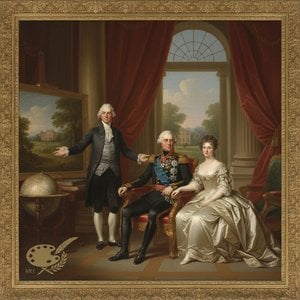
Thomas Tompion (1639–1713): The Father of English Clockmaking
- Early Life and Background: Born in Northwich, Cheshire, England, in 1639, Thomas Tompion’s early life remains somewhat obscure. He began his career as a comb maker before entering the service of Henry Harris, a London watchmaker, around 1660. This apprenticeship provided him with foundational skills in horology and marked the beginning of his ascent to becoming one of England's most celebrated clockmakers.
- Development and Innovations: Tompion rapidly surpassed his master and quickly established himself as an independent watchmaker and clockmaker. His workshop became a hub for innovation, attracting talented apprentices like George Graham and Joseph Williamson. He was elected a Fellow of the Royal Society in 1680, recognizing his contributions to science and mechanics. Tompion’s genius lay not only in crafting beautiful timepieces but also in pioneering new techniques and designs. Key innovations included:
- The use of foliot balance springs – a significant improvement over earlier designs.
- The introduction of the anchor escapement, which greatly improved accuracy.
- Development of the pendulum suspension using a "grasswork" mechanism to reduce friction and improve timekeeping precision.
- Experimentation with materials like brass and steel, pushing the boundaries of what was possible in clockmaking.
- Major Achievements and Notable Works: Tompion’s legacy is cemented by a series of exceptional clocks and watches. Some of his most celebrated creations include:
- The "Turnbull” clock (1670), known for its intricate design and innovative features.
- Numerous longcase clocks, often featuring elaborate marquetry and striking mechanisms – examples can be viewed here.
- Pocket watches of exceptional quality, demonstrating his mastery of miniature mechanics.
- The Great Clock for the Royal Observatory at Greenwich (completed posthumously with George Graham), a testament to his ambition and technical skill. This clock was crucial for maritime navigation and establishing accurate timekeeping standards.
- Historical Significance and Legacy: Thomas Tompion’s impact on English horology is undeniable. He elevated the craft of clockmaking from a trade to an art form, setting a standard of excellence that influenced generations of subsequent clockmakers. His innovations in escapement mechanisms and balance springs revolutionized timekeeping accuracy. He is rightfully considered the "father of English clockmaking," and his work continues to be highly prized by collectors worldwide. A plaque on Fleet Street commemorates the workshop he shared with George Graham, a lasting tribute to their combined contributions.
Explore more about Thomas Tompion here.