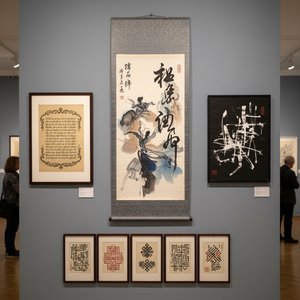
The Geometry of Soul: The Artistic Journey of Sabah Arbilli
Born in Iraq in 1977, Sabah Arbilli carries within his practice a profound dialogue between the structured precision of engineering and the fluid, emotive power of Arabic calligraphy. His journey into the visual arts was not a linear path but rather an unexpected departure from the world of civil engineering—a transition fueled by a lifelong fascination with the intricate geometry found in the formation of Arabic letters. This early preoccupation with form and rhythm, nurtured during childhood school holidays while crafting signage and wedding invitations, laid the foundation for an artist who views the alphabet not merely as a tool for communication, but as a vessel for deep, symbolic expression.
Arbilli’s academic pursuit of a Master’s degree in Visual Arts at the University of Wales allowed him to refine this childhood passion into a sophisticated contemporary language. By merging the structural principles of his engineering background with the expressive potential of various mediums, he has developed a style that transcends traditional boundaries. His work represents a bold reimagining of calligraphic traditions, moving away from literal legibility toward an abstract expressionism where the essence of the letter remains even as it dissolves into movement and texture.
A Synthesis of Structure and Emotion
The brilliance of Arbilli’s technique lies in his ability to balance perfected measurements with spontaneous, energetic brushwork. His training in engineering is palpably evident in the balanced compositions and the architectural stability of his pieces, yet this rigidity is constantly challenged by the visceral nature of his paint application. He utilizes the Arabic script as an agent for allegorical narration, investigating shifting moral precepts and the complexities of the human condition through the very shapes that define a culture.
In his most celebrated works, such as Bismillah, the power of the brushstroke serves as a reflection of both past and present experiences within his Iraqi homeland. Through his art, he seeks to induce an emotional resonance in his audience, inviting them to share in a journey that evokes the sounds, scents, and memories of a place of harmony and tranquility. This connection to his roots allows him to transform the canvas into a space where personal identity meets universal themes of belonging and displacement.
Themes of Identity and Global Resonance
Beyond the aesthetic beauty of his abstract letters, Arbilli’s oeuvre is deeply engaged with the pressing social issues of our time. His work serves as a poignant commentary on:
- Identity and Heritage: Exploring how the linguistic and cultural symbols of one's origin shape the modern self.
- Migration and Displacement: Utilizing the fluidity of calligraphy to mirror the movement of people and the shifting boundaries of home.
- Political Commentary: Using allegorical narratives to respond to the socio-political landscapes of the Middle East and beyond.
As a multi-disciplinary artist, Arbilli’s reach extends far beyond the canvas into sculpture, ceramics, and large-scale installations. This versatility ensures that his exploration of the Arabic script remains dynamic and evolving. By reimagining traditional calligraphy through the lens of contemporary abstraction, Sabah Arbilli has secured his place as a significant voice in the international art world, creating work that invites viewers to reevaluate prevailing societal standards through the timeless beauty of the written word.