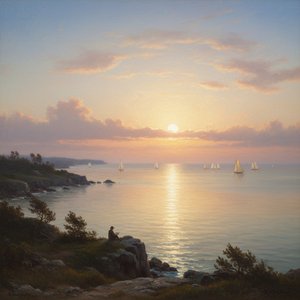
Richard Hilder: Bridging Victorian Tradition and Impressionistic Vision
Richard Cosway’s influence on British landscape painting is undeniable, but Richard Hilder emerged as a distinct voice in the mid-Victorian era, skillfully blending classical compositional principles with burgeoning Impressionistic tendencies. Born in 1813 in Dulwich Village, Surrey, Hilder’s artistic journey began amidst the intellectual ferment of London society, where he absorbed the ideas circulating around academies and exhibitions. His early training focused on drawing and watercolor painting under Thomas Henry Wylde, establishing a foundation for his lifelong dedication to capturing the subtleties of British countryside.- Early Influences: Cosway’s meticulous attention to detail and idealized depictions of aristocratic subjects instilled in Hilder a desire for precision and elegance – qualities he would later adapt to his own artistic endeavors.
- Formal Training & Artistic Development: He pursued further studies at the Slade School of Fine Art, honing his technical skills and experimenting with various mediums before gravitating primarily towards watercolor landscapes.
- The Impressionistic Touch: Unlike many of his contemporaries who adhered strictly to academic conventions, Hilder embraced fleeting moments of light and color, mirroring the growing influence of Impressionism on European art. This stylistic shift is evident in his later works, where he abandons harsh outlines for softer brushstrokes and atmospheric hues.
- Notable Landscapes: Among his most celebrated paintings are ‘Dunmow,’ a serene depiction of Essex countryside bathed in golden light; ‘Gypsies Watering Cows Along A Country Road British,’ showcasing the everyday life of rural England; and ‘Children Crossing A Stream,’ capturing a moment of childhood innocence amidst lush greenery.
- Technique & Style: Hilder’s watercolor technique was characterized by layering thin washes of color to build up tonal gradations, creating luminous effects that conveyed the atmosphere of his subjects with exceptional accuracy. He skillfully employed atmospheric perspective—a technique pioneered by Cosway—to simulate depth and distance, enhancing the realism of his landscapes.
问答环节
Kaip galiu pamatyti visus Richard H Hilder sukurtus kūrinius?
Visi Richard H Hilder kūriniai, esantys šis internetinis svetainė, galima peržiūrėti puslapio Visi kūriniai skiltyje.
Kaip rasti Richard H Hilder darbus konkrečia tema?
Richard H Hilder kūrybą galima tyrinėti pagal raktažodžius tame šio kūrinio autoriaus Pagrįsta raktažodžiais puslapyje. Kiekvienas raktažodis sugrupuoja susijusią kūrybinę veiklą.
Kaip rasti visas Richard H Hilder kūrinius tam tikra technika?
Richard H Hilder darbus pagal technikas galima peržiūrėti puslapio Visi mediai skiltyje.