A Painter of Quiet Moments: The World of Pierre Dupuys
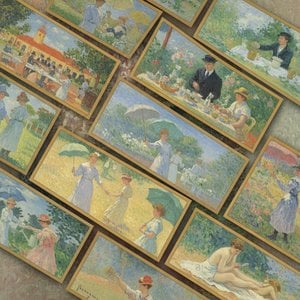
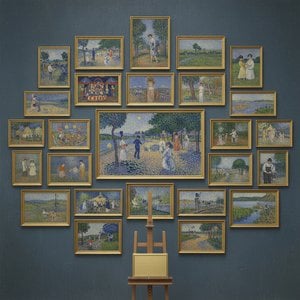
Pierre Dupuys emerges as a contemporary voice steeped in the traditions of French post-impressionism, yet distinctly his own. While biographical details remain intentionally sparse – a choice perhaps reflective of his desire to let the work speak for itself – his canvases resonate with a profound sensitivity and an intimate understanding of light, color, and composition. Dupuys’ art isn't about grand narratives or dramatic gestures; it is a celebration of the everyday, finding beauty in simple objects and fleeting moments. He currently resides and works in South Dakota, bringing a unique American perspective to his deeply European sensibility. His paintings offer a tranquil escape, inviting viewers into scenes that feel both familiar and dreamlike.
Echoes of Bonnard and the Nabis
The influence of Pierre Bonnard is undeniable in Dupuys’ work. Like Bonnard, he possesses an extraordinary ability to capture the luminosity of interior spaces and the subtle nuances of color. However, Dupuys doesn't simply replicate Bonnard’s style; he builds upon it, infusing his paintings with a contemporary freshness and a personal vision. The *intimacy* of Bonnard’s domestic scenes finds a parallel in Dupuys’ still lifes and landscapes, but where Bonnard often focused on figures within the space, Dupuys frequently centers the objects themselves – a bowl of fruit, a simple vase, or a sun-drenched garden. He also draws inspiration from the broader Nabis movement, particularly their emphasis on flattened perspective, decorative patterns, and symbolic use of color. The Nabis’ rejection of academic realism in favor of subjective experience is clearly evident in Dupuys' approach to representation. He isn’t interested in photographic accuracy; instead, he seeks to convey a feeling, an atmosphere, a particular quality of light.
Still Life and Landscape: A Harmonious Dialogue
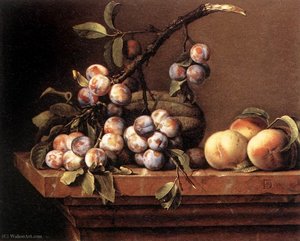
Dupuys primarily works within the genres of still life and landscape, often blurring the boundaries between them. His still lifes are not merely depictions of objects; they are carefully constructed arrangements that explore relationships between form, color, and texture. A recurring motif is fruit – plums, peaches, grapes – rendered with a lusciousness that evokes both abundance and fragility. These aren’t idealized representations but rather studies in the ephemeral nature of beauty. His landscapes share this same sensitivity to light and atmosphere. He often depicts gardens bathed in warm sunlight, capturing the play of shadows and the vibrant colors of flowers and foliage.
The compositions are deceptively simple, yet they possess a remarkable depth and complexity. Dupuys’ ability to create a sense of *spatial ambiguity* is particularly noteworthy; his landscapes often feel both expansive and intimate, drawing the viewer into the scene while simultaneously maintaining a certain distance.
Technique and Materials: A Pursuit of Luminosity
Dupuys employs a distinctive painting technique characterized by loose brushwork, layered colors, and a masterful use of light. He builds up his compositions gradually, applying thin washes of color to create a luminous effect. His palette is rich and vibrant, yet never garish; he favors warm tones – yellows, oranges, reds – that evoke a sense of warmth and tranquility.
He often leaves areas of the canvas unpainted, allowing the underlying layers to show through, adding depth and texture to his work. This technique creates a sense of movement and energy, as if the paintings are constantly shifting and changing in response to the light. He works primarily with oil paints on canvas, favoring traditional materials that allow him to achieve the desired level of luminosity and detail. The surface quality of his paintings is often described as velvety or luminous, reflecting his dedication to capturing the subtle nuances of light and color.
Historical Significance and Contemporary Relevance
While rooted in historical traditions, Pierre Dupuys’ work feels remarkably contemporary. In a world saturated with images, his paintings offer a refreshing alternative – a quiet space for contemplation and reflection. His emphasis on beauty, simplicity, and the everyday resonates with viewers seeking respite from the noise and chaos of modern life. He represents a continuation of the French post-impressionist tradition, carrying forward the legacy of artists like Bonnard and Matisse while forging his own unique path.
- His paintings are increasingly sought after by collectors who appreciate their subtle beauty and emotional depth.
- Dupuys’ work has been exhibited in galleries across the United States, gaining recognition for its distinctive style and evocative atmosphere.
- He embodies a commitment to traditional painting techniques while embracing a contemporary sensibility.
His art serves as a reminder that beauty can be found in the simplest of things, and that even in the midst of chaos, there is always room for quiet contemplation.