A Contemporary Vision Rooted in Mythology & Craftsmanship
Paul Wright is a contemporary British painter whose work resonates with a powerful energy, a captivating blend of expressionist technique and deeply symbolic subject matter. While his career has seen significant recognition – including multiple selections for the prestigious National Portrait Gallery Award – Wright’s artistic journey isn't defined solely by accolades but by a relentless pursuit of capturing vitality beyond mere likeness. He doesn’t simply paint portraits; he excavates inner worlds, hinting at psychological states and fleeting glimpses of identity through dynamic brushwork and a rich, often turbulent palette. His canvases are not static representations but rather energetic fields where form dissolves and reforms, mirroring the complexities of the human spirit. Wright's recent collaborative studio venture with Buchanan Christie Studio further demonstrates his commitment to pushing boundaries and exploring new techniques in portraiture, alongside partnerships with institutions like the NHS Immersive Lab, suggesting a desire to integrate art with broader societal needs.
Early Influences & Artistic Development
Born in Leicester, UK, in 1973, Wright’s foundation in illustration at Falmouth School of Art (BA, 1992-1995) provided the initial framework for his visual language. However, it was his time at Loughborough College of Art and Design that began to shape a more individualistic approach. Early exposure to traditional
fine art techniques clearly left an impression, but Wright quickly diverged from strict adherence, embracing abstraction as a means of conveying deeper emotional truths. His formative years were marked by residencies and exhibitions in diverse spaces – Cow House Studios, Joan Mitchell Center, the Guggenheim Museum,
Contemporary Art Center New Orleans, and YAYA Arts Center – each contributing to his evolving style. His long-standing involvement with YAYA (2007-2014), serving as both a mentor and studio assistant, reveals a commitment to community engagement and a belief in art’s power to uplift and inspire. This period instilled a sense of purpose and voice within his practice, grounding his work in real-world experiences.
Themes & Symbolism: Mythology, Identity & the Human Condition
Wright's oeuvre is characterized by recurring themes of mythology, identity, and the
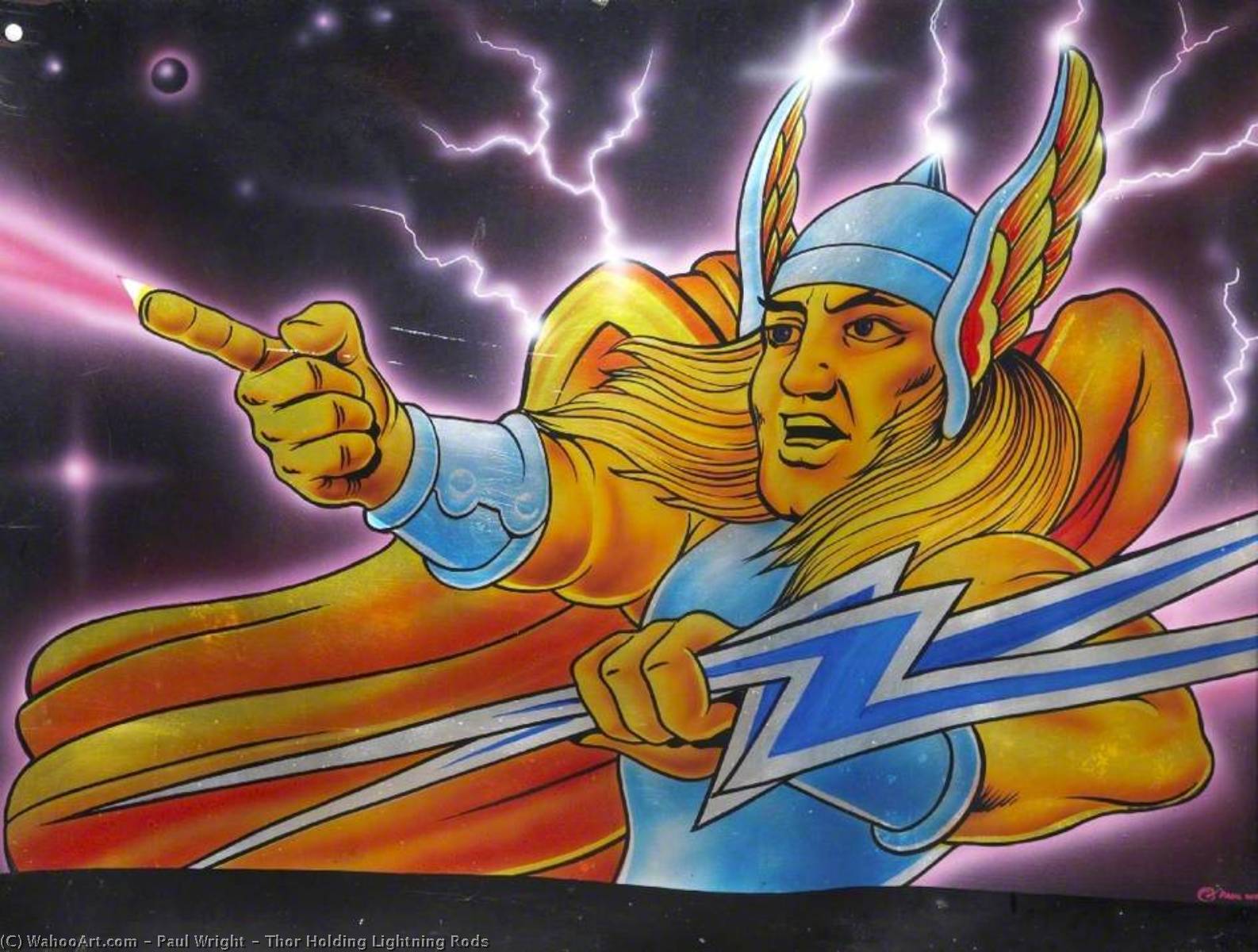
human condition. Works like
“Thor Holding Lightning Rods” immediately draw attention to this fascination with archetypal figures and their symbolic power. The image isn’t merely a depiction of the Norse god; it’s an exploration of strength, protection, and perhaps even vulnerability – the lightning rod suggesting a channeling of immense energy but also a potential for grounding or containment. Similarly,
“Joy Gregg II”, while less overtly mythological, delves into the complexities of
human emotion and connection. The subjects in Wright’s portraits are often depicted with an ambiguous psychological state, inviting viewers to project their own interpretations onto the canvas. He seeks not to *expose* his sitters but rather to offer a *glimpse* into their inner selves, hinting at stories untold. This ambiguity is achieved through his distinctive technique – sweeping strokes of the palette knife dissolving and reforming across the picture space, creating a sense of movement and fluidity.
Technique & Materials: A Masterful Manipulation of Colour
Wright’s mastery lies in his manipulation of colour and texture. He employs a predominantly
expressionist style, characterized by bold brushwork, impasto techniques, and a vibrant palette. His canvases are often large-scale, creating an immersive experience for the viewer. The energy of the sitter seems barely contained within the frame, with colours swirling and blending to evoke emotion and atmosphere. Wright’s approach is not simply about replicating reality; it's about capturing a sense of vitality that transcends mere representation. He frequently works in
oil paint, allowing him to build layers of texture and depth. The use of the palette knife is particularly significant, creating dynamic surfaces that reflect
light and shadow, adding another layer of complexity to his work. His recent collaborations with Buchanan Christie Studio suggest an ongoing exploration of new materials and techniques, further refining his already distinctive style.
Historical Significance & Contemporary Relevance
Paul Wright’s work occupies a unique space within contemporary
British art. He stands as a “defiant standard-bearer for the qualities of technique, craftsmanship, colour and texture in painting,” as one critic noted. While influenced by historical traditions, he avoids imitation, forging his own path with an individualistic approach that is both powerful and emotionally resonant. His inclusion in prestigious exhibitions like the National Portrait Gallery Award has solidified his position within the art world, but it’s his commitment to pushing boundaries – through collaborative projects and explorations of new techniques – that truly sets him apart. In a landscape often dominated by
conceptual art, Wright's focus on skill, emotion, and
symbolism offers a refreshing alternative, reminding viewers of the enduring power of painting to connect with the human spirit. His work is found in both private and public collections worldwide, testament to its lasting appeal and historical significance.






 The Dingles Fairground Heritage Centre
 Sculpture by the Sea - Cottesloe
 Catmose College


