A Master of Light and Shadow
Orazio Borgianni stands as a compelling figure within the transition from the Mannerist tradition to the burgeoning drama of the early Baroque period. Born in Rome, he was an Italian painter and etcher whose artistic journey was deeply intertwined with the shifting stylistic tides of his era. His early training was shaped by his brother, Giulio Borgianni, known as Scalzo, which provided him with a foundational mastery of form and composition. As his career progressed, Borgianni’s work began to reflect a profound engagement with the natural world and the human condition, moving away from the stylized elegance of Mannerism toward a more visceral, emotive realism.
The artist's trajectory was significantly altered by his travels and the patronage he received. The influence of Philip II of Spain led him to visit Spain, an experience that left a lasting imprint on his repertoire. During his time in Spain, he contributed to the Convento de Portacoeli in Valladolid and left behind works that now reside in the prestigious Prado Museum, such as St Christopher and the Stigmatization of St Francis. These excursions allowed him to blend diverse European influences, creating a unique visual language that combined Italian grace with a burgeoning sense of Spanish gravity.
The Synthesis of Influence and Technique
Borgianni’s artistic development is most notable for its sophisticated synthesis of competing styles. He possessed the rare ability to weave together the refined traditions of the Florentine school with the revolutionary, tenebrist innovations emerging from the work of Michelangelo Merisi da Caravaggio. This duality is perhaps most evident in his religious compositions, where he utilized chiaroscuro—the dramatic contrast between light and dark—to imbue his subjects with a palpable sense of volume and spiritual depth. His ability to manipulate light allowed him to create atmospheres that felt both sacred and intensely human.
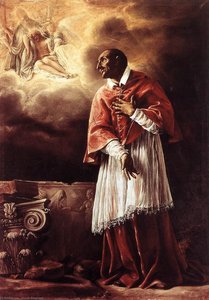
His technical prowess extended beyond the canvas into the realm of etching, demonstrating a versatile command over different media. Whether executing large-scale frescoes or intimate portraits, Borgianni’s hand is characterized by an attention to detail that captures the intricate textures of fabric, the subtle nuances of skin, and the profound weight of emotion. His works, such as St. Carlo Borromeo, serve as a theatrical window into the soul, utilizing an eclectic style that draws from both the Carracci school and the more rugged, dramatic elements of the early Baroque.
Legacy and Artistic Significance
The historical significance of Orazio Borgianni lies in his role as a bridge between eras. He was an artist who could inhabit the sophisticated, often artificial world of Mannerism while simultaneously embracing the raw, naturalistic energy that would define the Baroque age. His ability to navigate the patronage of high-ranking figures, including the Spanish ambassador and various ecclesiastical authorities, ensured that his work reached the most important altars and collections of his time.
Today, his contributions are preserved in some of the world's most esteemed institutions, reflecting a legacy of profound emotional resonance. His mastery is visible in works such as:
- Self-Portrait: A remarkable display of skill and contemplative depth, currently housed in the Galleria Nazionale d'Arte Antica in Rome.
- The Vision of St Jerome: A magnificent canvas that captures a moment of divine encounter through exquisite humility and light.
- Holy Family with St Elizabeth, the Young St John the Baptist and an Angel: A masterful exploration of composition and humanist ideals.
Through his evocative use of light and his ability to capture the intersection of earthly mortality and divine grace, Borgianni remains a vital subject for those studying the evolution of Italian art.
问答环节
Kaip galiu stebėti Orazio Borgianni kūrybą metmet metams?
Daugelis Orazio Borgianni kūrinių pateikiamų puslapio Kūrybos laiko linija sąraše rodomi chronologine tvarka, metus po metų.
Kuriuose meno...> Kuriuose meno judelseriu dirbo Orazio Borgianni?
Puslapio Visi stiliai kūriniai Orazio Borgianni yra suskirstyti pagal meno kryptis.
Ar yra chronologinis Orazio Borgianni aprašas?
Orazio Borgianni kūrybos kelias atskleidžiamas etapais puslapio Chronika chronologijoje: tai horizontali kūrybos darbų laiko linija, suskirstyta į karjeros periodų skyrius.