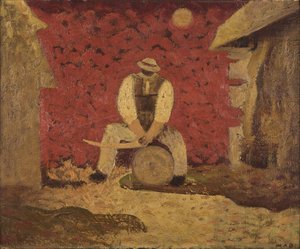
Miloš Alexander Bazovský: A Voice of Slovak Rural Life
Miloš Alexander Bazovský (1899-1968) stands as a towering figure in 20th-century Slovak art, a painter deeply rooted in the traditions and landscapes of his homeland. Often ranked among the most prominent voices of his era, Bazovský’s work transcends mere representation; he captured the essence of Slovak rural life with an unparalleled sensitivity and evocative power. Born in Turán nad Váhom, Slovakia, on January 11, 1899, into a family connected to education and culture, Bazovský's artistic journey was shaped by his intimate connection to the land and its people. His legacy endures not only through his captivating paintings but also as a vital link to Slovak heritage.
Early Life and Artistic Formation
Bazovský’s early life instilled in him a profound appreciation for the natural world and the rhythms of rural existence. He began his artistic training in Pešť, later refining his skills in Prague, a city renowned during this period as a vibrant hub of European art and intellectual discourse. This exposure to diverse artistic movements – from Expressionism to Cubism – undoubtedly influenced his evolving style, though he ultimately forged a unique path rooted firmly in Slovak identity. Crucially, Bazovský’s travels throughout Slovakia itself proved transformative. He immersed himself in the lives of villagers, meticulously observing their customs, professions, and daily routines. These experiences became the bedrock of his artistic vision, informing his choice of subjects and shaping his distinctive approach to depicting rural life.
A Distinctive Artistic Style: Folk Life and Regionalism
Bazovský’s artistic style is immediately recognizable for its deeply rooted regionalism. He eschewed grand narratives or idealized landscapes in favor of portraying the everyday lives of Slovak peasants, farmers, and artisans. His paintings are populated by figures engaged in familiar tasks – tending to livestock, working in fields, preparing meals, celebrating festivals – rendered with a remarkable degree of realism and empathy. His palette is typically earthy—ochres, browns, greens, and blues—reflecting the colors of the Slovak countryside. A key element of his style is his use of *impasto*, applying thick layers of paint to create textured surfaces that seem to pulse with life. This technique adds a tactile quality to his work, inviting viewers to almost feel the rough texture of the soil or the warmth of the hearth. Bazovský’s compositions often feature simple, uncluttered arrangements, emphasizing the dignity and resilience of his subjects.
Notable Works and Recognition
Among Bazovský's most celebrated works are “Cottages” (1949-1953), a captivating depiction of a small coastal village bathed in golden light; "The Washerwomen" (1935), which captures the quiet dignity of women engaged in their daily routines by the river; and “Still Life with a Candlestick and a Green Pitcher,” a deceptively simple composition that reveals his keen eye for detail and his ability to imbue ordinary objects with symbolic meaning. His paintings are not merely representations of scenes but windows into a specific cultural context, offering insights into the values, beliefs, and traditions of Slovak rural communities. His work received significant recognition during his lifetime, including solo exhibitions at the Slovak National Gallery in Bratislava (1960 and 1999), as well as retrospectives at the Turiec Gallery in Martin and the Jan Koniarek Gallery in Trnava. He was also featured in international biennales such as the IV Bienal Do Museu De Arte Moderna De São Paulo (1957) and the 33rd Venice Biennale (1966).
Legacy and Historical Significance
Miloš Alexander Bazovský’s contribution to Slovak art is profound. He served as a crucial link between traditional folk culture and modern artistic expression, preserving and celebrating the rich heritage of his nation. His work offers a poignant reflection on themes of identity, community, and the enduring connection between people and their land. His paintings are now housed in prominent collections across Slovakia, including the Slovak National Gallery, the Gallery of M. A. Bazovsky in Trenčín, and the Jan Koniarek Gallery in Trnava. His legacy continues to inspire artists and scholars alike, ensuring that his voice—the voice of rural Slovakia—will resonate for generations to come. Further research can be found on WahooArt.com and Wikipedia.