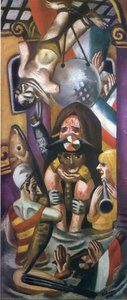
Max Beckmann, 1884 – 1950

Max Beckmann: 100 garsiausi paveikslai

Naktis (Platė 7) iš Šalo (1919) yra garsiausias Max Beckmann paveikslas, esantis Kunstsammlung Nordrhein-Westfalen kolekcijoje Diuseldorfas mieste. Didelis Agonijos Vaizdas (1906) ir Geležies tiltas (Frankfurto vaizdas) (1922) yra kitos dvi labiausiai žinomos pasaulyje kūrybosios darbai. Iš 401 Max Beckmann darbų mūsų kataloge – štai 100 dažniausiai analizuojami kolekcionerių bei lankytojų muziejų, su informacija apie metus, muziejų bei kiekvieno kūrinio istoriją.

Rangos vieta nulegiama pagal mūsų populiarumumo balas, kurį sudaro kiekvieno kūrinio paieškos, apsilankėjimai ir užsakėjimai. Atnaujinta lapkritis 2026. Kiekvieną šio puslapio šedevrą galite užsisakyti kaip muziejoriaus kokybės rankų darbo alievinę reprodukciją arba aukščiausios kokybės meninį spausdiną jūsų pasirinktu dydžiu.

Max Beckmann portretas
Max Beckmann · 1884 – 1950
Gedė · mirė
1884 – 1950, Leipcigas
Judėjimas
German expressionism
Darbai mūsų kataloge
401
Labiausiai žinomi
Naktis (Platė 7) iš Šalo (1919)
Daugiausia darbų yra
Bavarijos valstybinės paveikslų kolekcijos

Top 10: žymiausi Max Beckmann tapiai

Naktis (Platė 7) iš Šalo (1919) aut. Max Beckmann
1

Naktis (Platė 7) iš Šalo

1919 · Aliejus ant drobės · Kunstsammlung Nordrhein-Westfalen, Diuseldorfas

A Haunting Vision of Post-War Anxiety Max Beckmann’s 1919 masterpiece is a visceral and unforgettable depiction of societal trauma following World War I. More than just a painting, it's a powerful statement about alienation, fear, and the fragmentation of modern life – a cornerstone of the *Neue Sachlichkeit* (New Objectivity) movement. This intensely psychological work transcends mere representation, delving into the raw emotional landscape of a generation scarred by conflict.…

Ranku tapytos aliejaus reprodukcija nuo $306 33 × 30 cm Pusė kaip originalo $889 153 × 133 cm Užsakyti originalaus dydžio →
Didelis Agonijos Vaizdas (1906) aut. Max Beckmann
2

Didelis Agonijos Vaizdas

1906 · Aliejus ant drobės · Bavarijos valstybinės paveikslų kolekcijos, Miunchas

"Didžioji Agonijos scena": Žmogiškosios būsenos atspindys Max Beckmanno 1906 m. sukurtas „Didžiosios agonijos scenos“ paveikslas – tai neeilinė ankstyvos ekspresionizmo pavyzdžio iliustracija, numatanti XX amžiaus meno psichologinius tyrimus ir nerimo jausmą. Tai ne tik figūrų vaizdas; tai visceralus pažeidžiamumo, vienišumo ir galbūt net mirties tyrinimas. Paveikslas kviečia į giluminę apmąstymų kelionę, atskleidžiantis žmogaus patirties sudėtingumus. Kompozicija ir Simbolizmas: Nesaugumo Atmosfera Ant drobės pavaizduoti trys nuogi vyriškos figūros neapibrėtoje interjero erdvėje.…

Ranku tapytos aliejaus reprodukcija nuo $206 33 × 30 cm Pusė kaip originalo $733 141 × 131 cm Užsakyti originalaus dydžio →
Geležies tiltas (Frankfurto vaizdas) (1922) aut. Max Beckmann
3

Geležies tiltas (Frankfurto vaizdas)

1922 · Aliejus ant drobės · Kunstsammlung Nordrhein-Westfalen, Diuseldorfas

Max Beckmanno „Geležinis tiltas (Frankfurto vaizdas)“: Urbanistinio Peizažo Dinamika Šis paveikslas, pavadintas „Geležinis tiltas (Frankfurto vaizdas)“, sukurtas 1922 metais vokietų ekspresionisto Max Beckmanno, yra neeilinė urbanistinio peizažo interpretacija. Tai tarsi akimirka iš pulsuojančio miesto gyvenimo, užfiksuota audringais dažymo gestais ir ryškiomis spalvomis. Paveikslas kviečia pasitelkti vaizduotę ir įsijausti į ankstyvojo XX amžiaus Frankfurto atmosferą, kuriame industrinė siela susipina su žmogaus egzistencijos dramos akimirkomis. Beckmanno meistriškumas atskleidžiamas ne tik detalizuotoje erdvės…

Ranku tapytos aliejaus reprodukcija nuo $181 26 × 38 cm Pusė kaip originalo $183 25 × 42 cm Užsakyti originalaus dydžio →
Kolumbina (1950) aut. Max Beckmann
4

Kolumbina

1950 · Aliejus ant drobės · Saint Louis Art Museum, Saint Louis

Maksas Bekmanas savo kūryboje paliko nepaisantą pėdsaką, o „Kolumbina“ yra vienas ryškiausių vokiečių ekspresionizmo pavyzdžių, sukurtas 1950 metais, paskutiniaisjo paveikslą kūrinio autoriaus gyvenimo metais. Šis didelio formatinio erelio audinio paveikslas suCaptivant yra įspūdingas: jame matome sėdinti moterišką figūrą, papuoštą kaukė, apsuptą drąsių architektūrinės formos elementų ir pulsuojančių spalvų. Šis kūrinys yra tikras Bekmano stiliaus manifestas, pasižymintis iškrašytomis figūrinėmis formomis, giliu simbolizmu ir neįtikėtinu emociniu intensyvumu.

Ranku tapytos aliejaus reprodukcija nuo $181 28 × 36 cm
Aktoriai (1942) aut. Max Beckmann
5

Aktoriai

1942 · Aliejus ant drobės

Exploring Human Condition and Society This powerful triptych by Max Beckmann captures the complex tapestry of human existence and societal roles through a vivid, emotionally charged composition. Each panel presents a dynamic scene filled with distorted figures, symbolic objects, and expressive gestures that invite viewers to reflect on themes of confinement, identity, and social interaction. Beckmann’s portrayal of human figures—some seated, others standing or behind bars—evokes a sense of tension,…

Ranku tapytos aliejaus reprodukcija nuo $231 41 × 24 cm
Selfportrait in tuxedo, Busch-Reisinger M (1927) aut. Max Beckmann
6

Selfportrait in tuxedo, Busch-Reisinger M

1927 · Oil On Canvas

The gaze of Max Beckmann meets the viewer directly in Selfportrait in tuxedo, Busch-Reisinger M. This oil-on-canvas work, executed in 1927, captures the artist in a moment of poised, formal presence. He stands before us, a figure of quiet strength, wearing the elegant attire of a tuxedo that marks a specific era of social transition. The painting exists as a significant presence within the German Expressionism movement, embodying the tension…

Ranku tapytos aliejaus reprodukcija nuo $181 26 × 38 cm
Temptation (1937) aut. Max Beckmann
7

Temptation

1937 · Oil On Canvas

The canvas unfolds in three distinct panels, a triptych that pulls the viewer into a claustrophobic theater of desire and consequence. In the left panel, warriors and soldiers move alongside a nude female figure, their presence suggesting the heavy weight of power and the pull of sexuality. The central scene commands the eye with a dominant, seated nude woman; she sits as a focal point for the surrounding characters, her…

Ranku tapytos aliejaus reprodukcija nuo $181 41 × 24 cm Pusė kaip originalo $1166 199 × 170 cm Užsakyti originalaus dydžio →
The argonauts (1950) aut. Max Beckmann
9

The argonauts

1950 · Oil On Canvas

The artwork is a triptych titled The Argonauts, created between 1949 and 1950. The composition features a middle panel containing several figures: the poet Orpheus is positioned at the center, with Jason located at his right and the sea god Glaucus at his left. The painting depicts a variety of people in different positions, including individuals who are standing, sitting, or lying down. The scene includes at least 12 people,…

Ranku tapytos aliejaus reprodukcija nuo $181 38 × 26 cm
Quappi in blue in a boat (1950) aut. Max Beckmann
10

Quappi in blue in a boat

1950 · Oil On Canvas

To stand before Max Beckmann's Quappi in blue in a boat is to encounter a fascinating confluence of early 20th-century artistic anxieties filtered through the seemingly carefree veneer of a seaside tableau. Painted around 1950, this work captures a moment of repose—a woman elegantly posed on the beach, clad in a striking blue bathing suit, her posture suggesting both languor and studied composure. Yet, beneath the surface tranquility suggested by…

Ranku tapytos aliejaus reprodukcija nuo $181 25 × 39 cm

Likę Max Beckmann reitingo vietos, nuo 11 iki 100

Siesta aut. Max Beckmann
#14

Siesta

In 1923, Max Beckmann captures a quiet, domestic scene in his work titled Siesta. The scene unfolds within an interior setting, pulling the viewer into a private moment…

Užsisakyti reprodukciją nuo $206 →
Cabins (1948) aut. Max Beckmann
#23

Cabins

1948 · Kunstsammlung Nordrhein-Westfalen

In Cabins, we encounter a composition that feels less like a window into a scene and more like a psychological landscape. Painted in 1948, this work by Max…

Atneškite į savo namus nuo $256 →
The Duchess of Malvedi (1926) aut. Max Beckmann
#26

The Duchess of Malvedi

1926 · Bavarijos valstybinės paveikslų kolekcijos

In 1926, Max Beckmann produced The Duchess of Malvedi, a vertical close-up portrait that demands an immediate, unsettling presence. The composition focuses tightly on a single female figure,…

Atneškite į savo namus nuo $181 →
Hotel de l’Ambre (1949) aut. Max Beckmann
#35

Hotel de l’Ambre

1949 · Bavarijos valstybinės paveikslų kolekcijos

A dense, claustrophobic composition defines this 1949 oil on canvas, where architectural fragments collide in a shallow, flattened space. Dark vertical elements frame a central, chaotic void, suggesting…

Užsisakyti reprodukciją nuo $206 →
Fisherwomen aut. Max Beckmann
#43

Fisherwomen

Saint Louis Art Museum

The scene unfolds in a dense, crowded arrangement where figures overlap in thick, pressing planes. There is no single point for the eye to rest; instead, the gaze…

Atneškite į savo namus nuo $256 →
Sinagoga aut. Max Beckmann
#46

Sinagoga

Städel Museum

The city breathes with a heavy, unsettling rhythm in Sinagoga. Buildings lean inward, their sharp, angular forms slicing through a sky that feels thick with tension. There is…

Užsisakyti reprodukciją nuo $206 →
Carnival Paris (1930) aut. Max Beckmann
#54

Carnival Paris

1930 · Bavarijos valstybinės paveikslų kolekcijos

The painting presents a dense arrangement of overlapping figures within a compressed space. The composition is characterized by fragmented forms and a sense of theatrical movement. Thick, black,…

Užsisakyti rankinio kopijos tapybą nuo $206 →
Baccarat (1947) aut. Max Beckmann
#56

Baccarat

1947 · The Nelson-Atkins Museum of Art

The painting Baccarat is a work by Max Beckmann. Created in 1947 in Amsterdam, this oil on canvas captures a moment of high-stakes tension. The figures are gathered…

Atneškite į savo namus nuo $381 →
Self-Portrait (1905) aut. Max Beckmann
#64

Self-Portrait

1905 · Städel Museum

Self-Portrait is a work by Max Beckmann, executed in 1905. The artist, born in 1884 in Leipzig, Germany, produced this piece during his formative years, long before his…

Atneškite į savo namus nuo $181 →
Self-portrait (1901) aut. Max Beckmann
#66

Self-portrait

1901

The artwork titled Self-portrait by the artist Max Beckmann presents a stark confrontation with the viewer. Created about 1901, this piece focuses entirely on the artist's own likeness.…

Atneškite į savo namus nuo $181 →
Carnival (1920) aut. Max Beckmann
#73

Carnival

1920

In this 1920 work, we find ourselves thrust into a scene of profound disorientation. Carnival presents a crowded, claustrophobic space where the boundaries between celebration and nightmare begin…

Atneškite į savo namus nuo $231 →
The Skaters (1932) aut. Max Beckmann
#84

The Skaters

1932 · Minneapolis Institute of Art

The Skaters emerges from the canvas as a frantic, crowded moment of motion, captured by Max Beckmann in 1932. This oil on canvas work pulses with a restless…

Užsisakyti reprodukciją nuo $231 →
Claridge II (1930) aut. Max Beckmann
#90

Claridge II

1930

Claridge II is an oil painting by Max Beckmann, executed about 1930. The work belongs to the Expressionist tradition, characterized by a somber and dramatic atmosphere. It reflects…

Užsisakyti reprodukciją nuo $181 →
Death (1938) aut. Max Beckmann
#96

Death

1938

The canvas is a crowded, claustrophobic space where the air feels heavy with the scent of old wax and dust. In this 1938 work, Max Beckmann constructs a…

Atneškite į savo namus nuo $256 →

Max Beckmann tapų skirstymas pagal laikotarpius

Daugiausiai temų, kurių vaizdė Max Beckmann

Keturi populiariausi temų motyvai tarp šių šedevrų, su geriausiais kiekvieno pavyzdžiais.

Kur galima pamatyti Max Beckmann paveikslus

8 muziejai, kuriuose saugoma daugiausia šioje pusėje esamų paveikslų.

Muzejaus Miestas Max Beckmann darbai Šiojo sąrašo paveikslai
Bavarijos valstybinės paveikslų kolekcijos, MiunchasBavarijos valstybinės paveikslų kolekcijos Miunchas 35 Didelis Agonijos Vaizdas, Woman with Mandolin in Yellow and Red, Still Life with Cigar Box
Städel Museum, FrankfurtasStädel Museum Frankfurtas 18 Portrait of Carl Couple, The Circus Carriage, Sinagoga
Saint Louis Art Museum, Saint LouisSaint Louis Art Museum Saint Louis 39 Kolumbina, Portrait of Edie Rickey, Fisherwomen
National Gallery of Art, VašingtonasNational Gallery of Art Vašingtonas 7 Bathing Scene (The Green Cloak), Christ in Limbo, The Argonauts: Music
Kunsthalle Bremen, BremenaKunsthalle Bremen Bremena 4 Apachentanz, Lady in gray cap, Woman thinking by the sea
Thyssen-Bornemisza muziejus, MadridasThyssen-Bornemisza muziejus Madridas 4 Leave-Taking, Still life with yellow roses, Self-Portrait with Raised Hand
Kunstsammlung Nordrhein-Westfalen, DiuseldorfasKunstsammlung Nordrhein-Westfalen Diuseldorfas 3 Naktis (Platė 7) iš Šalo, Geležies tiltas (Frankfurto vaizdas), Cabins
Berlinische Galerie, BerlinasBerlinische Galerie Berlinas 2 Double image. People on the street, The street

Max Beckmann per dešimtmečius: po šedevrį kiekvienam laikotarpiui

  1. 1890s
    Self-portrait (1899) aut. Max Beckmann
    65 iš 100

    Self-portrait

    Amžius 6 – 15

    In this intimate oil portrait, the artist Max Beckmann turns his gaze inward, capturing a moment of quiet introspection. Titled Self-portrait, the work presents a young person caught…

  2. 1900s
    Didelis Agonijos Vaizdas (1906) aut. Max Beckmann
    #2 iš 100

    Didelis Agonijos Vaizdas

    Amžius 16 – 25 · Bavarijos valstybinės paveikslų kolekcijos

    "Didžioji Agonijos scena": Žmogiškosios būsenos atspindys Max Beckmanno 1906 m. sukurtas „Didžiosios agonijos scenos“ paveikslas – tai neeilinė ankstyvos ekspresionizmo pavyzdžio iliustracija, numatanti XX amžiaus meno psichologinius tyrimus…

  3. 1910s
    Naktis (Platė 7) iš Šalo (1919) aut. Max Beckmann
    1 iš 100

    Naktis (Platė 7) iš Šalo

    Amžius 26 – 35 · Kunstsammlung Nordrhein-Westfalen

    A Haunting Vision of Post-War Anxiety Max Beckmann’s 1919 masterpiece is a visceral and unforgettable depiction of societal trauma following World War I. More than just a painting,…

  4. 1920s
    Geležies tiltas (Frankfurto vaizdas) (1922) aut. Max Beckmann
    #3 iš 100

    Geležies tiltas (Frankfurto vaizdas)

    Amžius 36 – 45 · Kunstsammlung Nordrhein-Westfalen

    Max Beckmanno „Geležinis tiltas (Frankfurto vaizdas)“: Urbanistinio Peizažo Dinamika Šis paveikslas, pavadintas „Geležinis tiltas (Frankfurto vaizdas)“, sukurtas 1922 metais vokietų ekspresionisto Max Beckmanno, yra neeilinė urbanistinio peizažo interpretacija.…

  5. 1930s
    Temptation (1937) aut. Max Beckmann
    #7 iš 100

    Temptation

    Amžius 46 – 55

    The canvas unfolds in three distinct panels, a triptych that pulls the viewer into a claustrophobic theater of desire and consequence. In the left panel, warriors and soldiers…

  6. 1940s
    Aktoriai (1942) aut. Max Beckmann
    5 iš 100

    Aktoriai

    Amžius 56 – 65

    Exploring Human Condition and Society This powerful triptych by Max Beckmann captures the complex tapestry of human existence and societal roles through a vivid, emotionally charged composition. Each…

  7. 1950s
    Kolumbina (1950) aut. Max Beckmann
    #4 iš 100

    Kolumbina

    Amžius 66 · Saint Louis Art Museum

    Maksas Bekmanas savo kūryboje paliko nepaisantą pėdsaką, o „Kolumbina“ yra vienas ryškiausių vokiečių ekspresionizmo pavyzdžių, sukurtas 1950 metais, paskutiniaisjo paveikslą kūrinio autoriaus gyvenimo metais. Šis didelio formatinio erelio…

Max Beckmann tapų dažniausiai užduodami klausimai

Kuri Max Beckmann tapioja yra pati garsiausia?Rodyti atsakymą

Naktis (Platė 7) iš Šalo (1919), Kunstsammlung Nordrhein-Westfalen, Diuseldorfas. Toliau yra Didelis Agonijos Vaizdas (1906) ir Geležies tiltas (Frankfurto vaizdas) (1922).

Kuriuo amžiaus atσταση Max Beckmann nupiešė kūrinį Naktis (Platė 7) iš Šalo?Rodyti atsakymą

35 metų amžiaus: Naktis (Platė 7) iš Šalo sukurta 1919 m. ir Max Beckmann gimė 1884.

Kuriose yra 10 garsiausių Max Beckmann paveikslų?Rodyti atsakymą

Naktis (Platė 7) iš Šalo, Didelis Agonijos Vaizdas, Geležies tiltas (Frankfurto vaizdas), Kolumbina, Aktoriai, Selfportrait in tuxedo, Busch-Reisinger M, Temptation, Woman with Mandolin in Yellow and Red, The argonauts ir Quappi in blue in a boat. Viršuje esančioje reitingo lentelėje nurodyta kiekvieno kūrinio metis ir muziejus.

Kiek Max Beckmann paveikių yra?Rodyti atsakymą

Mūsų kataloge yra 401 Max Beckmann darbų, datuojamų nuo 1899 iki 1950.

Kur galima pamatyti garsiausius Max Beckmann paveikslus?Rodyti atsakymą

Dauguma jų yra Bavarijos valstybinės paveikslų kolekcijos (Miunchas), Städel Museum (Frankfurtas) ir Saint Louis Art Museum (Saint Louis). Viršuje esančiame lange muziejai išvardyti po vieni.

Kuriame laikotarpyje Max Beckmann tapė savo žymiausius kūrinius?Rodyti atsakymą

1930s laikotarpyje: 25 iš 100 šioje pusėje esančių darbų sukurtos tada, iš jų – Temptation.

Koks yra pirmasis ir paskutinis garsus Max Beckmann tapiojimas?Rodyti atsakymą

Pirmasis šioje pusėje yra Self-portrait (1899), paskutinis – Kolumbina (1950).

Kokia temas vaizdavo Max Beckmann?Rodyti atsakymą

Woman (32), Man (24) ir Figures (24), iš 100 šioje pusėje esančių darbų.

Ko buvo paveistas Max Beckmann kūpinys ir kokiais mediais?Rodyti atsakymą

Oil On Canvas: 77 iš 100 šioje pusėje esančių darbų.

Kelią meno kierlinę priklauso kūryba Max Beckmann?Rodyti atsakymą

German expressionism, kaip rodo šio puslapio paveikslai.

Kurių Max Beckmann paveikių turi Bavarijos valstybinės paveikslų kolekcijos?Rodyti atsakymą

Didelis Agonijos Vaizdas, Woman with Mandolin in Yellow and Red ir Still Life with Cigar Box yra vieni iš 16 šioje puslapyje esamų darbų, kuriuos saugo Bavarijos valstybinės paveikslų kolekcijos, Miunchas.

Kur galima įsigyti Max Beckmann reprodukciją?Rodyti atsakymą

Taip. Kiekvieną šioje pusėje esantį paveikslą galite užsakyti kaip muziejoriaus kokybės rankų darbų alievinę kopiją arba aukščiausios kokybės spausdinį pasirinktu jūsų pageidaujamu dydžiu tiesiai iš paties paveikslą puslapio.

Max Beckmann: biografija

The Life and Art of Max Beckmann

Max Beckmann was a man of many disciplines, working as a painter, draftsman, printmaker, sculptor, and writer. He entered the world on February 12, 1884, in Leipzig, Saxony. He grew up in an upper-middle-class family as the youngest of three children. His early years were shaped by the quiet stability of his home until 1894, when his father, Carl Beckmann, a grain merchant, passed away. His mother, Antoine Beckmann, remained a central figure in his life as he began to find his way through the complexities of modern existence.

His work often felt like a confrontation with the reality of the human condition. He did not merely paint scenes; he captured the tension of a changing era through a variety of mediums. His output was vast, ranging from large-scale canvases to intimate prints. He was a man who sought to articulate the weight of history through his hands, often using the tools of his trade to process the shifting landscapes of the twentieth century.

Early Life and Artistic Training

Born into a middle-class family in Leipzig, Germany, Max Beckmann showed an early inclination toward drawing. His initial sketches revealed a precocious talent that hinted at the depth of his later work. During these formative years, he sought out the rigor of the old traditions, training in a conservative academic style that emphasized technical precision. This grounding in formal technique provided him with a solid foundation, even as his own spirit began to push against the boundaries of conventional methods.

As he matured, Beckmann found himself drawn to the Old Masters. He spent much of his time studying their compositions and mastery of form, a fascination that would eventually help him develop a strikingly original style. He was not content with mere imitation; instead, he used the lessons of the past to build a personal visual language. This period of study was marked by a tension between his academic training and a growing desire to express something more profound and less structured.

By 1912, he was already tackling ambitious subjects that required a command of large-scale composition. One such work was his painting of The Sinking of the Titanic, a piece that demonstrated his ability to handle complex, dramatic narratives. At this stage, his work was characterized by academically correct depictions, focusing on the weight and presence of figures within a defined space. He was a history painter at heart, using the grand scale of the past to explore the human condition through a lens of structured, deliberate form.

Experiences During World War I

The outbreak of World War I brought a sudden, violent end to Beckmann's academic training. He did not remain a bystander to the conflict; instead, he volunteered to serve in the medical corps. Working as a medical orderly, he was thrust into the direct reality of human suffering. The clinical, structured world of his early training was replaced by the chaotic and harrowing conditions of the front lines.

The strain of this service eventually became too much to bear. While stationed on the Belgian front, the weight of the war's devastation led to a nervous breakdown. He was discharged from the military in 1915, returning to a life that had been fundamentally altered by what he had witnessed. The horrors he saw during his time in the medical corps ignited a radical shift in his vision. The academic precision of his youth gave way to a new way of seeing, one that reflected a fractured and troubled humanity.

Artistic Style and Technique

Beckmann’s visual language was built from a tension between tradition and a restless, modern impulse. He looked back to the Old Masters, finding a foundation in the works of Rembrandt and Rubens, while also drawing from the structured forms of Cézanne and the emotive brushwork of Van Gogh. His compositions often felt crowded and compressed, utilizing shallow space and dark, heavy outlines to push his subjects toward the viewer. This technique created a sense of claustrophobia, as if the figures were trapped within the frame. He frequently paired this distorted figuration with a brutal realism, using his canvases to offer sharp social criticism of the world around him.

The physical application of paint was central to his expressive power. He favored a masterful impasto technique, applying the medium in thick, gestural brushstrokes that gave his surfaces a palpable, heavy weight. This texture added a sense of urgency to his depictions of human struggle. His interests were not limited to the Western tradition; he also found inspiration in the unsettling, symbolic narratives of Northern European artists like Bosch, Bruegel, and Matthias Grünewald. By blending these influences, he developed a way of painting that felt both ancient and deeply rooted in the anxieties of the twentieth century.

The Weimar Republic and New Objectivity

During the 1920s, Beckmann found himself moving through a Germany that was struggling to find its footing. He became associated with the New Objectivity movement, a style that moved away from the inward-looking emotions of earlier years toward a more direct, often biting, look at reality. His work from this period captured the doomed nature of the Weimar Republic with a sense of acidic cynicism. He did not shy away from the chaos of the era, instead using his brush to document the tension of a society in transition.

Even when his subjects appeared light or festive, such as circus performers or social gatherings, an undercurrent of moodiness or unease often remained beneath the surface. There was a persistent sense of discomfort in his compositions. This tension was particularly evident in his graphic work. He produced several black-and-white print portfolios during these years, including the work titled Hell, which utilized the raw power of printmaking to explore the darker aspects of the human condition.

Exile in Amsterdam and the Nazi Regime

The political climate in Germany grew increasingly hostile toward Beckmann’s vision. In 1933, the rise of the Nazi regime brought direct consequences to his professional life when he was dismissed from his teaching position at the Stadel Art School in Frankfurt. His work was targeted by the authorities and included in the Degenerate Art exhibition, a move that signaled the impossibility of remaining in his homeland. Facing this mounting pressure and the threat of the regime, he chose to leave Germany behind.

Beckmann spent ten years in self-imposed exile in Amsterdam. This period was marked by the profound uncertainty of living through the Second World War. While in Amsterdam, his paintings often turned toward mythic and parabolic images, moving away from the specific realities of the world he had left behind. His art during these years reflected a sense of being unmoored from a particular time or place, focusing instead on the internal struggles of the human condition.

Life and Work in America

After years of living in exile in Amsterdam, Max Beckmann finally immigrated to America in 1947. His arrival marked a new chapter of stability, though his focus remained deeply tied to the act of creation and the sharing of his craft. He spent his first two years in the United States living in St. Louis, Missouri, where he became an active part of the local artistic community. During this time, he shared his knowledge through teaching positions at Washington University in St. Louis and the Brooklyn Museum.

The final years of his life were spent in New York, where he moved in 1949. This period was brief, lasting only until his death in 1950. Even in these concluding months, his work continued to reflect the personal and psychological depth that had characterized his entire career. His presence in the American art scene was marked by a refusal to simplify his complex visual language, even as he settled into a new home far from his German roots.

Notable and Key Artworks

Beckmann’s canvases often felt like crowded, claustrophobic rooms where the tension of the era was physically palpable. In 1919, he produced The Night, a work that captures the fragmentation of modern life through distorted figures and a sense of profound alienation. This piece reflects the societal trauma left in the wake of the Great War, using a heavy, psychological approach to depict the chaos of the post-war period. His ability to translate internal anxiety into a visual language became a defining feature of his output.

As the industrial landscape of Germany shifted, so did his focus. His 1922 painting, The Iron Bridge (View of Frankfurt), uses thick, gestural brushstrokes to depict a city in transition. The composition is anchored by the heavy, geometric silhouette of the suspension bridge, cutting through a palette of saturated earth tones and industrial grays. It captures the pulsating energy of an urban environment caught between the old world and a rapidly modernizing future.

Throughout his life, Beckmann returned to his own image, using his own face to explore the human condition. His 1938 work, Self-Portrait with Horn, shows him navigating a world of increasing uncertainty. Even in his final years, his work remained deeply personal. His Self-Portrait in Blue Jacket, painted in 1950, remains a significant part of his late period, reflecting the man he had become after his time in exile and his move to America.

Legacy and Historical Impact

Max Beckmann remains a central figure in the history of 20th-century painting. While he often resisted the labels placed upon him, his work is widely considered a cornerstone of the German Expressionism movement. He possessed a singular ability to translate the fractured psyche of a continent into a visual language that felt both deeply personal and universally understood. His paintings do not merely depict scenes; they carry an extraordinary psychological depth that forces a confrontation with the human condition.

His influence extended far beyond the borders of Germany. Even as he navigated the difficult years of exile in Amsterdam and his eventual move to the United States, his voice remained distinct. He managed to bridge the gap between traditional academic training and the radical shifts of modernism. By refusing to settle into a single movement, he carved out a space that was entirely his own, characterized by a tension between the physical world and the internal, often troubled, landscape of the mind.

Where to See His Works Today

Finding the physical traces of Beckmann's life requires traveling through the cities that shaped his exile and his later years. In Germany, the Kunstsammlung Nordrhein-Westfalen in Duesseldorf maintains a significant presence of his work, holding pieces like The Night from 1919. His presence in Europe is also felt in Zurich, where the Kunsthaus Zürich preserves his imagery. These collections offer a way to see how his vision shifted as he moved through the complexities of the early twentieth century.

For those following his path to the United States, his later life is documented in American institutions. The Metropolitan Museum of Art in New York holds works from his final years, including his 1950 Self-Portrait in Blue Jacket. The Museum of Modern Art (MoMA) also maintains his works within its permanent collection. These pieces reflect the final chapter of a man who spent his last years navigating the streets of New York.