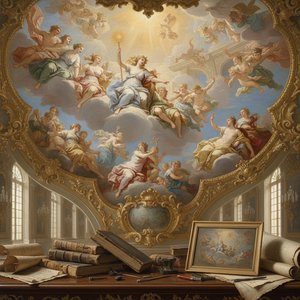
Matthäus Günther: A Bavarian Baroque Visionary
Matthäus Günther (7 September 1705 – 30 September 1788) stands as a pivotal figure in the artistic landscape of Bavaria during the Baroque and Rococo eras, leaving an indelible mark on religious art and architectural decoration. Born in Peissenberg, Germany—then Tritschengreith—Günther’s formative years instilled within him a deep appreciation for craftsmanship and detail, qualities that would become hallmarks of his prolific output. He ascended to prominence as director of the Augsburg Academy in 1762, cementing his legacy not only as an artist but also as an educator shaping the next generation of Bavarian painters.
Early Life & Artistic Training
Günther’s artistic journey commenced in Munich from 1723 to 1728 under the tutelage of Cosmas Damian Asam, one of Bavaria's foremost Baroque architects and artists. This mentorship proved invaluable, immersing Günther in the techniques of fresco painting—a medium particularly suited for monumental church decorations—and fostering a stylistic sensibility that would define his oeuvre. The influence of Asam’s dramatic compositions and masterful use of chiaroscuro undoubtedly shaped Günther’s artistic vision from its inception. He honed his skills further through collaborations with Franz Xaver Asam, establishing a powerful creative partnership that yielded exceptional results.
The Rococo Style & Church Decoration
Günther's contribution to the Rococo style is undeniable. Unlike the grandeur of Baroque art, Rococo embraced elegance, asymmetry, and pastel hues—a stylistic shift Günther skillfully adopted, particularly in his extensive work decorating churches throughout Bavaria and Tyrol. Over forty churches bear witness to his artistic prowess, showcasing approximately 70 frescoes and 25 panels that exemplify the movement’s characteristic exuberance and refined ornamentation. His depictions frequently prioritized capturing fleeting emotions and conveying spiritual narratives with remarkable sensitivity—a departure from the more formal conventions of earlier periods.
Notable Works & Artistic Technique
Günther's artistic technique was characterized by meticulous observation and a dedication to realism, achieved through painstaking layering of pigments and masterful blending techniques. He possessed an exceptional ability to render textures convincingly, capturing the nuances of drapery, skin tones, and architectural surfaces with breathtaking accuracy. The artist’s palette favored vibrant colors—particularly reds, blues, and golds—creating luminous interiors that captivated viewers and elevated the spiritual experience. Among his most celebrated achievements are “The Apotheosis Of St Benedict” and “Die Apotheose Des Benediktinerordens,” monumental frescoes demonstrating Günther's mastery of perspective and dramatic composition. These works continue to inspire admiration for their beauty and artistic innovation.
Historical Significance & Legacy
Matthäus Günther’s influence extended beyond his immediate contemporaries, establishing him as a cornerstone of Bavarian Baroque and Rococo art history. His work served as an exemplar for subsequent artists striving to emulate the stylistic ideals of his time—a testament to his enduring artistic vision. Today, Günther's frescoes adorn churches across Bavaria and Tyrol, offering visitors a glimpse into the artistic spirit of the eighteenth century and reminding us of the transformative power of visual art in conveying religious faith and aesthetic beauty. His legacy persists as a symbol of Bavarian cultural heritage and a celebration of artistic excellence.