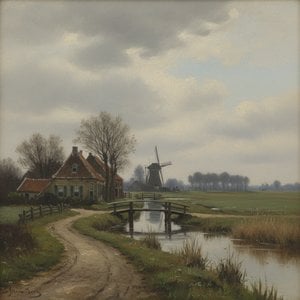
The Impressionist of the Cornish Coast
Mary McCrossan, a name whispered with reverence among admirers of the British landscape movement, was an artist whose brush captured the very soul of the Atlantic coastline. Born in Liverpool in 1865, her journey from the industrial heart of England to the rugged, salt-sprayed cliffs of Cornwall is a testament to a life driven by an unyielding passion for light and atmosphere. Her early years were marked by a profound academic rigor; she honed her craft at the prestigious Liverpool School of Art, where her burgeoning talent was recognized through gold and silver medals. This foundation of technical excellence was further enriched by her transformative time in Paris at the Académie Delécluze. It was within the vibrant, avant-garde atmosphere of France that McCrossan encountered the revolutionary principles of Impressionism, learning to see the world not as a collection of static objects, but as a fleeting dance of light, shadow, and color.
The transition from the structured studios of her youth to the spontaneous plein air techniques of her maturity was seamless, fueled by a deep-seated connection to the natural world. Her studies in Paris instilled in her a mastery of tonal harmony and an ability to translate the ephemeral qualities of the atmosphere onto canvas. This period of her life was perhaps most significant for its emphasis on capturing the immediate sensation of a scene, a skill that would later define her celebrated works in the Cornish landscape tradition.
A Symbiosis of Light and Landscape
Around 1900, McCrossan found her true artistic home in St Ives, Cornwall. This move was far more than a change of scenery; it was a profound artistic homecoming. In the creative crucible of St Ives, she entered into a vital professional and spiritual dialogue with Albert Julius Olsson, another titan of the Cornish school. Their relationship was one of mutual inspiration, where McCrossan’s Impressionist sensibilities merged with the expressive potential of tonal painting. Under the influence of this stimulating environment, her work began to oscillate between the delicate capture of light and a more robust, textured exploration of the landscape.
Her repertoire was remarkably diverse, ranging from the serene and atmospheric to the intimate and domestic. While she is most renowned for her marine scenes and sweeping coastal vistas, her ability to imbue even the smallest subject with grandeur was unparalleled. One might find herself lost in the quietude of Kitchen Interior, a grayscale study that reveals a different facet of her technical prowess—a more grounded, realist approach to the beauty found in everyday objects. Conversely, her later works, such as the vibrant 1931 piece The Witchball, showcase a mastery of bold colors and dynamic brushstrokes that evoke a sense of warmth and communal energy through still-life composition.
Legacy and Artistic Significance
Throughout her prolific career, McCrossan maintained a dual presence in the art worlds of both London and Cornwall. By keeping a studio at Cheyne Walk in London, she ensured her work remained connected to the broader artistic discourse of the era, even as her heart remained anchored to the Cornish coast. Her exhibitions were prestigious milestones, reaching the halls of the Royal Academy and securing her place among the significant painters of her generation.
The enduring legacy of Mary McCrossan lies in her ability to bridge the gap between academic precision and Impressionist freedom. Her work serves as a vital historical record of the Cornish landscape movement, capturing a specific era of British art where the boundaries of light and form were being joyfully redefined. To look upon a McCrossan painting is to experience the salt air of St Ives and the shimmering light of a fading afternoon, preserved forever through her masterful hand.
Key Highlights of Her Career:
- Academic Excellence: Recipient of multiple gold and silver medals from the Liverpool School of Art and a prestigious traveling scholarship from Paris.
- Artistic Influence: A pivotal figure in the Cornish landscape movement, heavily influenced by her studies at the Académie Delécluze.
- Collaborative Spirit: Worked closely with prominent artist Albert Julius Olsson in St Ives, refining the tonal Impressionist style.
- Versatile Mastery: Renowned for a body of work that spans from atmospheric marine scenes and landscapes to intricate still lifes and domestic studies.