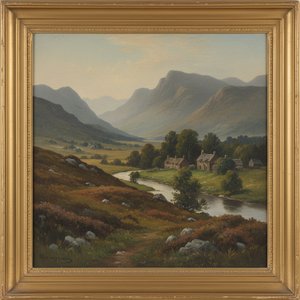
Louise Ellen Perman (1854-1921): A Quiet Florist’s Legacy
Louise Ellen Perman, born in Eastwood, Glasgow, in 1854, emerged as a significant figure within the Scottish art scene of the Victorian era. Though often overshadowed by her contemporaries—particularly Jessie Algie and Jessie Marion King—Perman carved out a distinctive artistic path marked by exquisite floral watercolors and oil paintings that continue to resonate with collectors and scholars alike. Her life was shaped by intellectual curiosity and a deep connection to the natural world, influences which profoundly informed her artistic vision.
Early Life and Artistic Training
Perman’s formative years were spent in Glasgow, where she received an education that fostered both academic rigor and artistic sensibility. Notably, she enrolled at the Glasgow School of Art in 1881-90, immersing herself in a curriculum focused on drawing and painting—a decision that would prove pivotal to her subsequent career. The school’s emphasis on observation and technique instilled in Perman a meticulous approach to portraying botanical subjects, a characteristic that distinguishes her oeuvre from many of her peers. Her teacher was John Ruskin, who encouraged students to study nature closely and to depict it with honesty and sensitivity.
Floral Painting: Technique and Style
Perman's artistic style is characterized by a remarkable blend of realism and Impressionistic brushwork. She meticulously rendered the delicate textures and subtle hues of flowers—roses, lilies, violets—capturing their ephemeral beauty with astonishing accuracy. However, unlike purely representational artists, Perman skillfully employed loose brushstrokes to convey atmosphere and emotion, reflecting Ruskin’s influence on her artistic thinking. Her paintings often exhibit a luminous quality achieved through layering glazes and utilizing complementary colors to heighten visual impact. The Glasgow School of Art's curriculum encouraged students to experiment with different mediums and techniques—a practice that undoubtedly contributed to Perman’s distinctive style.
Notable Achievements and Exhibitions
Perman’s artistic career spanned several decades, during which she participated in numerous exhibitions across Scotland and Europe. Her paintings were regularly showcased at the Royal Scottish Academy between 1885 and 1920—a testament to her reputation as a respected artist within her time. Among her most celebrated works is “White Roses,” purchased by the Luxembourg in Paris in 1908, demonstrating her recognition on an international stage. Furthermore, she was a founding member of the Glasgow and West of Scotland Lady Artists’ Club and served as Vice-President from 1916 until her death in 1921—a role that underscored her commitment to fostering artistic dialogue and supporting fellow female artists. Her paintings are held in collections across Britain and Europe, including the Victoria and Albert Museum and Glasgow Museums' Collections.
Legacy and Recognition
Despite facing challenges common to women artists of the Victorian era—limited opportunities for professional advancement and societal biases—Louise Ellen Perman persevered in her artistic pursuits, leaving behind a body of work that continues to inspire admiration. Contemporary art historians have increasingly recognized Perman’s contribution to Scottish art history, acknowledging her stylistic innovations and her unwavering dedication to capturing the beauty of the natural world. Neil Munro described Helensburgh as “Painters too have favoured it; there is no Helensburgh School it is true, but studios hide among its flowers, and an infinite number of pictures have been inspired by the hills, shores and sylvan lanes of its neighbourhood”—a sentiment that encapsulates the enduring influence of Perman’s artistic vision on the cultural landscape of Scotland. Her legacy resides not only in her paintings themselves but also in the inspiration she provided to subsequent generations of artists who sought to honor Ruskin's teachings.