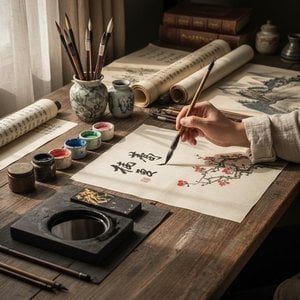
Early Life and Artistic Foundations
Li Baolin, born in Siping, Jilin Province, China, in 1958, emerged as a significant figure in contemporary Chinese ink painting, deeply rooted in the traditions of landscape art yet distinctly his own. His formative years were profoundly shaped by the cultural climate of post-revolutionary China and an early dedication to artistic expression. Baolin’s journey began with rigorous training at the Central Academy of Fine Arts, where he had the distinct privilege of studying under two giants of 20th-century Chinese painting: Li Keran and Ye Qianyu. These masters weren't merely instructors; they were custodians of a rich heritage, passing down not only technical skills but also a profound understanding of ink’s expressive potential and the philosophical underpinnings of traditional art.
Li Keran, renowned for his monumental landscapes imbued with both grandeur and subtlety, instilled in Baolin an appreciation for the power of suggestion and the importance of capturing the essence of nature. Ye Qianyu, a versatile artist known for his figure paintings and dynamic compositions, broadened Baolin’s artistic horizons, encouraging him to explore different styles and techniques. This dual mentorship proved pivotal, laying the groundwork for Baolin's unique synthesis of classical rigor and contemporary sensibility.
The Development of the ‘Li Family Landscape’ Style
Following his graduation from the Central Academy of Fine Arts in 1963, Li Baolin embarked on a path that would define his artistic identity. He initially served as a painter for the Navy in South China, an experience that undoubtedly influenced his understanding of scale and composition. However, it was his subsequent role at the Chinese Institute – first as a full-time painter and later as head of its Creative and Research Department – that allowed him to fully develop what became known as the ‘Li Family Landscape’ style.
This distinctive approach isn't simply an imitation of Li Keran’s work, but rather a thoughtful evolution. Baolin builds upon the grandeur and depth characteristic of his mentor’s mountain paintings, yet infuses them with a unique formative sense – a personal touch that sets his landscapes apart. He masterfully blends traditional techniques with contemporary perspectives, creating works that are both deeply rooted in history and strikingly relevant to modern audiences. The ‘Li Family Landscape’ is characterized by its atmospheric perspective, subtle gradations of ink, and a profound sense of tranquility.
Major Achievements and International Recognition
Throughout his career, Li Baolin has consistently garnered recognition for his exceptional talent and dedication to the art of ink painting. He became a member of the Council of the National Academy of Painting of China, solidifying his position as a leading figure in the national art scene. His appointment as Vice President of the Institute of Chinese Painting further underscored his influence and commitment to fostering artistic excellence.
Baolin’s work has been showcased in numerous exhibitions both domestically and internationally, including significant presentations in Italy, Malaysia, Japan, Korea, and Taiwan. These exhibitions have not only broadened his audience but also facilitated a cross-cultural dialogue about the enduring power of Chinese art. A particularly noteworthy achievement was his commission by the Ministry of Culture to create Splendid China, a monumental painting commemorating the first anniversary of Hong Kong’s return – a testament to his artistic skill and national significance.
A Legacy of Tradition and Innovation
Li Baolin's contribution extends beyond his own captivating paintings. As Honorary President of the Li Keran Academy of Painting, he actively promotes the preservation and development of traditional Chinese art forms. He received a special allowance from the government in 2004 for his contributions as a National Expert, acknowledging his dedication to cultural heritage.
His landscapes are not merely depictions of scenery; they are meditations on nature, reflections on history, and expressions of personal philosophy. They invite viewers to contemplate the beauty and fragility of the natural world, and to connect with the rich artistic traditions of China. Baolin’s work stands as a powerful example of how tradition can be both honored and innovated upon, ensuring that the art of ink painting continues to thrive in the 21st century. His enduring legacy lies not only in his stunning visual creations but also in his unwavering commitment to preserving and promoting the cultural heritage he so deeply values.
问答环节
Ar galiu peržiūrėti Li Baolin kūrybą pagal nuotaiką?
Li Baolin Nuotaudų kambarys – tai puslapis, kuriame kūriniai sugrupuoti pagal nuotaiką.
Ar yra apžvalga visų temų, kurias vaizdavo Li Baolin?
Li Baolin kūrybą temomis galima tyrinėti puslapio Tematų atlasas temų kataloge.
Kaip laikui bėgant evoliucionavo Li Baolin kūryba?
Chronologinė Li Baolin kūrybos apžvalga galima rasti puslapio Chronika, kuriame kūriniai pateikiami pagal jų kūrimo tvarką, skirstant į skyrius.