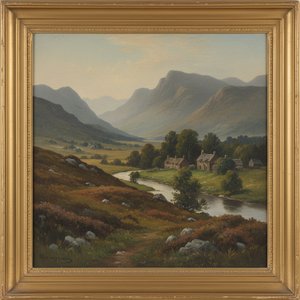
A Vision of the American West: The Art of John Frost
John Frost is an artist deeply connected to the evocative power of the desert landscape, particularly that of the Mojave Desert and the broader American West. While biographical details remain somewhat elusive – a deliberate choice perhaps, allowing his work to speak for itself – Frost’s paintings resonate with a profound understanding of light, space, and the subtle drama inherent in seemingly barren environments. He isn't an artist steeped in historical narrative or formal training as much as one born from immersion; his canvases are less about depicting *what* is there and more about conveying *how it feels* to be present within these vast, often unforgiving terrains. The WahooArt platform serves as a primary source for experiencing Frost’s work, offering a glimpse into a world where the silence speaks volumes and the colors shift with an almost spiritual intensity.
The Allure of the Mojave
Frost's artistic focus centers on the American West, specifically the Mojave Desert. His paintings aren’t simply representations of geographical locations; they are emotional landscapes, imbued with a sense of solitude, resilience, and quiet majesty. The palette he employs is often characterized by warm earth tones – ochres, siennas, and burnt umbers – punctuated by the cool blues and violets of distant mountains and expansive skies. This careful orchestration of color creates a depth that draws the viewer in, inviting contemplation and a sense of connection to the natural world. He masterfully captures the unique quality of desert light, its ability to both reveal and conceal, transforming familiar forms into something ethereal and otherworldly. The influence of early California Impressionism is subtly present, but Frost moves beyond mere replication of visual effects; he seeks to capture the *essence* of the desert experience – the heat shimmering on the horizon, the stillness broken only by the whisper of wind, the feeling of being utterly small in the face of immense natural power.
Technique and Style
While details regarding Frost’s formal training are scarce, his technique suggests a self-taught artist with a keen observational eye and a deep understanding of oil painting principles. His brushwork is often loose and expressive, allowing for a sense of movement and spontaneity. He isn't concerned with hyperrealism; instead, he prioritizes capturing the atmosphere and emotional impact of a scene. Layers of paint are skillfully applied to create texture and depth, mimicking the ruggedness of the desert terrain. The use of glazing techniques adds luminosity and richness to his colors, enhancing the sense of light and shadow. His style can be broadly categorized as representational with strong leanings towards atmospheric impressionism, but it’s a style uniquely his own – one that prioritizes feeling over precise detail and invites viewers to connect with the landscape on an emotional level.
Historical Context and Significance
John Frost's work emerges within a tradition of American Western art, yet he distinguishes himself from many of his predecessors. While artists like Albert Bierstadt focused on grand, romanticized depictions of the West’s vastness, Frost offers a more intimate and nuanced perspective. He isn’t interested in celebrating conquest or manifest destiny; instead, he focuses on the inherent beauty and resilience of the natural world. His paintings can be seen as a response to the increasing urbanization and industrialization of modern life, offering a refuge from the noise and chaos of the city. In this sense, his work resonates with contemporary concerns about environmentalism and the importance of preserving wild spaces. The growing popularity of Frost’s art suggests a renewed appreciation for the American West – not as a frontier to be conquered, but as a landscape worthy of reverence and protection. His paintings serve as a powerful reminder of the beauty that exists in simplicity and solitude, inviting viewers to reconnect with nature and find peace within its vastness.