Jerzy Faczynski, 1917 – 1943

Jerzy Faczynski: 69 garsiausi paveikslai

Ballerina yra garsiausias Jerzy Faczynski paveikslas. Abstract Woman ir Shepherd yra kitos dvi labiausiai žinomos pasaulyje kūrybosios darbai. Iš 69 Jerzy Faczynski darbų mūsų kataloge – štai 69 dažniausiai analizuojami kolekcionerių bei lankytojų muziejų, su informacija apie metus, muziejų bei kiekvieno kūrinio istoriją.

Rangos vieta nulegiama pagal mūsų populiarumumo balas, kurį sudaro kiekvieno kūrinio paieškos, apsilankėjimai ir užsakėjimai. Atnaujinta lapkritis 2026. Kiekvieną šio puslapio šedevrą galite užsisakyti kaip muziejoriaus kokybės rankų darbo alievinę reprodukciją arba aukščiausios kokybės meninį spausdiną jūsų pasirinktu dydžiu.

Jerzy Faczynski portretas
Jerzy Faczynski · 1917 – 1943
Gedė · mirė
1917 – 1943
Darbai mūsų kataloge
69
Labiausiai žinomi
Ballerina

Top 10: žymiausi Jerzy Faczynski tapiai

Likę Jerzy Faczynski reitingo vietos, nuo 11 iki 69

Daugiausiai temų, kurių vaizdė Jerzy Faczynski

Keturi populiariausi temų motyvai tarp šių šedevrų, su geriausiais kiekvieno pavyzdžiais.

Jerzy Faczynski tapų dažniausiai užduodami klausimai

Kuri Jerzy Faczynski tapioja yra pati garsiausia?Rodyti atsakymą

Ballerina. Toliau eina Abstract Woman ir Shepherd.

Kuriose yra 10 garsiausių Jerzy Faczynski paveikslų?Rodyti atsakymą

Ballerina, Abstract Woman, Shepherd, Faces, Nude, Nude, Nude, Ballerina, Woman ir The Madonna And Child. Viršuje esančioje reitingo lentelėje nurodyta kiekvieno kūrinio metis ir muziejus.

Kiek Jerzy Faczynski paveikių yra?Rodyti atsakymą

Mūsų kataloge yra 69 darbų autoriaus Jerzy Faczynski.

Kokia temas vaizdavo Jerzy Faczynski?Rodyti atsakymą

Women (11), Nudes (7) ir Buildings (6), iš 69 šioje pusėje esančių darbų.

Kur galima įsigyti Jerzy Faczynski reprodukciją?Rodyti atsakymą

Taip. Kiekvieną šioje pusėje esantį paveikslą galite užsakyti kaip muziejoriaus kokybės rankų darbų alievinę kopiją arba aukščiausios kokybės spausdinį pasirinktu jūsų pageidaujamu dydžiu tiesiai iš paties paveikslą puslapio.

Jerzy Faczynski: biografija

A Life Forged in Conflict and Creation


The life of Jerzy Faczynski was a profound testament to the resilience of the human spirit amidst the wreckage of the twentieth century. Born in 1917 in Yenakiieve, Ukraine, to Polish parents, his early years were steeped in an atmosphere of artistic appreciation, nurtured by his mother, Marian, a dedicated artist and teacher. This foundational connection to beauty would later become his sanctuary during the darkest chapters of his life. When the shadows of World War II descended upon Europe, Faczynaryski’s path took a dramatic turn from the studio to the cockpit, as he enlisted in the Polish Air Force. His journey was marked by the harrowing realities of war, including capture by Nazi forces and a daring, resolute escape that mirrored the very strength found in his later architectural designs. As a refugee in Britain, he did not merely survive; he sought to rebuild the cultural identity of a displaced nation, joining the Polish School of Architecture in Liverpool—a vital beacon of intellectual life for the Polish diaspora.

The Architecture of Faith and Modernity


Faczynski’s architectural legacy is defined by a singular mission: to translate the eternal essence of the Catholic faith into the language of modern form. His work represents a masterful intersection of Art Deco elegance and the rigorous, functional principles of Modernism. Drawing deep inspiration from the Bauhaus movement, he sought to strip away the superfluous, focusing instead on how light, space, and structure could evoke spiritual transcendence. This pursuit led him to design more than fifty churches, works that stand as monuments to both his technical precision and his liturgical devotion. His architectural vocabulary was not merely about stone and mortar but about creating sacred spaces that resonated with the contemporary era, blending historical reverence with an innovative, forward-looking aesthetic that sought to capture the very soul of the liturgy.

A Versatile Hand: From Ink to Expressionism


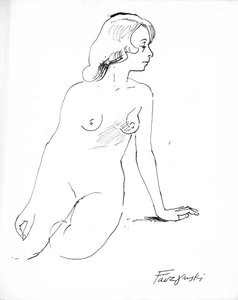
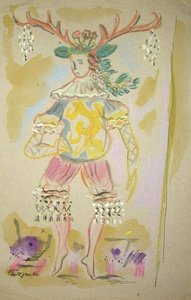
While his architectural achievements provided a structural legacy, his graphic works offered a window into his emotional landscape. Faczynski’s artistry was remarkably diverse, ranging from the delicate precision of monochrome sketches to the raw, emotive power of watercolor and ink. In pieces such as Manor House, one observes a captivating, almost nostalgic exploration of historical themes through impressionistic detail. Conversely, his more experimental works reveal a fascination with the psychological depths of the human condition. His haunting watercolor, Man With A Cigarette, utilizes expressive distortion and vibrant color to evoke profound feelings of isolation and vulnerability, bordering on the realms of Surrealism. Similarly, his ink drawings, such as the Reclining Woman, utilize the dynamic, fragmented lines of Abstract Expressionism to capture raw emotion. Through these varied mediums, Faczynski remained a lifelong witness to the beauty and the turbulence of the world, leaving behind a body of work that continues to resonate with historical depth and artistic brilliance.