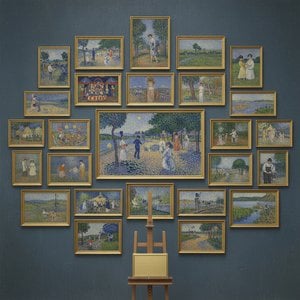
Souvenir with portrait of a man, said to be Lieutenant d'Alézac
Souvenir
Jean-Pierre Mendouze: A Whisper of Ivory and Parisian Elegance
Born in the heart of Paris in 1760, Jean-Pierre Mendouze emerged during a pivotal era in French art – the late 18th century. His life, tragically cut short in 1793, coincided with the tumultuous years leading up to the French Revolution, yet his artistic legacy endures as a testament to his exceptional skill and refined sensibility. Mendouze wasn’t a name that dominated grand salons or commanded public attention like some of his contemporaries; instead, he carved out a distinguished niche for himself as a master miniaturist, specializing in the delicate art of portrait miniatures on ivory. This intimate scale demanded an unparalleled level of precision and observation, qualities that Mendouze possessed in abundance.
The Delicate Art of Ivory Miniature
Mendouze’s technique was characterized by a remarkable realism achieved through painstaking detail. He worked primarily with ivory, a material prized for its luminosity and the subtle gradations of tone it offered. The process itself was incredibly demanding – each miniature required hours, sometimes days, of meticulous labor. Mendouze didn't simply paint; he sculpted light and shadow onto the surface of the ivory, capturing not just likeness but also the very essence of his subjects. His portraits were renowned for their subtle expressions, the delicate rendering of fabrics, and the way he managed to imbue each miniature with a sense of life and personality. He was particularly adept at portraying the nuances of aristocratic fashion – the intricate lace collars, the powdered wigs, the shimmering silks – reflecting the opulent world he inhabited.
Influences and Artistic Context
While Mendouze operated largely outside the spotlight of major artistic movements like Neoclassicism or Romanticism, his work was undoubtedly influenced by the prevailing trends of the time. He shared a period with other prominent French artists such as Jean-Baptiste Isabey and François Gérard, all grappling with the changing aesthetic sensibilities of the late 18th century. However, Mendouze’s focus on miniature painting distinguished him. The genre itself had roots in earlier European traditions, particularly Dutch portrait miniatures, but Mendouze brought a distinctly French elegance and refinement to the form. The influence of Rococo artistry – its emphasis on grace, beauty, and playful ornamentation – can be seen subtly woven into his compositions, though tempered by a remarkable restraint.
Notable Works and Legacy
Among Mendouze’s surviving works is “Souvenir,” a captivating miniature depicting a man believed to be Lieutenant d'Alézac (available for viewing at WahooArt.com). This piece exemplifies his signature style: the careful rendering of facial features, the subtle play of light on the subject’s attire, and the overall sense of intimacy and quiet dignity. His works are not merely portraits; they are miniature windows into a bygone era, offering glimpses of Parisian society and its customs. Today, Mendouze's miniatures reside in prestigious collections worldwide, including those at the Metropolitan Museum of Art in New York and the Louvre Museum in Paris – institutions that recognize the enduring value of his artistic contribution.
A Lasting Impression
Jean-Pierre Mendouze’s life was tragically brief, yet his legacy as a master miniaturist continues to resonate. He represents a quiet but significant voice within 18th-century French art – an artist who, through the delicate medium of ivory and paint, captured the essence of his subjects with remarkable skill and sensitivity. His work at WahooArt.com offers a unique opportunity to appreciate the artistry of this forgotten master, allowing viewers to connect with a world of elegance, refinement, and exquisite detail.
Explore his complete collection on WahooArt.com
Discover “Souvenir” and other captivating miniatures.
WahooArt.com redakcijos komanda
Karo viktorina
Kiekviename klausime yra tik vienas teisingas atsakymas.
Klausimas 1:
Jean-Pierre Mendouze was primarily known for his work in which art form?
Klausimas 2:
During what century was Jean-Pierre Mendouze most active as an artist?
Klausimas 3:
Which museum holds a work by Jean-Pierre Mendouze?
Klausimas 4:
What was a key characteristic of Mendouze's artistic style?
Klausimas 5:
Jean-Pierre Mendouze is often compared to which other notable French artists?
Atraskite 25 Georges Seurat šedevrus! Išsami analizė, istorijos ir įkvėpimas interjero dizainui. Pointilizmo meistras, impresionizmas ir chromoluminarizmas – viskas WahooArt.com. Explore the full collection online!
Explore the captivating world of Jean-Baptiste Pater, a master of Rococo painting. Discover his elegant *fête galante* scenes and shimmering portraits – a glimpse into 18th-century French aristocracy. Learn about his legacy & find high-quality reproductions.
Atraskite 25 Pierre'Auguste Renoir šedevrus! Impresionizmo meistro paveikslai, kupini šviesos ir grožio. Meno istorija, technikos paslaptys ir įkvėpimas jūsų interjerui. Aukštos kokybės reprodukcijos – WahooArt.com