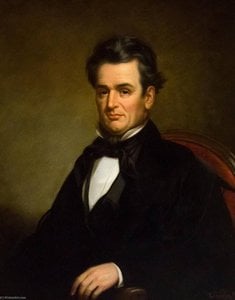
The Architect of Rhode Island’s Visual Legacy
James Sullivan Lincoln, a name etched into the very soul of New England’s cultural history, stands as a monumental figure often revered as "The Father of Rhode Island Art." Born in 1811 in Taunton, Massachusetts, his journey was one of profound resilience and burgeoning talent. Following the untimely passing of his father when Lincoln was just fourteen, the young artist was thrust into the industrious world of Providence, working for an engraving company to support his family. It was within this meticulous environment of fine lines and detailed etchings that his innate gift for visual representation began to crystallize. Under the watchful eye of the artist C.T. Hinckley, Lincoln’s raw skill blossomed, allowing him to masterfully replicate the works of masters like Gilbert Stuart. This early immersion in the precision of engraving would later inform the breathtaking anatomical accuracy and disciplined realism that became his artistic hallmark.
As his career matured, Lincoln transitioned from a gifted apprentice to a pre-eminent portraitist whose studio on South Main Street became a sanctuary for the era's most distinguished figures. His ascent was marked by an extraordinary ability to capture not just the physical likeness of his subjects, but their very essence—a psychological depth that transcended mere representation. One of his earliest triumphs involved the wealthy industrialist Samuel Slater; Lincoln’s portrait of the man was so profoundly successful that it prompted multiple copies, including a notable version for Brown University. This ability to marry academic realism with an intimate understanding of human character allowed him to become the preferred chronicler of Rhode Island's elite, from powerful governors to influential mayors.
Mastery of Technique and the Beaux Arts Influence
The evolution of Lincoln’s style was deeply influenced by the grand artistic currents flowing from Europe to the American shores. His time studying under the legendary John Singer Sargent in Paris provided him with a sophisticated command of the Beaux Arts style. From this prestigious training, he absorbed an emphasis on classical ideals of beauty, proportion, and a masterful manipulation of light and shadow. This Parisian influence breathed a certain grandeur into his work, enabling him to utilize dramatic lighting and rich textures to create portraits that felt both timeless and intensely alive. His canvases were characterized by a rigorous commitment to anatomical precision, ensuring that every fold of fabric and every subtle expression was rendered with an unwavering dedication to truth.
Beyond the technical brilliance of his brushwork, Lincoln’s work serves as a vital historical record of 19th-century American life. His portraits are more than individual studies; they are windows into a period of immense industrial and political transformation. Through his eyes, we witness the gravitas of leaders like Ulysses S. Grant and the dignified presence of local statesmen. His dedication to the pursuit of excellence was not merely personal but communal, as evidenced by his pivotal role in founding the Providence Art Club in 1876. As its first president, he championed the cause of academic art, fostering a collaborative environment that would elevate the entire cultural landscape of Rhode Island for generations to come.
A Lasting Impression on American Art
The legacy of James Sullivan Lincoln is woven into the very fabric of the institutions he helped build and the history he so carefully preserved. His contributions extend far beyond the walls of his private studio, reaching into the halls of government where his portraits of Rhode Island governors continue to preside over the State House. To study a Lincoln portrait is to engage in a dialogue with the past, experiencing the elegance, leadership, and historical significance of a bygone era through a lens of profound artistry.
His life’s work can be summarized by several enduring contributions:
- Cultural Foundation: Establishing the Providence Art Club, which became a cornerstone for artistic community and education in New England.
- Historical Documentation: Creating an unparalleled collection of portraits of Rhode Island's political and industrial leaders, now housed in significant public institutions.
- Artistic Excellence: Bridging the gap between American realism and the sophisticated techniques of the French Beaux Arts tradition.
- Mentorship: Inspiring a new generation of artists through his commitment to rigorous training and classical standards.
Klausimai ir atsakymai
Kur galiu pamatyti visus James Sullivan Lincoln kūrybos darbus?
Visi ši ši internetinė svetainė esantys James Sullivan Lincoln kūriniai galima peržiūrėti puslapyje Visi kūriniai.
Kur galima rasti James Sullivan Lincoln kūrybos darbus, suskirstytus pagal raktažodžius?
James Sullivan Lincoln puslapio Raktažodžiais skiltyje kūriniai suskirstyti pagal raktinius žodžius.
Kur galiu pamatyti James Sullivan Lincoln kūrybą 3D galerijoje?
Galima apsilankyti virtualiai: James Sullivan Lincoln puslapyje 3D galerija kūriniai pristatomi trimensione galerijoje.