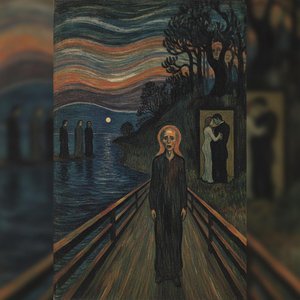
The Enigmatic Legacy of Hugh Buss
To encounter the work of Hugh Buss is to step into a quiet, shadowed corner of art history, where the boundaries between memory and reality seem to blur. Born in 1894 in the German town of Metzingen, Buss lived through one of the most turbulent eras of human existence, yet his personal narrative remains shrouded in a profound, almost intentional, silence. While the names of his contemporaries often echo loudly through the halls of museums, Buss exists as an intriguing puzzle for the modern scholar—a figure whose life trajectory is difficult to trace, but whose artistic presence lingers through the luminous quality of his surviving canvases.
The early years of this German master are lost to the fog of time, leaving us to imagine a formative period shaped by the seismic shifts of the early 20th century. Growing up in Germany during the twilight of the 19th century, Buss would have been a witness to the rise of German Expressionism and the surrealist movements that sought to dismantle traditional perspectives. Although direct evidence of his formal education is elusive, one can sense the spectral influence of titans like Ernst Ludwig Kirchner and Otto Dix within his approach to light and form. There is a palpable tension in his work, a suggestion that beneath the surface of his meticulously observed scenes lies a deeper, more psychological exploration of the human condition.
A Mastery of Light and Tonal Subtlety
Buss’s artistic output is defined by a remarkable dedication to the interplay of light and color. His primary medium, oil on canvas, served as a vessel for capturing the ephemeral nature of atmosphere. Whether he was rendering a sprawling landscape or an intimate portrait, his technique relied heavily on tonal subtlety and a keen eye for how light interacts with texture. His paintings do not merely depict subjects; they inhabit them, breathing life into the stillness of the canvas through a sophisticated use of luminosity.
His oeuvre is characterized by several key artistic hallmarks:
- Luminous Oil Techniques: A profound ability to manipulate oil pigments to create a sense of internal radiance within his subjects.
- Observational Precision: A commitment to meticulous detail that honors the natural world while imbuing it with emotional weight.
- Atmospheric Depth: The use of soft transitions and tonal shifts to evoke a sense of space, time, and mood.
In his landscapes, one finds a quiet reverence for the natural world, where the play of shadows can transform a simple vista into a profound meditation on existence. His portraits, meanwhile, suggest a deep psychological intimacy, capturing not just the likeness of his sitters but a fleeting glimpse into their inner lives.
Historical Significance and Rediscovery
Though Hugh Buss may be considered an artist lost in time, his contributions to the tapestry of 20th-century art remain significant for those who seek beauty in the understated. The presence of his works in esteemed collections, such as the Hugh Lane Gallery, serves as a vital link to a period of intense artistic experimentation. His ability to bridge the gap between the structured observation of classical traditions and the emotive freedom of modernism places him in a unique position within the history of German art.
As we continue to piece together the fragments of his biography, the importance of preserving his legacy becomes increasingly clear. Buss reminds us that art history is not merely a collection of famous names, but a vast, interconnected web of voices—some loud and some whispered—that collectively define our visual heritage. To study Buss is to engage in a form of historical detective work, finding beauty in the gaps between known facts and rediscovering the light that he so masterfully captured on canvas.
Klausimai ir atsakymai
Ar galiu apsilankyti virtualiame Hugh Buss kūrybos muziejuje?
Hugh Buss kūrybą galite apžiūrėti 3D galerijoje, apsilankę puslapyje 3D galerija.
Iš kokios šalies yra Hugh Buss?
Hugh Buss gimė Germany.
Ar yra pilnas Hugh Buss kūrybos darbų sąrašas?
Visi ši ši internetinė svetainė esantys Hugh Buss kūriniai galima peržiūrėti puslapyje Visi kūriniai.