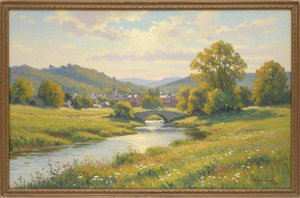
Harry Fenn (1837 – 1911): Pioneer of Pictorial Narrative
Harry Fenn (14 September 1837 – 22 April 1911) stands as a pivotal figure in the history of Victorian illustration, particularly renowned for his groundbreaking contributions to landscape engraving and his depictions of exotic locales like Egypt, Palestine, and Sinai. Born in Richmond, England, Fenn’s artistic journey began with apprenticeship under Dalziel & Forster in London, honing his skills in wood engraving – a technique that would become synonymous with his distinctive style. This formative experience instilled in him an unwavering dedication to capturing the beauty of the natural world through meticulous detail and expressive composition.
His relocation to New York City in 1857 marked a significant turning point, establishing him as a respected engraver and fostering collaborations that propelled him to international acclaim. Notably, Fenn married Marian Thompson in 1862, embarking on a transatlantic adventure encompassing extended stays in England and Italy where he pursued formal artistic training – a decision undoubtedly influencing his subsequent stylistic choices. He quickly gained recognition for his evocative illustrations of Whittier’s “Snow-Bound,” cementing his reputation as the foremost landscape artist of his era and earning him the moniker "the Father of Decorative Printing."
Fenn's magnum opus arrived in 1867 with “Snow-Bound,” a collaborative effort with John Greenleaf Whittier that captivated audiences and established a precedent for combining visual storytelling with textual narrative. This project showcased Fenn’s mastery of wood engraving, utilizing innovative page layouts to heighten the impact of Whittier’s poetry—a technique that would become influential across the artistic landscape. He became instrumental in shaping the burgeoning field of decorative printing, demonstrating how images could enrich and amplify literary works.
The monumental undertaking known as “Picturesque America,” spearheaded by William Cullen Bryant and Douglas Woodward, solidified Fenn's legacy as a visionary artist. Published between 1870 and 1874, this ambitious series comprised over 250 engraved plates depicting the diverse landscapes of the United States—from towering mountains to serene valleys. Fenn’s meticulous attention to detail and his masterful use of tonal shading elevated wood engraving to new heights, transforming it into a medium capable of conveying profound emotional resonance. The project's success spurred further explorations of visual storytelling and cemented Fenn’s position as a pioneer in the realm of artistic expression.
Beyond “Picturesque America,” Fenn’s artistic endeavors extended to Europe and Palestine, where he produced stunning engravings that captured the grandeur of ancient civilizations and biblical sites. His collaborations with Woodward on "Picturesque Europe" and "Picturesque Palestina" further showcased his versatility and cemented his reputation as a storyteller who seamlessly blended artistry and scholarship. Harry Fenn's enduring influence can be seen in subsequent generations of illustrators, whose work continues to honor his pioneering spirit and celebrate the transformative power of visual narrative. His contribution to art history remains undeniable—a testament to his unwavering commitment to capturing beauty and conveying emotion through the medium of wood engraving.