The Convergence of Art and Science: The Legacy of Franz Michael Regenfuss
In the vibrant intellectual landscape of the eighteenth century, few figures embodied the era's thirst for discovery as elegantly as Franz Michael Regenfuss. A German artist, engraver, and naturalist hailing from Nuremberg, Regenfuss occupied a unique space where the precision of scientific inquiry met the delicate beauty of fine art. Born in 1712, he was part of a generation that viewed the natural world not merely as a backdrop for human drama, but as a complex, intricate system waiting to be decoded through careful observation and masterful representation.
Regenfuss’s journey began within the rich artistic traditions of Nuremberg. Trained with rigorous discipline, his early years were dedicated to mastering the technical complexities of painting and engraving. This foundational expertise provided him with more than just aesthetic skill; it granted him the surgical precision required for the meticulous task of documenting the minute details of marine life. However, his ambitions soon transcended the boundaries of traditional portraiture or landscape, as an insatiable curiosity about conchology—the study of shells—began to reshape his creative trajectory.
A Masterpiece of Natural History
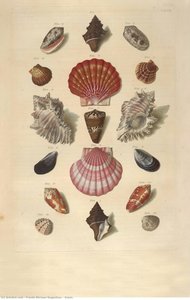
The pinnacle of Regenfuss’s career lies in his monumental achievement, “Choix de Coquillages et de Crustacés” (Selection of Shells and Crustaceans). This project was far more than a mere collection of illustrations; it was a lifelong pursuit of scientific truth through the medium of copperplate engraving. Beginning as early as 1748, Regenfuss embarked on a mission to create a comprehensive treatise that would serve both the scholar and the connoisseur. His work on this series was characterized by an extraordinary level of detail, capturing the iridescent textures, spiraling geometries, and subtle colorations of mollusks and crustaceans with breathtaking accuracy.
The development of this magnum opus was marked by both profound dedication and significant challenges. Regenfuss’s commitment to excellence led him to delay publication when he found existing scientific texts insufficient for his high standards. His travels eventually took him to Copenhagen, where he served as the engraver to King Frederick V of Denmark. This prestigious position provided him with the resources and stability necessary to continue his intricate work. Interestingly, the visual splendor of his plates was a collaborative triumph; while Regenfuss executed the masterful engravings, much of the delicate hand-coloring was performed by his wife, Margaret Helene Regenfuss, adding a layer of warmth and vitality to the scientific specimens.
Historical Significance and Enduring Influence
When “Choix de Coquillages et de Crustacés” finally emerged in its bilingual French and German form, it achieved widespread acclaim across Europe. The work stood as a testament to the Enlightenment ideal of empirical observation, bridging the gap between the artist's studio and the naturalist's laboratory. Regenfuss did not simply draw shells; he translated the biological complexity of the ocean into a visual language that could be understood by the scientific community and admired by art collectors alike.
Today, the legacy of Franz Michael Regenfuss remains etched in the annals of both art history and natural science. His ability to synthesize technical prowess with an inquisitive spirit allows his work to endure as more than just historical documentation. Instead, his engravings serve as windows into a period of profound discovery, reminding us of a time when the stroke of an engraver's tool could contribute as much to our understanding of the world as the most rigorous scientific text. His life remains a beautiful example of how the pursuit of beauty and the pursuit of knowledge can become one and the same.