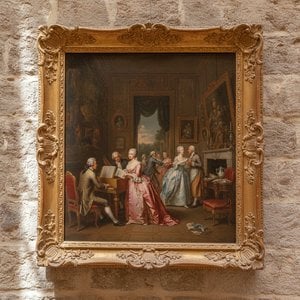
The Legacy of Edward Samuel Harper: A Master of Portrait and Precision
In the heart of the British Midlands, amidst the burgeoning industrial spirit of the Victorian era, the life of Edward Samuel Harper (1854–1941) unfolded as a profound testament to artistic dedication. Born in Handsworth, Staffordshire, Harper was a man of dual mastery, navigating the delicate precision of a jeweller and the expressive depth of a painter with equal grace. His journey was one of deep-rooted connection to his community, particularly the vibrant artistic landscape of Birmingham. As he matured, his work became more than mere representation; it became a window into the soul of an era, capturing both the intimate nuances of individual character and the sweeping social textures of his time.
Harper’s early years laid the foundation for a career defined by meticulous observation. His ascent within the prestigious Royal Birmingham Society of Artists (RBSA) began in 1881 when he was elected an associate member, a milestone that signaled his arrival among the elite of his generation. This affiliation was not merely a professional achievement but the beginning of a lifelong dialogue with the artistic movements of his day. His style, while rooted in the traditions of Victorian art, possessed a unique sensitivity to human emotion. Whether through the subtle curve of a lip or the thoughtful gaze of a sitter, Harper had an uncanny ability to convey psychological complexity, making his portraits feel less like static images and more like living, breathing encounters.
A Dual Mastery of Craft and Instruction
Beyond the canvas, Harper’s contribution to the arts was deeply intertwined with the physical beauty of fine craftsmanship. His expertise as a jeweller informed the precision found in his brushwork, lending a certain luminous clarity to his compositions. This intersection of fine art and decorative craft allowed him to approach his subjects with a jeweler's eye for detail and a painter's eye for light. However, perhaps his most enduring contribution to the future of British art was his role as an educator. For four decades, Harper served as a pillar of the Birmingham School of Art, where he taught drawing and painting to generations of aspiring talents.
His pedagogical influence cannot be overstated; through his teaching, the techniques of observation and the values of artistic discipline were passed down, shaping the aesthetic trajectory of the region. His commitment to the next generation of artists ensured that his legacy would extend far beyond his own lifetime. This dedication to the growth of others was mirrored in his leadership roles, most notably when he served as the President of the Royal Birmingham Society of Artists from 1935 to 1938, a period during which he worked tirelessly to foster institutional excellence and artistic community.
Capturing the Spirit of an Age
The breadth of Harper’s oeuvre offers a fascinating glimpse into the social milieu of late 19th and early 20th-century Britain. While his portraits are celebrated for their intimacy, his genre paintings provide a broader, more panoramic view of life. In these works, he captured the vibrancy of Birmingham’s industrial landscape, documenting the rhythms of everyday existence with a masterful use of colour and light. His ability to transition from the quiet, introspective space of a portrait to the bustling, energetic scenes of social reality demonstrates a remarkable versatility.
As we reflect on the life of Edward Samuel Harper, we see an artist whose significance lies in his multifaceted impact:
- Artistic Versatility: The seamless blending of portraiture and genre painting, characterized by emotional depth and technical precision.
- Institutional Leadership: His pivotal role in the RBSA, serving as President and elevating the status of Birmingham's artistic community.
- Educational Impact: A forty-year tenure at the Birmingham School of Art that nurtured countless artistic successors.
- Cultural Documentation: Providing a visual record of the Victorian and Edwardian social and industrial landscapes through his observant eye.
Ultimately, Harper remains a cornerstone of British regional art history. His life was a continuous pursuit of beauty, whether found in the glint of a precious stone or the nuanced expression on a human face, leaving behind a body of work that continues to resonate with warmth, accuracy, and profound humanity.