Early Life and Artistic Awakening
David Gwinnett is a contemporary British artist whose work pulsates with the energy of landscape, infused with an emotional depth that resonates deeply with viewers. Born in North Wales, his connection to the natural world began not as a conscious artistic pursuit but as an intrinsic part of his upbringing. The rugged beauty of Snowdonia, the dramatic coastlines, and the ever-changing light became etched into his memory, forming the foundational imagery for his future explorations in paint. While formally educated, Gwinnett’s early artistic development was largely self-directed, driven by a fervent desire to capture not merely *what* he saw, but *how* it felt – the raw power of a storm rolling across the mountains, the quiet solitude of a hidden cove, the vibrant hues of heather blooming on the hillsides. This intuitive approach, prioritizing emotional response over strict representation, would become a defining characteristic of his style. He initially experimented with various mediums, finding early success in watercolour, but it was acrylics that ultimately allowed him to achieve the bold colour palettes and textural effects he envisioned.The Evolution of an Abstract Language
Gwinnett’s artistic journey wasn't a sudden leap into abstraction; rather, it was a gradual process of distillation. His earlier works demonstrate a clear representational base – detailed depictions of Welsh landscapes, often featuring sheep grazing in fields or coastal scenes bathed in golden light. However, even within these realistic portrayals, there existed a growing emphasis on colour and atmosphere. He began to simplify forms, exaggerating certain elements while omitting others, prioritizing the overall mood over precise detail. This evolution was fueled by his exposure to a diverse range of artistic influences. While acknowledging the legacy of British landscape painters like J.M.W. Turner and John Constable, Gwinnett also drew inspiration from abstract expressionists such as Mark Rothko and Willem de Kooning, admiring their ability to convey profound emotion through non-representational forms.- Influence of Colour Field Painting: The impact of artists like Rothko is evident in Gwinnett’s use of layered colour washes and his exploration of the emotional power of hue.
- Connection to Abstract Expressionism: De Kooning's energetic brushwork and gestural approach informed Gwinnett’s own dynamic compositions.
- Welsh Landscape as Core Inspiration: Despite his move towards abstraction, the Welsh landscape remains a constant source of inspiration, providing the subject matter and emotional foundation for his work.
Major Themes and Techniques
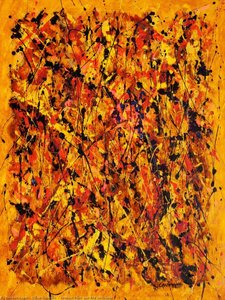
Gwinnett’s paintings are characterized by their bold colour palettes, dynamic compositions, and layered textures. He often employs acrylics on large-scale canvases, building up layers of paint through a combination of brushwork, pouring, and scraping techniques. This process creates a sense of depth and movement, inviting the viewer to immerse themselves in the artwork. Recurring themes within his oeuvre include the power of nature, the passage of time, and the emotional connection between humans and the environment. His series inspired by the Vale of Maentwrog, for example, captures the dramatic beauty of this Welsh valley through a vibrant interplay of blues, greens, and purples, evoking both the tranquility and the raw energy of the landscape. “I’m not trying to paint a specific place,” Gwinnett explains, “but rather the feeling that place evokes within me.” He frequently incorporates black into his compositions, using it as a grounding element or as a contrasting force to heighten the intensity of other colours. This use of black is not merely aesthetic; it also symbolizes the shadows and complexities inherent in the natural world.Recognition and Historical Significance
David Gwinnett has rapidly gained recognition within the contemporary art scene, with his work exhibited in galleries across the UK and increasingly attracting international attention. His paintings are held in numerous private collections, and he is considered a significant voice in the ongoing dialogue surrounding abstract landscape painting. While it’s still early in his career to definitively assess his long-term historical significance, Gwinnett's contribution lies in his ability to bridge the gap between abstraction and representation, creating works that are both visually striking and emotionally resonant. He represents a new generation of British artists who are reinterpreting traditional landscape themes through a contemporary lens, demonstrating a deep respect for nature while simultaneously pushing the boundaries of artistic expression. His work stands as a testament to the enduring power of landscape as a source of inspiration and a reflection of the human condition. His paintings offer not just an aesthetic experience but also an invitation to contemplate our relationship with the natural world and the emotions it evokes.Klausimai ir atsakymai
Kur galiu pamatyti David Gwinnett kūrybą 3D galerijoje?
David Gwinnett 3D galerija yra puslapis, kuriame kūriniai rodomi virtualioje trimensione galerijoje.
Kaip galiu stebėti David Gwinnett kūrybos eigą metmet metams?
David Gwinnett kūriniai chronologine tvarka galima rasti puslapio Kūrybos chronologija kūrinio chronologijoje.
Kur galima rasti temomis suskirstytus David Gwinnett kūrybos darbus?
David Gwinnett kūrybą temomis galima tyrinėti puslapio Tematų katalogas temų kataloge.