Claude Bonnefond (1796–1860): Painter of Rustic Landscapes and Italian Echoes
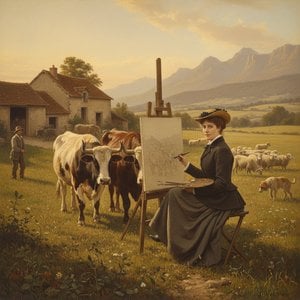
Claude Bonnefond, born in Lyon in 1796, stands as a pivotal figure within the Romantic landscape tradition of France. His artistic journey was marked by an unwavering devotion to capturing the essence of rural life—particularly the Provençal countryside—and infused with the profound aesthetic impact of his formative travels through Italy. While overshadowed by contemporaries like Corot and Millet, Bonnefond’s distinctive style – characterized by luminous color palettes and meticulous attention to detail – cemented his place as a significant contributor to the artistic landscape of his era.
- Early Life & Education: Jean-Claude Bonnefond's upbringing was steeped in the artisan traditions of Lyon, where his father operated a bakery. Despite facing hardship following his father’s untimely death, Bonnefond received an exceptional education thanks to his mother’s remarriage and the generosity of her first husband, securing admission to the École nationale supérieure des beaux-arts de Lyon at just twelve years old. He honed his skills under the tutelage of Pierre Revoil and Alexis Grognard, absorbing the stylistic precepts of Neo-Classical art.
- Italian Influence & Artistic Style: Bonnefond’s decision to embark on a protracted journey to Italy in 1816 proved transformative. This immersion in Italian artistic culture profoundly shaped his aesthetic sensibilities, propelling him toward the luminist style championed by artists like Claude Lorrain and influencing his palette—predominantly dominated by warm yellows and reds—and compositional techniques. He meticulously rendered scenes of pastoral life, emphasizing atmospheric perspective and capturing fleeting moments of beauty.
- The École des Beaux-Arts & Engraving: Recognizing the importance of fostering artistic talent, Bonnefond accepted Victor Prunelle’s invitation to direct the École des Beaux-arts de Lyon in 1830. During his tenure, he established a school of engraving, overseen by Victor Vibert, nurturing a cohort of seventeen Prix de Rome laureates between 1831 and 1860—a testament to his commitment to artistic education.
- Notable Paintings & Recognition: Bonnefond’s oeuvre comprises numerous landscapes depicting the Provençal region with remarkable accuracy. Among his most celebrated works are “The Messenger,” “The Fortune Teller,” “A Farrier Near a Forge,” and “The Vow to the Madonna.” These paintings exemplify his masterful command of light and color, conveying an emotional resonance that transcends mere visual representation. In 1834, he was awarded Knighthood in the Legion of Honor, acknowledging his contributions to French culture.
- Legacy & Historical Significance: Bonnefond’s artistic legacy resides primarily within the Romantic landscape movement. His unwavering dedication to portraying rural life and his embrace of Italian luminist principles established him as a distinctive voice amidst the broader artistic currents of his time. Though often overlooked in comparative studies, Bonnefond's paintings continue to inspire admiration for their evocative beauty and technical precision—a lasting testament to his enduring influence on French art history.
Bonnefond died peacefully in Lyon in 1860, leaving behind a body of work that embodies the spirit of Romanticism’s pursuit of sublime beauty and its celebration of the natural world.