Christoffel Bisschop: A Painter of Everyday Life and Dutch Tradition
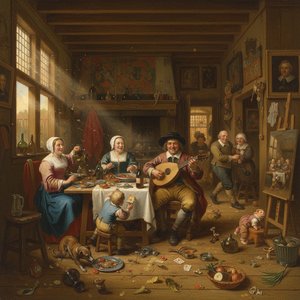
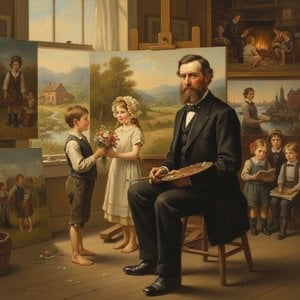
Dutch painter Christoffel Bisschop (1828 – 1904) stands as a significant figure in nineteenth-century genre painting, particularly renowned for his depictions of domestic interiors and scenes capturing the spirit of rural Holland. Born in Leeuwarden, Friesland, Bisschop’s artistic journey began under the tutelage of influential artists like Hendrik Schaaff and Jacob Schoemaker Doyer, establishing him firmly within the artistic landscape of his time. His formative years instilled a deep appreciation for observation and detail—skills that would become hallmarks of his distinctive style. His academic training at the Royal Academy in The Hague with Huib van Hove further honed his technical abilities and broadened his artistic horizons. Subsequently, Bisschop ventured to Paris, immersing himself in the vibrant atmosphere of Impressionism and engaging with luminaries like Charles Gleyre, marking a pivotal moment in his artistic evolution. This exposure to Parisian art undeniably influenced his palette and compositional sensibilities. Bisschop’s prolific output spanned decades, producing numerous canvases that captured the nuances of daily life—scenes from rural households, portraits of ordinary individuals, and evocative depictions of landscapes imbued with regional character. Notably, he achieved particular acclaim for his meticulous renderings of Hindeloopen, a town celebrated for its preservation of traditional costume and customs. These paintings offer invaluable glimpses into Dutch society during the Victorian era, reflecting not only aesthetic beauty but also cultural heritage. A respected artist and teacher, Bisschop established a studio in The Hague and nurtured the talents of aspiring painters like Bernard Blommers and Karel Klinkenberg, contributing to the artistic vitality of his community. His involvement with organizations such as the Pulchri Studio and the Nederlands Kunstenaars Genootschap underscores his commitment to fostering artistic excellence. Bisschop’s legacy extends beyond his individual artworks; he played a crucial role in shaping the visual culture of Friesland and safeguarding its traditions. The Fries Museum houses a comprehensive collection of his paintings, alongside artifacts from his workshop—a testament to his enduring influence on art history and cultural preservation. Major retrospectives celebrating his oeuvre in 1905 and 2008 cemented his place as one of the most important artists of his generation.- Notable Works: “The Interrupted Prayer,” “A Sunny Corner,” “The Falconer” exemplify Bisschop’s masterful technique and ability to convey emotion through subtle visual cues.
- Style & Technique: Bisschop favored a meticulous approach, employing detailed brushwork and careful tonal gradations to achieve remarkable realism—a characteristic that aligns with the tenets of Academic Impressionism.
- Influences: Schaaff’s influence instilled an appreciation for classical composition, while Gleyre's Parisian experience broadened Bisschop’s artistic perspective.