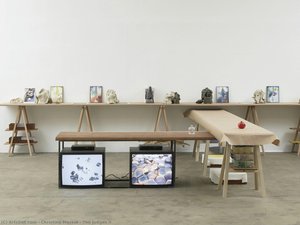
A Sculptor of Shifting Perspectives: The World of Christina Mackie
Christina Mackie, born in Oxford, England, in 1956, is an artist whose work resists easy categorization. For over four decades, she has cultivated a practice that moves fluidly between sculpture, video, photography, and drawing, underpinned by a consistent fascination with the interplay of natural and man-made forces. Her journey began with studies at the Vancouver School of Art in 1974, followed by an MA in Fine Art from Central Saint Martins College of Art and Design in London in 1978 – formative experiences that laid the groundwork for her interdisciplinary approach. Mackie’s artistic evolution isn't defined by distinct phases but rather a continuous series of explorations, driven by a deep sensitivity to materials and their inherent properties. She doesn’t seek to impose form but to reveal potential, allowing objects and processes to dictate the direction of her work. This intuitive methodology is perhaps best understood through the lens of her extensive residency experiences – from the CCA Kitakyushu in Japan (2000) to the VASL Residency in Karachi, Pakistan (2006), and more recently, the XXIV CSAV–Artists Research Laboratory in Italy (2018). These periods of immersion in diverse cultural contexts have broadened her perspective and enriched her material vocabulary.
Early Influences and Conceptual Foundations
Mackie’s early work hinted at a preoccupation with systems of representation and the inherent instability of meaning. While formally trained as a painter, she quickly moved beyond traditional boundaries, embracing three-dimensional forms and incorporating found objects into her assemblages. This shift wasn't merely stylistic; it reflected a growing interest in challenging conventional notions of artistic authorship and control. Her work began to explore the tension between order and chaos, precision and accident. The influence of minimalist sculpture is discernible in some early pieces, but Mackie quickly diverged from its austere aesthetic, introducing elements of chance and unpredictability. She became fascinated by the geological processes that shape our world – erosion, sedimentation, crystallization – viewing them as metaphors for cultural transformation and decay. This fascination with natural forces would become a defining characteristic of her mature work. The artist’s studio itself functions as a microcosm of these explorations, a space where materials are constantly being tested, manipulated, and reconfigured.
Major Themes and Artistic Developments
Mackie's sculptures often take the form of intricate installations that blur the boundaries between object and environment. She frequently employs materials such as crystals, clay, garnet sand, and pigment blocks, subjecting them to forces of compression, gravity, technology, or simply careful observation. A key development in her work has been the integration of digital media – particularly video and animation – which allows her to explore concepts of process and control in new ways. Pieces like *Powder People* (2018), originally commissioned for Spazio Culturale Antonio Ratti in Italy, exemplify this approach. The sculpture features piles of materials alongside procedural animations that model the behavior of crowds, raising questions about data mining, information aggregation, and the erosion of democratic processes. This work demonstrates Mackie’s ability to connect abstract sculptural forms with pressing social and political concerns. Another significant theme is the representation of time across geological spans. *The Judges II* (2011), a complex arrangement of ceramics, minerals, watercolours, ink paintings, and monitors, invites viewers to consider the tools – forensic, artistic, or geological – we use to interpret the past and connect with the present.
Recognition and Historical Significance
Christina Mackie’s work has garnered significant recognition within the contemporary art world, with exhibitions at prestigious institutions including Tate Britain, Tate Liverpool, Chisenhale Gallery, and the Henry Moore Institute. She was awarded the Beck's Futures Art Prize in 2005 and the Paul Hamlyn Award in 2010, providing crucial support for her ongoing explorations. Her pieces are held in numerous public collections, including those of the Tate, the Arts Council Collection, and the British Council Collection. Mackie’s historical significance lies in her ability to synthesize diverse artistic traditions – minimalism, land art, conceptualism – into a unique and compelling visual language. She challenges viewers to question their assumptions about materiality, representation, and the relationship between nature and culture. Her work is not easily deciphered; it resists simple interpretations, inviting instead a sustained engagement with its complex layers of meaning. In an era increasingly dominated by digital technologies and rapid cultural change, Mackie’s sculptures offer a powerful reminder of the enduring importance of physical experience and intuitive exploration. She stands as a vital voice in contemporary art, pushing boundaries and prompting critical reflection on the world around us.
Recent Work and Future Directions
The 2024 exhibition at Goldsmiths CCA marked a significant moment for Mackie, representing her first major institutional solo show in the UK for over a decade. The presentation of new paintings alongside key sculptural works highlighted the dynamic interdisciplinarity that defines her practice. Installations like *Powder People* were restaged within the unique context of the Daskalopolous Tank Gallery, a metal-lined Victorian water tank transformed into an exhibition space. This deliberate juxtaposition of materials and environments underscores Mackie’s commitment to exploring the interplay between form and context. Recent work continues to delve into themes of geological time, digital simulation, and the impact of human activity on the natural world. Video sequences featuring falling objects and fragmenting forms reflect a broader meditation on impermanence and decay. As she moves forward, Mackie remains committed to her intuitive methodology, allowing materials and processes to guide her artistic explorations. Her work promises to continue challenging viewers and expanding our understanding of contemporary sculpture.