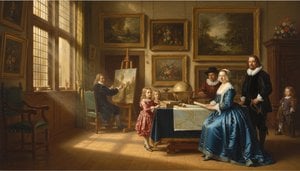
The Quiet Observer of Haarlem: The Life of Bartholomeus Molenaer
In the vibrant, bustling atmosphere of the Dutch Golden Age, where grand maritime triumphs and opulent portraits often commanded the spotlight, there existed a more intimate form of storytelling. Bartholomeus Jansz. Molenaer, born around 1618 in the storied city of Haarlem, was a master of this subtle narrative. While his brother, Jan Miense Molenaer, achieved greater fame, Bartholomeus carved out a legacy defined by a profound sensitivity to the rhythms of everyday existence. Growing up in a household led by the tailor Jan Mientsen Molenaer, Bartholomeus was immersed in a world where the textures of common life were ever-present. This domestic foundation, coupled with the artistic influence of his brother Nicolaes, prepared him for a career dedicated to capturing the unvarnebed truth of the human condition.
His professional ascent was marked by his admission to the prestigious Haarlem Guild of St. Luke in 1640, a milestone that solidified his standing within the elite circle of Dutch masters. During the early 1640s, he lived alongside his brother Jan Miense at Lombaertsteech, an arrangement that likely allowed for a rich exchange of techniques and perspectives. His life, though relatively brief—concluding in September 1650—was a concentrated period of artistic devotion, during which he mastered the art of transforming the mundane into the monumental.
Shadows and Light: The Artistry of Genre Painting
To step into a canvas by Molenaer is to enter a world of soft light and deep, evocative shadows. He was a specialist in genre painting, a style focused on scenes of ordinary people engaged in the simple activities of life. His work often features peasants gathered in dimly lit interiors, perhaps sharing a drink in a tavern or focused intently on a game of kolf. What distinguishes Molenaer from his contemporaries is his masterful use of chiaroscuro. He frequently employed a signature technique where a deep shadow would anchor the lower left corner of his compositions, creating a sense of depth and pulling the viewer’s eye toward the illuminated drama unfolding in the center of the room.
His technical prowess was not merely about light, but about the emotional weight of the subjects themselves. Influenced by the gritty realism of Adriaen Brouwer and the atmospheric landscapes of Adriaen van Ostade, Molenaer infused his scenes with a palpable sense of atmosphere. Whether depicting students lost in study or the boisterous energy of a village gathering, his brushwork captured the tactile reality of cloth, wood, and skin. There is a quiet dignity in his peasants; they are not mere caricatures of poverty, but characters endowed with psychological depth and a quiet, resilient grace.
A Lasting Legacy in the Dutch Golden Age
The historical significance of Bartholomeus Molenaer lies in his ability to act as a visual chronicler of the social fabric of 17th-century Netherlands. While much of the art of his era sought to celebrate national pride and mercantile wealth, Molenaer looked inward, toward the hearth and the tavern. His paintings serve as windows into the social hierarchies and domestic realities of the time, offering a poignant commentary on the shared human experience across different social strata.
Though he passed away in his native Haarlem at the young age of approximately 32, his contributions to the Dutch Golden Age remain indispensable. His work continues to resonate because it finds beauty in the ephemeral:
- The Intimacy of Domesticity: Capturing the quiet moments of family and communal life.
- Technical Mastery: The sophisticated use of light and shadow to create narrative tension.
- Social Insight: Providing a window into the lives of the working classes through meticulous observation.
Klausimai ir atsakymai
Kur galima rasti Bartholomeus Molenaer kūrybą, suskirstytą pagal meno kryptis?
Bartholomeus Molenaer kūrybą pagal stilių galima peržiūrėti puslapio Visi meno kryptys skiltyje.
Ar galiu ieškoti Bartholomeus Molenaer kūrinių pagal raktažodžius?
Bartholomeus Molenaer kūrybą galima tyrinėti pagal raktažodžius tame šio autoriaus Raktažodžiais puslapyje. Kiekvienas raktažodis sugrupuoja susijusią kūrybinę veiklą.
Kur galiu pamatyti Bartholomeus Molenaer kūrybos spalvų profilį?
Bartholomeus Molenaer Paletės genomas – tai puslapis, kuriame pateikiamas kūrybos efortų spalvų profilis.