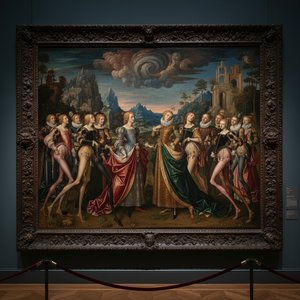
Adoration of the Christ Child and Annunciation to the Shepherds
Studies of Trees
Sheet of Studies of Figures and Heads
Museums on APS:
Biblioteca Ambrosiana
New Orleans Museum of Art
Fondazione d'Arco
Also known as:
Aurelio Luini (C. 1530–1593)
Aurélio Luini
Nationality: Italy
Works on APS: 3
Daugiau…
Lifespan: 63 years
Art period: Renaissance
Died: 1593
Copyright status: Public domain
Born: 1530, Luino, Italy
A Life Immersed in Lombard Light: Aurelio Luini and the Echoes of Renaissance Milan
Born around 1530 in the picturesque town of Luino, nestled on the shores of Lake Maggiore in Italy, Aurelio Luini inherited a rich artistic legacy. He was the fourth and final son of Bernardino Luini, a prominent painter deeply influenced by Leonardo da Vinci and a key figure in the vibrant Milanese art scene. This familial connection profoundly shaped Aurelio’s trajectory, immersing him from an early age in a world of pigments, frescoes, and the pursuit of artistic excellence. While his father's style was already established, Aurelio would carve out his own niche within the evolving landscape of late Lombard Mannerism, becoming known for his evocative depictions of figures and masterful fresco work. His life unfolded against a backdrop of religious fervor, political shifts, and an increasing fascination with classical antiquity—influences that subtly yet significantly colored his artistic vision.
Formative Years and Artistic Development
Aurelio’s early training undoubtedly took place within his father's workshop, absorbing the techniques and aesthetic principles of the Renaissance tradition. However, he wasn’t merely a follower; he actively engaged with the intellectual currents of his time. In 1560, Aurelio joined forces with fellow artists including Giovan Paolo Lomazzo to establish the Accademia della Val di Blenio—a group dedicated to challenging the prevailing conventions of Mannerism and seeking a more naturalistic approach to art. This academy fostered an environment of experimentation and critical dialogue, encouraging members to look beyond established norms and explore new avenues of expression. A key aspect of this exploration involved revisiting the drawings of Leonardo da Vinci, meticulously studying anatomy and embracing direct observation from life—a practice championed by his father but now pursued with renewed vigor. Aurelio’s early works reveal a delicate balance between the refined elegance inherited from Bernardino Luini and a growing desire for greater realism and emotional depth.
Frescoes and Religious Commissions: A Flourishing Career
Aurelio Luini's career blossomed primarily through religious commissions, particularly in fresco painting. One of his most significant achievements is the collaborative work with his brother Giovan Pietro on the Bergamini Chapel within the San Maurizio al Monastero Maggiore in Milan (1555). These frescoes are a testament to their combined skill and artistic sensibility, showcasing vibrant colors, dynamic compositions, and a captivating narrative quality. Beyond this landmark project, Aurelio undertook numerous other commissions throughout Lombardy. He created a poignant *Lamentation* for the church of San Barnaba, adorned the walls of Santa Maria di Campagna near Lake Maggiore alongside Carlo Urbino, and contributed frescoes to San Vincenzo alle Monache (now housed in the Pinacoteca di Brera). His dedication extended to significant projects within Milan itself, including a *Saint Tecla* for the cathedral and a *Madonna between SS. Roch and Sebastian* for Tortona Cathedral. These works demonstrate his versatility and ability to adapt his style to suit diverse architectural settings and devotional contexts.
Style and Influences: A Synthesis of Tradition and Innovation
Aurelio Luini’s artistic style is characterized by a graceful elegance, refined draftsmanship, and a subtle yet expressive use of color. He inherited the delicate modeling and harmonious compositions of his father, but infused them with a greater sense of emotional intensity and psychological realism. His figures possess a gentle dynamism, conveying both spiritual devotion and human vulnerability. While deeply rooted in the Renaissance tradition, Aurelio also absorbed influences from contemporary Mannerist painters, evident in his elongated forms and sophisticated use of spatial arrangements. However, he never succumbed to the excesses of Mannerism, maintaining a sense of clarity and balance that distinguishes his work. His studies of figures—often executed as independent drawings—reveal a meticulous attention to anatomical detail and a profound understanding of human form. These studies weren’t merely preparatory sketches but served as vehicles for exploring artistic possibilities and refining his technique. His ability to blend tradition with innovation cemented his position as a leading figure in late Lombard Mannerism.
Legacy and Historical Significance
Aurelio Luini passed away in 1593, leaving behind a body of work that reflects the artistic sensibilities of a transitional period. He stands as a bridge between the High Renaissance ideals of his father’s generation and the emerging Baroque style. While not as widely celebrated as some of his contemporaries, Aurelio's contributions to Lombard art are significant. His frescoes continue to captivate viewers with their beauty, grace, and emotional depth. He represents a crucial link in the artistic lineage of Milanese painting, demonstrating how Renaissance traditions could be adapted and revitalized to meet the changing demands of the 16th century. His emphasis on direct observation from life and his meticulous studies of anatomy foreshadowed developments in later artistic movements, solidifying his place as a noteworthy figure in the history of Italian art.
WahooArt.com redakcijos komanda
Karo viktorina
Kiekviename klausime yra tik vienas teisingas atsakymas.
Klausimas 1:
In what city was Aurelio Luini born?
Klausimas 2:
Aurelio Luini is considered a representative of which artistic style?
Klausimas 3:
With whom did Aurelio Luini collaborate on the frescoes in San Maurizio al Monastero Maggiore?
Klausimas 4:
What was one of Aurelio Luini's artistic interests that he revived from Leonardo da Vinci?
Explore the dramatic evolution of Northern Mannerism. Discover how masters like Bosch and Grünewald transitioned from Renaissance harmony to profound, elegant distortion through an expert analysis of symbolism, emotional intensity, and artistic innovation.
Discover the timeless art of fresco painting. Explore the profound history, technical mastery of buon fresco, and the enduring legacy of Renaissance masters like Michelangelo in this expert guide to painting on wet plaster.
Explore the profound mastery of fresco painting, from the technical alchemy of buon fresco to the legendary narratives of Renaissance masters like Ghirlandaio. Discover how this timeless medium shaped art history and continues to inspire architectural grandeur today.