1873 - 1935

Pagrindiniai faktai

  • Died: 1935
  • Born: 1873, Gümmer, Germany
  • Works on this site: 1
  • Copyright status: Public domain

A Life Captured in Oil and Ink

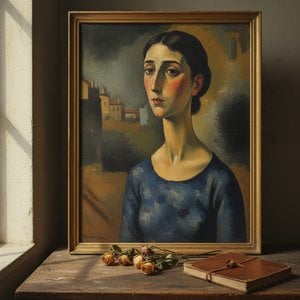
The life of August Heitmüller begins in Gümmer, 1873. A German painter, his hands move between the heavy texture of oil on canvas and the sharp, graphic lines of linocut. There is a quiet presence in his work, often centered on the human form or the stillness of nature. One sees it in his portraits, where faces emerge from the grain of cardboard or the weave of cloth. He captures a girl in a portrait, her features rendered with a focused, steady hand.

His reach extends beyond the brush. He explores the starker possibilities of printmaking, leaving marks through linogravure. In pieces like Le Fermier, the medium dictates a different rhythm, one of contrast and weight. He also works in watercolor, where the fluidity of pigment on paper allows for a lighter touch, seen in his studies of violets in shades of purple, yellow, and white.

Portraits and Personal Connections

The subjects of his work often suggest a deeply personal orbit. A large oil painting depicts Leni Zimmermann-Heitmüller, a figure captured on a scale of 115.5 by 76 cm. This connection to the artist Leni Zimmermann-Heitmüller hints at a world where art and kinship intersect. His portraits do not merely record likenesses; they hold space for the individuals within them, whether it is a man in a formal study or a lady adorned with an amber necklace in Meran.

The movement of his career reflects a transition through different eras of the early 20th century. His works carry the weight of their time, from the textured surfaces of his oil paintings to the monochromatic precision of his linocuts, such as Krähen auf dem Feld. These pieces exist as fragments of a life that concluded in 1935.

Patikrinkite savo akį

Kiekviename klausime yra tik vienas teisingas atsakymas.

Klausimas 1:
In which year was August Heitmüller born?
Klausimas 2:
What medium was used for the artwork 'Purple, yellow and white violets'?
Klausimas 3:
Which of these works is a linogravure by the artist?
Klausimas 4:
According to the records, in which year did August Heitmüller die?
Klausimas 5:
What is the medium of the painting 'Bildnis der Künstlerin Leni Zimmermann-Heitmüller'?

Klausimai ir atsakymai

Kas yra August Heitmüller?

A Life Captured in Oil and Ink The life of August Heitmüller begins in Gümmer, 1873. A German painter, his hands move between the heavy texture of oil on canvas and the sharp, graphic lines of linocut. There is a quiet presence in his work, often centered on the human form or the stillness of nature. One sees it in his portraits, where faces emerge from the grain of cardboard or the weave of cloth. He captures a girl in a portrait, her features rendered with a focused, steady hand. His reach ext

What is the medium of the painting 'Bildnis der Künstlerin Leni Zimmermann-Heitmüller'?

Oil on canvas

Kokiam meno periodui priklausė August Heitmüller?

Modern

In which year was August Heitmüller born?

1873

Ar August Heitmüller kūriniai vis dar yra saugomi autorinės teisės?

Ne, šio autoriaus darbai priklauso viešajai domenui.

Iš kur yra August Heitmüller?

Germany

Kada ir kur gimė August Heitmüller?

1873, Gümmer, Germany

Kada mirė August Heitmüller?

1935

Which of these works is a linogravure by the artist?

Le Fermier

According to the records, in which year did August Heitmüller die?

1935