

Sent from Rome (1973) yra garsiausias Anders Kirkegaard paveikslas, esantis Statens Museum For Kunst kolekcijoje Kopenhaga mieste. "New Language: Double-plus Good Entrance to the Peace Ministry" translated in 2050 to "Old Language: Descent into Hell" (1976) ir The Long Journey (1983) yra kitos dvi labiausiai žinomos pasaulyje kūrybosios darbai. Iš 3 Anders Kirkegaard darbų mūsų kataloge – štai 3 dažniausiai analizuojami kolekcionerių bei lankytojų muziejų, su informacija apie metus, muziejų bei kiekvieno kūrinio istoriją.
Rango vieta nulegiama pagal mūsų populiarumumo balas, kurią sudaro kiekvieno kūrinio paieškos, apsilankėjimai ir užsakėjimai. Atnaujinta lapkritis 2026.


1 muziejai, kuriuose saugoma daugiausia šioje puslapyje esamų paveikslų.
| Muzejaus | Miestas | Anders Kirkegaard darbai | Šiojo sąrašo paveikslai |
|---|---|---|---|
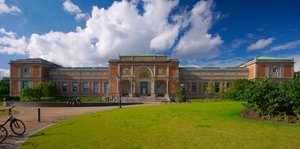 Statens Museum For Kunst |
Kopenhaga | 3 | Sent from Rome, "New Language: Double-plus Good Entrance to the Peace Ministry" translated in 2050 to "Old Language: Descent into Hell", The Long Journey |
Maždaug per dešimt metų, nuo 1973 iki 1983, apima visus Anders Kirkegaard datuotus šedevrus: štai jie, metas po metų.


Sent from Rome (1973), Statens Museum For Kunst, Kopenhaga. Toliau yra "New Language: Double-plus Good Entrance to the Peace Ministry" translated in 2050 to "Old Language: Descent into Hell" (1976) ir The Long Journey (1983).
27 metų amžiaus: Sent from Rome sukurta 1973 m. ir Anders Kirkegaard gimė 1946.
Mūsų kataloge yra 3 Anders Kirkegaard darbų, datuojamų nuo 1973 iki 1983.
Dauguma jų yra Statens Museum For Kunst (Kopenhaga). Viršuje esančiame lange muziejai išvardyti po vieni.
Pirmasis šioje pusėje yra Sent from Rome (1973), paskutinis – The Long Journey (1983).
Sent from Rome, "New Language: Double-plus Good Entrance to the Peace Ministry" translated in 2050 to "Old Language: Descent into Hell" ir The Long Journey yra vieni iš 3 šioje puslapyje esamų darbų, kuriuos saugo Statens Museum For Kunst, Kopenhaga.
The story of Anders Kirkegaard is one of a singular spirit navigating the complexities of the human condition through the medium of paint. Born in 1946, he moved through the decades with a quiet but firm resolve, eventually making his home in Hundested. He was a man who did not seek to follow the established paths of his contemporaries, choosing instead to walk an individualist route that often placed him in an outsider position within the Danish art scene. This independence was not a matter of mere stubbornness, but a necessity born from his desire to confront the very essence of existence.
His life was a continuous dialogue between the internal self and the external world. He used his own body and his own history as the primary landscapes for his explorations, turning the canvas into a site of profound self-examination. This personal focus allowed him to produce works that felt both deeply private and strangely universal. By the time he passed away in 2024 at the age of 78, he had left behind a body of work that challenged the viewer to look closely at the wounds and the wonders of being alive.
His presence in the art world was marked by a refusal to settle for easy answers. He sought a certain truth, often finding it in the tension between the physical form and the psychological state. His commitment to this pursuit meant that his art was never merely decorative; it was a confrontation. He lived as he painted, with a directness that demanded a response from anyone who dared to look upon his creations.
The brushwork of Anders Kirkegaard reveals a man deeply preoccupied with the physical reality of existence. He approached the canvas with a meticulous, almost surgical patience, applying color by color and stroke by stroke to build up a complex web of fine fibers. This disciplined method allowed him to model anatomical studies and psychological landscapes that felt both tangible and unsettling. His use of substance and color leaned heavily into expressionism, creating a sense of weight and presence that demanded the viewer's attention. Through this layered application, he could transform a simple surface into a site of eruptive color or a depiction of internal injury.
His visual language was fundamentally figurative, yet it frequently drifted into the realm of the surreal. He populated his compositions with a recurring vocabulary of the human form, specifically focusing on male torsos, severed limbs, and various disembodied parts. These elements often appeared in strange, almost insect-like arrangements, sometimes resembling specimens pinned to a board. This preoccupation with the flesh led some to describe his aesthetic as a form of "cadaver-romance," a term that captures the tension between the raw, decaying reality of the body and the intense, almost romanticized way he rendered its textures and colors.
The driving force behind his brush was the profound weight of human existence. He sought to map the internal drama of being, often turning his gaze inward to explore the complexities of the soul. This preoccupation with the existential meant that his canvases frequently functioned as private self-portraits. He used his own physiognomy and the contours of his own body to navigate these deep waters, making his work deeply autobiographical. Through his own flesh and bone, he attempted to find a version of truth that resonated beyond his own skin.
His imagination was a fertile ground where ancient myths and sacred texts met the heavy prose of great literature. He drew heavily from the stories of Greek mythology and the profound narratives of the Bible to ground his explorations of the human condition. The psychological depth found in the writings of Dostoevsky and Orwell provided a literary shadow to his visual inquiries. He was a man of great learning, and this intellectual hunger allowed him to weave complex philosophical questions into his imagery, often using long, descriptive titles to invite a dialogue with those who stood before his work.
The visual language he developed was shaped by the presence of significant figures in Danish art. He looked toward the works of Svend Wiig Hansen and L.A. Rings, finding inspiration in their approaches to form and atmosphere. This influence is particularly evident in how he interpreted the landscape, sometimes creating paraphrases of existing works to capture a specific mood or light. His art was a constant struggle to reconcile the physical world with the psychological landscapes that reside within us all.
The artist’s relationship with the sacred was marked by a profound engagement with the weight of religious history. In 1971, the Struer Menighedsråd approached him with a request to design a new altarpiece for their church. Though the project faced the complexities of local approval, his vision eventually found a home in the form of a work titled Bespottelsen. This piece, which depicts a scene of mockery, was later placed within the Struer Kirke Menighedshus, where it remains a significant part of the local spiritual landscape.
His ability to translate heavy, existential themes into large-scale sacred art led to a major commission for Sct. Nicolai Kirke in Vejle. He provided an altarpiece for this space, a work of considerable scale that measures approximately 560 cm in height and 230 cm in width. When fully opened, the structure reaches a height of 460 cm, commanding the space with its physical presence and its confrontation of the viewer.
The artist’s hand often turned inward, seeking to map the complexities of his own existence through the very flesh he inhabited. This preoccupation found its most profound expression in the series titled Jedermann i skikkelse af mig selv. In these works, he utilized a continuous sequence of self-portraits to explore the human drama, often using his own physiognomy and body as the primary landscape for his investigations. These pieces were not merely likenesses but were deeply autobiographical, capturing the struggles and the physical presence of the man himself.
His explorations extended into the realm of the surreal and the symbolic, where the boundaries of the body often seemed to dissolve or transform. In the work Skjulested for en kigger, created between 1968 and 1969, he began to establish the peculiar visual language that would define his career. Later, in 1983, he produced Et stykke med mursten, TAK! (Opus XI, 83), a work that demonstrated his ability to marry heavy, material presence with his singular vision. Even in his later years, he continued to engage with the traditions of the past, as seen in Nature Vivante II (Parafrase over La Rings), which he worked on between 2008 and 2009.