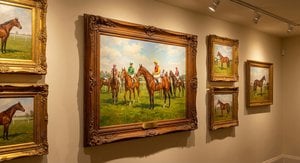
Alfred Augustus Glendening: A Painter of English Light and Tranquility
Alfred Augustus Glendening, a name perhaps less familiar than some of his Victorian contemporaries, nevertheless deserves recognition as a significant figure in late 19th-century British landscape painting. Born in Greenwich around 1840 – though precise details of his early life remain somewhat elusive – Glendening’s journey from railway clerk to accomplished artist offers an intriguing glimpse into the changing social and artistic landscape of his era. His work, characterized by a serene beauty and meticulous observation of light and color, captures the essence of rural England with a quiet grace that continues to resonate today.
Glendening’s artistic career began modestly in 1864 with an exhibition at The Royal Society of British Artists, showcasing his evocative depiction of Grasmere Lake. This initial success marked the beginning of a prolific output, spanning nearly four decades and encompassing hundreds of paintings. He quickly established himself as a regular exhibitor at prestigious venues such as the Royal Academy and Suffolk Street Gallery, gaining recognition for his ability to translate the subtle nuances of the English countryside onto canvas. His subjects were diverse – rolling fields, meandering rivers, picturesque villages, and glimpses of dramatic coastlines – but consistently imbued with a sense of tranquility and timelessness.
The Influence of Thames and Welsh Landscapes
Glendening’s artistic development was profoundly shaped by his early exposure to the natural beauty of the River Thames and the captivating landscapes of Wales. The Thames, with its ever-changing light and reflections, provided a constant source of inspiration, while his frequent travels to North Wales allowed him to master the dramatic interplay of light and shadow on mountains and water. These experiences instilled in him a deep appreciation for the subtleties of color and texture, which he skillfully rendered in his paintings.
He was particularly drawn to the Welsh countryside, finding inspiration in its rugged beauty and atmospheric conditions. His depictions of Snowdonia, with their towering peaks and shimmering lakes, are testaments to his ability to capture the grandeur of nature while maintaining a sense of intimacy and quiet contemplation. His work often featured small figures – shepherds tending their flocks, anglers casting their lines – subtly integrated into the landscape, adding a human element to his serene scenes.
Technique and Style
Glendening’s style can be described as meticulously detailed yet remarkably understated. He eschewed the grandiosity of some of his contemporaries, preferring instead to focus on capturing the quiet beauty of everyday life in rural England. His brushwork was precise and controlled, carefully layering colors to create a sense of depth and atmosphere. He paid particular attention to the effects of light, using subtle gradations of tone to evoke the warmth of the sun or the cool shadows of dusk.
His paintings are characterized by a harmonious balance between observation and imagination. He was not merely a recorder of scenes but an interpreter of their essence, imbuing them with a sense of mood and emotion. The use of color is particularly noteworthy – he favored muted tones and subtle harmonies, creating a feeling of serenity and tranquility.
Notable Works and Legacy
Among Glendening’s most celebrated works are “Under the Beeches,” a captivating depiction of a sun-drenched woodland scene, and “The Village Postman,” a charming portrayal of rural life. His paintings frequently featured the River Thames, often capturing scenes of leisurely boating or riverside gatherings. He also produced numerous landscapes of North Wales, showcasing the dramatic beauty of Snowdonia and other mountainous regions.
Glendening’s work reflects the broader trends in 19th-century British landscape painting – a shift away from heroic subjects and grand compositions towards a more intimate and observational approach. He is remembered as a skilled painter who captured the essence of English rural life with remarkable sensitivity and grace. His paintings continue to be exhibited at The Munnings Art Museum, offering viewers a glimpse into a bygone era of British art and landscape.
Further Exploration
For further information about Alfred Augustus Glendening, consider visiting these resources:
- The Village Postman: https://en.art/alfred-augustus-glendening-the-village-postman-AS7SQ9-en/
- Alfred East Art Gallery: https://en.museums/alfred-east-art-gallery-united-states-of-america-kettering-en/
- Augustus E. Willson: https://en.wikipedia.org/wiki/Augustus_E._Willson
You can also explore his work and learn more about his life on the websites of art galleries such as Brave Fine Art and Artvee.
问答环节
Kuriuose meno...> Kuriuose meno judelseriu dirbo Alfred Augustus Glendening?
Alfred Augustus Glendening kūrybą pagal stilių galima peržiūrėti puslapio Visi stiliai skiltyje.
Ar galiu pasimokyti apie Alfred Augustus Glendening spalvų naudojimą visuose darbuose?
Alfred Augustus Glendening Paletės genoma yra puslapis, kuriame pateikiamas kūrybos efortų spalvų profilis.
Kokie kiti Alfred Augustus Glendening vardai yra žinomi?
Alfred Augustus Glendening taip pat žinomas (a) pavadinimais Augustus E. Willson, Alfred A. Glendening.