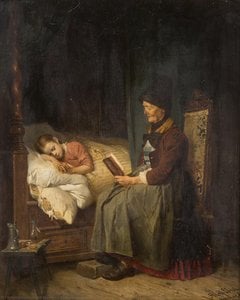
Adolf Eberle, 1843 – 1914

Adolf Eberle: 21 garsiausi paveikslai

A futile attempt (1880) yra garsiausias Adolf Eberle paveikslas. Return from the Hunt (1886) ir Two Hunters with Girl in the Room and Gemsbok (1886) yra kitos dvi labiausiai žinomos pasaulyje kūrybosios darbai. Iš 21 Adolf Eberle darbų mūsų kataloge – štai 21 dažniausiai analizuojami kolekcionerių bei lankytojų muziejų, su informacija apie metus, muziejų bei kiekvieno kūrinio istoriją.

Rangos vieta nulegiama pagal mūsų populiarumumo balas, kurį sudaro kiekvieno kūrinio paieškos, apsilankėjimai ir užsakėjimai. Atnaujinta lapkritis 2026. Kiekvieną šio puslapio šedevrą galite užsisakyti kaip muziejoriaus kokybės rankų darbo alievinę reprodukciją arba aukščiausios kokybės meninį spausdiną jūsų pasirinktu dydžiu.

Adolf Eberle portretas
Adolf Eberle · 1843 – 1914
Gedė · mirė
1843 – 1914, Munich
Judėjimas
Realism
Darbai mūsų kataloge
21
Labiausiai žinomi
A futile attempt (1880)
Daugiausia darbų yra
Petit Palais

Top 10: žymiausi Adolf Eberle tapiai

A futile attempt (1880) aut. Adolf Eberle
1

A futile attempt

1880 · Lithograph

The room is small, a tight frame of wood and stone that holds the weight of a single moment. In this lithograph, light enters from a single source, perhaps a doorway or a window, casting long, heavy shadows across the floorboards. An elderly man sits at the center, his presence anchored by the gravity of age. Around him, three figures—a young girl and two women—gather in a silent circle. They…

Ranku tapytos aliejaus reprodukcija nuo $256 28 × 36 cm
Return from the Hunt (1886) aut. Adolf Eberle
2

Return from the Hunt

1886 · Oil

A group of figures gathers within a rustic interior, marking the conclusion of a hunt. At the center, an older man in traditional hunting attire presents the day's catch upon a table. He holds a rifle, his presence anchoring the composition. Beside him, a woman and a young boy observe the bounty, while a young man to the right holds both a rifle and a fox. The room is filled…

Ranku tapytos aliejaus reprodukcija nuo $256 36 × 28 cm Pusė kaip originalo $358 71 × 61 cm Užsakyti originalaus dydžio →
Two Hunters with Girl in the Room and Gemsbok (1886) aut. Adolf Eberle
3

Two Hunters with Girl in the Room and Gemsbok

1886 · Oil On Canvas

The composition of this 1886 oil painting presents a rustic interior, likely a hunting lodge or cottage, defined by heavy wooden floorboards and structured furniture. On the right side of the frame, three figures occupy the space: two men are seated at a table, while a young woman stands nearby. To the left, the scene shifts toward the results of a hunt, featuring a dead gemsbok lying on the floor…

Ranku tapytos aliejaus reprodukcija nuo $231 36 × 28 cm Pusė kaip originalo $302 65 × 51 cm Užsakyti originalaus dydžio →

Likę Adolf Eberle reitingo vietos, nuo 11 iki 21

Daugiausiai temų, kurių vaizdė Adolf Eberle

Keturi populiariausi temų motyvai tarp šių šedevrų, su geriausiais kiekvieno pavyzdžiais.

Kur galima pamatyti Adolf Eberle paveikslus

1 muziejai, kuriuose yra daugiausia šioje puslapyje esamų paveikslų.

Muzejaus Miestas Adolf Eberle darbai Šiojo sąrašo paveikslai
Petit Palais, ParisPetit Palais Paris 1 Whose Dinner is it

Adolf Eberle per metus: kiekvienų metų šedevrai

Adolf Eberle kūrė 18 metų, nuo 1869 iki 1886: štai ši ilga karjera skaidriai, per geriausius mokslą ir veikalus.

  1. 1869
  2. 1869
  3. 1880
    A futile attempt (1880) aut. Adolf Eberle
    #1 iš 21

    A futile attempt

    Amžius 37

    The room is small, a tight frame of wood and stone that holds the weight of a single moment. In this lithograph, light enters from a single source,…

  4. 1886
    Return from the Hunt (1886) aut. Adolf Eberle
    #2 iš 21

    Return from the Hunt

    Amžius 43

    A group of figures gathers within a rustic interior, marking the conclusion of a hunt. At the center, an older man in traditional hunting attire presents the day's…

  5. 1886
    Two Hunters with Girl in the Room and Gemsbok (1886) aut. Adolf Eberle
    Vieta 3 iš 21

    Two Hunters with Girl in the Room and Gemsbok

    Amžius 43

    The composition of this 1886 oil painting presents a rustic interior, likely a hunting lodge or cottage, defined by heavy wooden floorboards and structured furniture. On the right…

Adolf Eberle tapų dažniausiai užduodami klausimai

Kuri Adolf Eberle tapioja yra pati garsiausia?Rodyti atsakymą

A futile attempt (1880). Toliau eina Return from the Hunt (1886) ir Two Hunters with Girl in the Room and Gemsbok (1886).

Kuriuo amžiaus atσταση Adolf Eberle nupiešė kūrinį A futile attempt?Rodyti atsakymą

37 metų amžiaus: A futile attempt sukurta 1880 m. ir Adolf Eberle gimė 1843.

Kuriose yra 10 garsiausių Adolf Eberle paveikslų?Rodyti atsakymą

A futile attempt, Return from the Hunt, Two Hunters with Girl in the Room and Gemsbok, A bedtime story, Thatched barn, Breakfast Time, The natural history lesson, The successful letter, The Day's Bag ir Happy family in a barn interior. Viršuje esančioje reitingo lentelėje nurodyta kiekvieno kūrinio metis ir muziejus.

Kiek Adolf Eberle paveikių yra?Rodyti atsakymą

Mūsų kataloge yra 21 Adolf Eberle darbų, datuojamų nuo 1869 iki 1886.

Kur galima pamatyti garsiausius Adolf Eberle paveikslus?Rodyti atsakymą

Dauguma jų yra Petit Palais (Paris). Viršuje esančiame lange muziejai išvardyti po vieni.

Kuriame laikotarpyje Adolf Eberle tapė savo žymiausius kūrinius?Rodyti atsakymą

1869 laikotarpyje: 2 iš 21 šioje pusėje esančių darbų sukurtos tada, iš jų – A bedtime story.

Koks yra pirmasis ir paskutinis garsus Adolf Eberle tapiojimas?Rodyti atsakymą

Pirmasis šioje pusėje yra A bedtime story (1869), paskutinis – Return from the Hunt (1886).

Kokia temas vaizdavo Adolf Eberle?Rodyti atsakymą

Woman (3), Table (3) ir Man (2), iš 21 šioje pusėje esančių darbų.

Kelią meno kierlinę priklauso kūryba Adolf Eberle?Rodyti atsakymą

Realism, kaip rodo šio puslapio paveikslai.

Kur galima įsigyti Adolf Eberle reprodukciją?Rodyti atsakymą

Taip. Kiekvieną šioje pusėje esantį paveikslą galite užsakyti kaip muziejoriaus kokybės rankų darbų alievinę kopiją arba aukščiausios kokybės spausdinį pasirinktu jūsų pageidaujamu dydžiu tiesiai iš paties paveikslą puslapio.

Adolf Eberle: biografija

Early Life and Artistic Training

Adolf Eberle was born in Munich, Germany, on January 11, 1843, into a family deeply rooted in the artistic tradition of Bavaria. His father, Robert Eberle, himself a painter, instilled in young Adolf a passion for visual art from an early age—a formative influence that would shape his entire career trajectory. Recognizing his son’s talent, Robert ensured he received a comprehensive education encompassing both academic pursuits and practical artistic training. Notably, Eberle enrolled at the Academy of Fine Arts in Munich in 1860, where he studied under Karl von Piloty, a respected instructor known for fostering realism and meticulous observation within the landscape genre. This mentorship proved invaluable, equipping Eberle with the foundational skills necessary to excel as a painter.

Emergence as Genre Painter

Eberle’s artistic focus quickly crystallized around genre painting—a tradition particularly prominent in Bavaria during the latter half of the 19th century. Unlike historical or mythological subjects, genre painters sought to depict everyday life, capturing scenes from rural communities and portraying the customs, traditions, and occupations of ordinary people. Eberle skillfully captured the essence of Bavarian and Tyrolean society, depicting farmers tending their fields, huntsmen pursuing game in mountainous terrain, and families engaging in domestic activities—subjects that resonated deeply with audiences of his time. His early works demonstrated a remarkable ability to convey atmosphere and emotion through precise detail and nuanced color palettes. The engraving of *Pfändung der letzten Kuh* (Mortgaging the Last Cow), created by William Unger in 1861, established him as a rising talent within the artistic landscape and garnered critical acclaim for its realism and evocative portrayal of rural life.

Notable Paintings and Artistic Style

Eberle’s oeuvre comprises numerous paintings that exemplify his distinctive artistic style—characterized by meticulous observation, tonal harmony, and an unwavering commitment to portraying authentic human experience. Among his most celebrated pieces are *Erster Rehbock* (First Stag), completed in 1879, which vividly captures the thrill of the hunt amidst the Bavarian Alps; *Feldschule in Wallensteins Lager*(Field School in Wallenstein’s Camp), depicting a classroom setting within a military encampment—a testament to his versatility as an artist; and *Die verunglückte Musikprobe*(Music Test Gone Wrong)—a poignant depiction of youthful ambition thwarted by circumstance. His paintings are imbued with warmth and luminosity, achieved through masterful use of color and light—techniques honed during his studies under Piloty. Furthermore, Eberle’s meticulous attention to detail—evident in the rendering of textures, costumes, and facial expressions—elevated his work beyond mere representation, transforming it into emotionally resonant narratives that convey a profound understanding of human psychology.

Recognition and Legacy

Adolf Eberle achieved considerable recognition during his lifetime for his contributions to Bavarian art history. His paintings were exhibited extensively in Munich and internationally, attracting critical acclaim from prominent art critics and collectors alike. The sale of *Childhood Fun* at Bonhams in 2007—fetching $16,800—demonstrated the enduring appeal of his work and underscored its significance within the broader context of Impressionist aesthetics. Similarly, the auction of *The Day's Bag* at Christie’s in London in 2012 garnered £7,500, affirming Eberle’s reputation as a master of genre painting. Beyond his artistic achievements, Eberle’s legacy extends to the naming of Solln’s Eberlestraße after him—a symbolic tribute to his enduring influence on Bavarian culture and artistic heritage. His paintings continue to inspire admiration for their ability to capture the spirit of a bygone era and convey timeless themes of rural life, family values, and human emotion.