


Introduction
To gaze upon the '07-Modern' masterpieces is to encounter a world irrevocably altered, a landscape of fractured perspectives and bold new visions. This period—roughly spanning the late 19th century through the early 20th—wasn’t merely about *what* was being painted, but *how*. It was an era defined by rebellion against academic tradition, a fervent exploration of inner experience, and a relentless pursuit of originality.
The late 19th century witnessed unprecedented societal shifts: the rise of industrialization, rapid urbanization, and groundbreaking scientific discoveries. These forces shattered old certainties, prompting artists to question established norms and seek new ways to represent reality. The Impressionists, initially scorned for their loose brushwork and focus on fleeting moments, paved the way for even more radical departures. Post-Impressionism, with figures like Van Gogh and Cézanne, delved deeper into subjective emotion and formal experimentation. Then came Fauvism’s explosive color, Cubism's geometric deconstruction, and Expressionism’s raw emotional intensity—each movement building upon its predecessors while forging its own distinct path.
These weren’t isolated stylistic shifts; they were reflections of a profound cultural upheaval. Artists grappled with themes of alienation, anxiety, the subconscious mind, and the changing role of humanity in an increasingly mechanized world. They challenged conventional notions of beauty, perspective, and representation, laying the foundations for much of the art that followed.
But why do these works continue to resonate so powerfully today? Beyond their historical significance, they offer a timeless exploration of the human condition—our joys, our sorrows, our fears, and our aspirations. They remind us that seeing is not simply believing, but interpreting; that truth is often subjective; and that art has the power to transform our understanding of ourselves and the world around us.
Over the following pages, we will embark on a journey through ten masterpieces that define this pivotal period. Each artwork represents a turning point in artistic thought, a bold statement of individuality, and a testament to the enduring power of human creativity. Prepare to be challenged, inspired, and moved by these iconic visions.
American Gothic - Grant Wood
 American Gothic - Grant Wood
A stillness hangs over Grant Wood’s American Gothic , a quietude that speaks volumes about resilience and the heartland of America.
Completed in 1930, this painting isn't simply an image; it’s a cultural cipher. Wood captured not just a farmer and his daughter (often misconstrued as his wife) before their Iowa farmhouse, but a nation wrestling with the anxieties of the Great Depression while clinging to enduring values. The work became instantly iconic, embodying both the stoicism and perceived conservatism of rural America.
As a cornerstone of American Regionalism, American Gothic deliberately turned away from European abstraction, embracing distinctly American themes and landscapes with meticulous detail. Wood’s smooth brushwork—influenced by Flemish masters like Jan van Eyck—creates an almost photographic clarity. The deliberate flattening of space and geometric forms – the house's rectangular structure, the faces’ oval shapes, the pitchfork’s sharp triangles – contribute to its unique visual impact.
Every element is laden with symbolism: the pitchfork representing hard labor, the Carpenter Gothic window alluding to faith and morality. Today, American Gothic continues to inspire a sense of groundedness and authenticity in interiors—a yearning for simpler times reflected in rustic textures, muted earth tones, and handcrafted objects. It’s a reminder that beauty can be found not just in grand gestures but also in the quiet dignity of everyday life, making it an irreplaceable masterpiece defining the '07-Modern' art period.
Three Musicians - Pablo Picasso
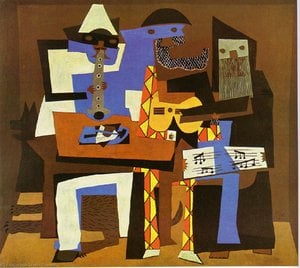 Three Musicians - Pablo Picasso
To encounter Picasso’s Three Musicians is to stand before a distillation of artistic innovation, a work that redefined the possibilities of representation.
Painted in 1921, this masterpiece embodies the height of Synthetic Cubism. Departing from the fragmented analysis of earlier works, Picasso embraced bolder colors and flatter planes, constructing an image both intellectually stimulating and visually captivating. The composition—depicting Harlequin, Pierrot, and a monk engaged in a silent performance—is not merely a depiction but a re-imagining of form itself.
Picasso masterfully deconstructs and reassembles his subjects, creating a dynamic interplay between positive and negative space. The flattened perspective rejects traditional realism, offering multiple viewpoints simultaneously. While appearing collage-like, this effect is achieved entirely through paint—layers of oil skillfully blended to create smooth surfaces and subtle tonal variations within defined geometric shapes.
Drawing inspiration from the Italian *Commedia dell'arte*, the figures evoke a sense of wit and pathos. Today, Three Musicians resonates with modern interiors seeking a sophisticated balance between boldness and restraint—a testament to Picasso’s enduring legacy. Its vibrant color palette and geometric forms inspire a refined aesthetic, reminding us that true artistry lies in the power of abstraction and the timeless beauty of reimagined reality, securing its place among the Top 10 Masterpieces Defining the '07-Modern' art period.
The Young Ladies of Avignon - Pablo Picasso
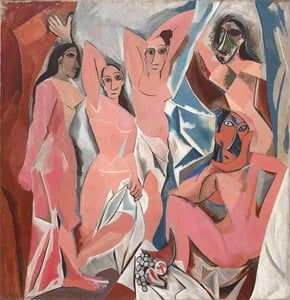 The Young Ladies of Avignon - Pablo Picasso
To gaze upon Picasso’s Les Demoiselles d’Avignon is to witness a seismic shift—the moment modern art truly began.
Painted in 1907, this monumental work isn't simply a depiction of five female figures; it’s the detonation point for Cubism and a radical break with centuries of artistic tradition. Picasso deliberately rejected conventional beauty, presenting fragmented, angular forms that confront and challenge the viewer.
The influence of African tribal masks and Iberian sculpture is strikingly evident, reflecting a fascination with ‘primitive’ art and a desire to move beyond Western conventions. This rejection of traditional perspective creates a flattened space—dynamic yet unsettling—that would redefine visual expression for generations.
Today, Les Demoiselles d’Avignon continues to inspire a bold aesthetic in modern interiors—a celebration of geometric forms, unexpected color palettes, and the power of abstraction. Its fragmented energy resonates with contemporary design sensibilities, reminding us that true artistry lies in challenging expectations and embracing the beauty of imperfection. This masterpiece secures its place among the Top 10 Masterpieces Defining the '07-Modern' art period as a testament to Picasso’s revolutionary vision.
The kiss - Gustav Klimt
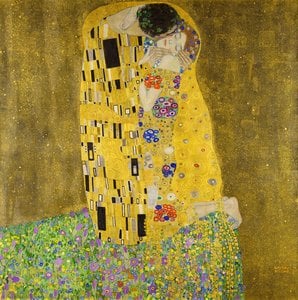 The kiss - Gustav Klimt
To encounter Klimt’s The Kiss is to be enveloped in a golden dream—a yearning for connection and transcendence rendered with breathtaking beauty.
Created during his “Golden Phase,” this masterpiece embodies the Art Nouveau movement and stands as a pinnacle of the Austrian Secession. Rejecting academic traditions, Klimt sought to create a ‘total work of art,’ blurring the lines between painting, architecture, and design—a vision vividly realized in The Kiss through its decorative richness and harmonious composition.
Klimt’s innovative technique is central to its impact. The extensive use of gold leaf – inspired by Byzantine mosaics – elevates the scene to an almost sacred realm. This opulent surface interacts beautifully with vibrant hues within the patterned robes, symbolizing masculinity and femininity. The enclosed space emphasizes intimacy and protection, creating a world apart from reality.
The enduring appeal of The Kiss lies in its ability to evoke powerful emotions—tenderness, passion, and blissful unity. At WahooArt, we are proud to offer hand-painted reproductions that preserve the emotion and texture of this iconic work, allowing you to experience its beauty within your own space. It’s a celebration of love, securing its place among the Top 10 Masterpieces Defining the '07-Modern' art period.
The Disintegration of Persistence of Memory, 1952-54 - Salvador Dalí
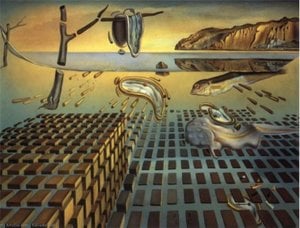 The Disintegration of Persistence of Memory, 1952-54 - Salvador Dalí
A silence hangs over Dalí’s The Disintegration of Persistence of Memory —a haunting meditation on time, decay, and the fragile nature of reality.
Created between 1952 and 1954, this work isn't merely a reimagining of his earlier masterpiece; it’s a deconstruction—a visual exploration of existence itself. Rooted in Surrealism, Dalí blends meticulous realism with illogical imagery, unlocking the subconscious mind through dreamlike precision.
Dalí’s masterful technique is on full display here, boasting incredibly detailed rendering and a strong diagonal composition that emphasizes disorientation. The recurring motif of melting clocks symbolizes time's relativity—its subjective nature and ultimate impermanence. Decaying fish and crawling ants reinforce themes of mortality and subconscious desires.
The predominantly earthy color palette contributes to the painting’s melancholic mood, while the pale blue offers a subtle contrast. At WahooArt, we are proud to offer hand-painted reproductions that preserve this emotional landscape—allowing you to experience its beauty within your own space. The Disintegration of Persistence of Memory secures its place among the Top 10 Masterpieces Defining the '07-Modern' art period as a testament to Dalí’s enduring vision.
Water Lilies - Claude Monet
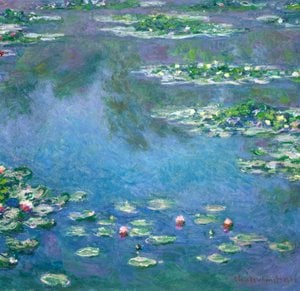 Water Lilies - Claude Monet
To gaze upon Monet’s Water Lilies is to enter a world bathed in light—a sanctuary of tranquility and fleeting beauty.
Painted during a pivotal period in his career, this work exemplifies Impressionism at its finest. Rejecting traditional constraints, Monet employed loose brushstrokes and a vibrant palette to capture the *feeling* of being present within his beloved Giverny garden—a sanctuary he transformed into an immersive experience.
The composition focuses on the densely populated surface of a water lily pond, dominated by an interplay of light and reflection. Delicate pink and white blossoms float amidst varying shades of green, creating a vibrant and textured surface that shimmers with life. Monet’s masterful use of color—from deep emeralds to pale sages—evokes a sense of calm and harmony.
Today, Water Lilies continues to inspire a sense of serenity in modern interiors—a reminder of the beauty found within nature's fleeting moments. At WahooArt, we are proud to offer hand-painted reproductions that preserve this emotional resonance, allowing you to experience its timeless elegance within your own space. It’s a masterpiece securing its place among the Top 10 Masterpieces Defining the '07-Modern' art period.
Number 1, 1949 - Paul Jackson Pollock
 Number 1, 1949 - Paul Jackson Pollock
Imagine standing before a canvas teeming with energy—a visual echo of raw emotion and unfiltered impulse. This is the experience of Jackson Pollock’s Number 1, 1949 .
Created in 1950, this work embodies the revolutionary spirit of Abstract Expressionism. Rejecting traditional easel painting, Pollock laid his canvas on the floor and unleashed a torrent of paint—a radical shift that prioritized the act of creation itself. The swirling network of lines and splatters isn’t about depicting something; it’s about expressing pure emotion directly onto the surface.
Layers of interwoven lines – varying in thickness, density, and direction – create an all-over composition that draws the eye across the entire canvas. Subtle hints of reddish-pink tones offer delicate contrast within a predominantly muted palette. The absence of a focal point encourages prolonged contemplation, inviting viewers to lose themselves in the intricate details.
Today, Number 1, 1949 continues to inspire a sense of boundless energy and freedom—a reminder that true artistry lies in authentic expression. At WahooArt, we are proud to offer hand-painted reproductions that preserve this emotional resonance, allowing you to experience its timeless elegance within your own space. It’s a masterpiece securing its place among the Top 10 Masterpieces Defining the '07-Modern' art period.
Frida Kahlo - `The Two Fridas` - Frida Kahlo
 Frida Kahlo - `The Two Fridas` - Frida Kahlo
Imagine a heart laid bare—a raw confession rendered with unflinching honesty and breathtaking vulnerability. This is the essence of Frida Kahlo’s The Two Fridas .
Completed in 1939, this double self-portrait isn't merely a depiction of physical likeness; it’s an exploration of identity, pain, and resilience following her divorce from Diego Rivera. The two figures—one adorned in traditional Tehuana attire, the other in European dress—represent the fracturing within Kahlo herself.
Kahlo’s style is a captivating blend of Surrealism, Mexican folk art traditions, and unflinching realism. Executed in oil on canvas, the painting showcases meticulous brushwork and precise detail. The clasped hands connected by visible arteries symbolize their shared life force but also vulnerability. A surgical clamp held by the “rejected” Frida alludes to heartbreak, while blood droplets signify loss.
The Two Fridas transcends a simple painting; it’s an intensely personal confession laid bare. It speaks to universal themes of identity crisis and the search for wholeness. At WahooArt, we are proud to offer hand-painted reproductions that preserve this emotional resonance, allowing you to experience its timeless elegance within your own space—a reminder of the enduring strength found within vulnerability. This masterpiece secures its place among the Top 10 Masterpieces Defining the '07-Modern' art period.
Time transfixed - René Magritte
 Time transfixed - René Magritte
Imagine a quiet room—a sense of refined tranquility disturbed by an impossible intrusion. This is the feeling evoked by René Magritte’s Time Transfixed .
Completed in 1938, this masterpiece presents a profoundly unsettling yet captivating juxtaposition – a powerful steam locomotive seemingly bursting forth from the confines of a classically styled fireplace. It isn't merely an image; it’s a visual paradox that challenges our perception of reality and domestic tranquility.
Magritte’s masterful oil-on-canvas technique is evident in the smooth blending of tones and subtle gradations that create a convincing illusion of depth. The composition is strikingly symmetrical, anchored by the central fireplace mantelpiece. This formality is deliberately undermined by the forceful intrusion of the train, creating dynamic tension.
Time Transfixed transcends a simple painting; it’s an exploration of progress, disruption, and the subconscious. At WahooArt, we are proud to offer hand-painted reproductions that preserve this emotional resonance, allowing you to experience its timeless elegance within your own space—a reminder of the power of art to provoke thought and challenge conventional perspectives. This masterpiece secures its place among the Top 10 Masterpieces Defining the '07-Modern' art period.
Composition VIII - Wassily Kandinsky
 Composition VIII - Wassily Kandinsky
Imagine a vibrant symphony unfolding before your eyes—a visual exploration of inner necessity and spiritual resonance. This is the experience of Wassily Kandinsky’s Composition VIII .
Created in 1923, this large-scale canvas isn’t merely a painting; it's an energetic dynamism that continues to captivate viewers nearly a century after its creation. Having pioneered abstract art alongside artists like Piet Mondrian, Kandinsky moved away from representational imagery entirely, believing that pure form and color could evoke emotions directly.
The canvas pulsates with a complex interplay of geometric shapes: circles, triangles, squares, and lines dance across a pale background. These aren’t rigid forms; they appear to float and interact, creating a sense of movement and depth despite the absence of traditional perspective. Kandinsky masterfully employs contrasting colors – fiery reds and yellows juxtaposed against cool blues and greens – enhancing the painting's visual energy.
Composition VIII transcends a simple artwork; it’s an exploration of spiritual themes—a search for underlying order within apparent chaos. At WahooArt, we are proud to offer hand-painted reproductions that preserve this emotional resonance, allowing you to experience its timeless elegance within your own space—a reminder of the power of art to inspire calm and reflection. This masterpiece secures its place among the Top 10 Masterpieces Defining the '07-Modern' art period.
Conclusion
As the light fades, casting long shadows across the gallery walls, we find ourselves lingering—not merely having *seen* these masterpieces, but having been touched by them.
The canvases of Pollock, Kahlo, Magritte, and Kandinsky are not frozen moments in history; they are living forces that continue to whisper beauty, emotion, and meaning into modern life. They remind us that art is not simply about what we see, but how it makes us *feel*—the raw energy of expression, the quiet contemplation of identity, the unsettling thrill of the unexpected.
These ten works represent a pivotal shift in artistic consciousness, a bold rejection of convention and an embrace of inner truth. They invite us to question our perceptions, explore our emotions, and connect with something deeper within ourselves—a shared human experience that transcends time and culture.
At WahooArt, we believe that art should be accessible to all. We are honored to offer hand-painted reproductions of these iconic works, allowing you to bring their timeless elegance into your own space. Explore our full collection and discover the masterpiece that speaks to *your* soul—a reminder that beauty, emotion, and inspiration are always within reach.








