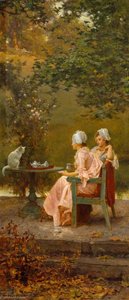
Marcus Stone, 1840 – 1921

61 garsiausių Marcus Stone paveikių

Veržė Marcus Stone šlovę tapyba The Painter's First Work (1862); ji eksponuojama Fine Arts Museums of San Francisco, San Francisco. A Pleasant Spot on the Thames (1863) ir The Lost Bird (1883) seka juos kolekcionerių bei muziejų lankytojų širdyse. Iš 62 Marcus Stone kūrinių mūsų kataloge, šios 61 yra labiausiai gerbiamos – kiekvienas jų pateikiamas su datos, muziejaus ir išskirtinės ypatybės aprašymu.

Rangos vieta nulegiama pagal mūsų populiarumumo balas, kurį sudaro kiekvieno kūrinio paieškos, apsilankėjimai ir užsakėjimai. Atnaujinta lapkritis 2026. Kiekvieną šio puslapio šedevrą galite užsisakyti kaip muziejoriaus kokybės rankų darbo alievinę reprodukciją arba aukščiausios kokybės meninį spausdiną jūsų pasirinktu dydžiu.

Marcus Stone portretas
Marcus Stone · 1840 – 1921
Gedė · mirė
1840 – 1921, London
Judėjimas
Victorian genre painting
Darbai mūsų kataloge
62
Labiausiai žinomi
The Painter's First Work (1862)
Daugiausia darbų yra
Guildhall Art Gallery

Marcus Stone: dešimties šedevrai

The Painter's First Work (1862) aut. Marcus Stone
1

The Painter's First Work

1862 · Oil On Canvas · Fine Arts Museums of San Francisco, San Francisco

In this oil on canvas, Marcus Stone presents a scene that captures a moment of intense domestic interaction. Painted about 1862, The Painter's First Work offers a glimpse into the artist's early engagement with narrative storytelling. The work depicts a group of four figures within a detailed interior, where a man in a red frock coat gestures toward an older man, while a young boy and a maid observe the…

Ranku tapytos aliejaus reprodukcija nuo $256 37 × 27 cm
A Pleasant Spot on the Thames (1863) aut. Marcus Stone
2

A Pleasant Spot on the Thames

1863 · Oil On Canvas · Wolverhampton Art Gallery, Wolverhampton

The oil painting titled A Pleasant Spot on the Thames was executed by the artist Marcus Stone. This work dates to 1863. The piece is a representation of a specific outdoor scene, rendered through visible brushwork on a canvas measuring 38 x 61 cm.

Ranku tapytos aliejaus reprodukcija nuo $231 40 × 25 cm Pusė kaip originalo $272 61 × 38 cm Užsakyti originalaus dydžio →
The Lost Bird (1883) aut. Marcus Stone
3

The Lost Bird

1883 · Oil On Canvas

A young girl stands amidst an autumnal forest, her presence defined by a quiet, heavy sadness. She holds an empty birdcage, a detail that anchors the composition and directs the viewer toward her somber expression. The setting is composed of blurred foliage in warm, muted tones of yellow, brown, and orange, creating a soft depth that isolates the figure. A subtle touch of red appears in her sash and the…

Ranku tapytos aliejaus reprodukcija nuo $181 23 × 44 cm Pusė kaip originalo $335 56 × 108 cm Užsakyti originalaus dydžio →
Il y en a toujours un autre (1882) aut. Marcus Stone
4

Il y en a toujours un autre

1882 · Oil On Canvas

There is a certain stillness that settles over a scene when the light begins to soften, much like the atmosphere captured in this 1882 work. We find ourselves in a secluded garden, where the air feels heavy with the scent of damp earth and late afternoon shadows. Two figures sit together on a bench, their presence marked by a gentle, understated intimacy. A man in a red jacket and a…

Ranku tapytos aliejaus reprodukcija nuo $206 21 × 48 cm Pusė kaip originalo $507 71 × 154 cm Užsakyti originalaus dydžio →
Her First love Letter (1889) aut. Marcus Stone
5

Her First love Letter

1889 · Oil · Auckland Art Gallery Toi o Tāmaki, Aucklandas

In this 1889 oil painting, we find ourselves drawn into a secluded garden, a space where the rush of the outside world seems to have been filtered out by the dense canopy of trees. Two young women are seated at a central red table, their arrangement forming a gentle triangle that guides the eye through a narrative of shared secrets. One woman is absorbed in the contents of a letter,…

Ranku tapytos aliejaus reprodukcija nuo $206 41 × 25 cm Pusė kaip originalo $734 168 × 110 cm Užsakyti originalaus dydžio →
Good Friends (1887) aut. Marcus Stone
6

Good Friends

1887 · Oil On Canvas

In this 1887 oil on canvas, we find ourselves invited into a private, shaded sanctuary. Two women sit together at a table, sheltered by a lush canopy of trees that seems to enclose them in a soft, green embrace. There is a stillness here, a pause in the rush of life. A white cat rests nearby, adding to the sense of domestic peace. The composition draws the eye upward through…

Ranku tapytos aliejaus reprodukcija nuo $206 21 × 48 cm Pusė kaip originalo $211 23 × 51 cm Užsakyti originalaus dydžio →
Claudio, Deceived by Don John, Accuses Hero (1861) aut. Marcus Stone
10

Claudio, Deceived by Don John, Accuses Hero

1861 · Oil · Guildhall Art Gallery, London

The scene unfolds within a crowded, historical setting where a group of figures in medieval attire is gathered in a moment of high tension. At the center of the composition, a woman stands as the focal point, her presence surrounded by several men. One man extends a finger toward her in a gesture of accusation, while another man holds a dagger, the metal catching the light. The figures are arranged…

Ranku tapytos aliejaus reprodukcija nuo $181 36 × 27 cm Pusė kaip originalo $184 38 × 29 cm Užsakyti originalaus dydžio →

Daugiau šedevrų: Marcus Stone, nuo 11 iki 61

In Love (1888) aut. Marcus Stone
#12

In Love

1888 · Nottingham Castle Museum And Art Gallery

In the quiet corners of the late Victorian era, few artists could capture the delicate nuances of human connection as masterfully as Marcus C. Stone. His 1888 masterpiece,…

Atneškite į savo namus nuo $181 →
Laukianti (1921) aut. Marcus Stone
#34

Laukianti

1921 · Walker Art Gallery

Štai „Laukianti“ – Marcus Stone Aukštųjų Karalių Akademijos Čiūnių Šildymo Šaltinio Dekoratyvinė Vaizdų Kolekcija Marcus Stone RA (1840-1921) išsiskiria kaip svarbus Viktoro laikotarpio dailininkas, kuriuos pagrindinė įsiminti reikšmė…

Užsisakyti reprodukciją nuo $181 →

Marcus Stone tapų skirstymas pagal laikotarpius

Daugiausiai temų, kurių vaizdė Marcus Stone

Keturi populiariausi temų motyvai tarp šių šedevrų, su geriausiais kiekvieno pavyzdžiais.

Kur galima pamatyti Marcus Stone paveikslus

7 muziejai, kuriuose saugoma daugiausia šioje pusėje esamų paveikslų.

Muzejaus Miestas Marcus Stone darbai Šiojo sąrašo paveikslai
Guildhall Art Gallery, LondonGuildhall Art Gallery London 3 Claudio, Deceived by Don John, Accuses Hero, On the Road from Waterloo to Paris, Married for Love
Walker Art Gallery, LiverpulisWalker Art Gallery Liverpulis 2 My Lady Is a Widow and Childless, Laukianti
Fine Arts Museums of San Francisco, San FranciscoFine Arts Museums of San Francisco San Francisco 1 The Painter's First Work
Wolverhampton Art Gallery, WolverhamptonWolverhampton Art Gallery Wolverhampton 1 A Pleasant Spot on the Thames
Auckland Art Gallery Toi o Tāmaki, AucklandasAuckland Art Gallery Toi o Tāmaki Aucklandas 1 Her First love Letter
Nottingham Castle Museum And Art Gallery, NotinghamasNottingham Castle Museum And Art Gallery Notinghamas 1 In Love
Salford Museum - Art Gallery, Greater ManchesterSalford Museum - Art Gallery Greater Manchester 1 The Lake of Brienz

Marcus Stone, dešimtmetė po dešimtmetės: pagrindinis kiekvieno laikotarpio kūrinys

  1. 1850s
  2. 1860s
    The Painter's First Work (1862) aut. Marcus Stone
    Vieta 1 iš 61

    The Painter's First Work

    Amžius 20 – 29 · Fine Arts Museums of San Francisco

    In this oil on canvas, Marcus Stone presents a scene that captures a moment of intense domestic interaction. Painted about 1862, The Painter's First Work offers a glimpse…

  3. 1870s
  4. 1880s
    The Lost Bird (1883) aut. Marcus Stone
    #3 iš 61

    The Lost Bird

    Amžius 40 – 49

    A young girl stands amidst an autumnal forest, her presence defined by a quiet, heavy sadness. She holds an empty birdcage, a detail that anchors the composition and…

  5. 1890s
  6. 1910s
    Reverie (1917) aut. Marcus Stone
    #8 iš 61

    Reverie

    Amžius 70 – 79
  7. 1920s
    Laukianti (1921) aut. Marcus Stone
    #34 iš 61

    Laukianti

    Amžius 80 – 81 · Walker Art Gallery

    Štai „Laukianti“ – Marcus Stone Aukštųjų Karalių Akademijos Čiūnių Šildymo Šaltinio Dekoratyvinė Vaizdų Kolekcija Marcus Stone RA (1840-1921) išsiskiria kaip svarbus Viktoro laikotarpio dailininkas, kuriuos pagrindinė įsiminti reikšmė…

Marcus Stone šedevrai: klausimai ir atsakymai

Kuriu paveiksluku Marcus Stone yra labiausiai žinomas?Rodyti atsakymą

The Painter's First Work (1862), Fine Arts Museums of San Francisco, San Francisco. Toliau yra A Pleasant Spot on the Thames (1863) ir The Lost Bird (1883).

Kiek metų buvo Marcus Stone, kai tapė šį kūrinį The Painter's First Work?Rodyti atsakymą

22 metų amžiaus: The Painter's First Work sukurta 1862 m. ir Marcus Stone gimė 1840.

Kokie yra 10 didžiausių paveikslavų Marcus Stone?Rodyti atsakymą

The Painter's First Work, A Pleasant Spot on the Thames, The Lost Bird, Il y en a toujours un autre, Her First love Letter, Good Friends, Welcome Footsteps, Reverie, The royal nursey ir Claudio, Deceived by Don John, Accuses Hero. Viršuje esančioje reitingo lentelėje nurodyta kiekvieno kūrinio metis ir muziejus.

Kiek darbų namdė Marcus Stone?Rodyti atsakymą

Mūsų kataloge yra 62 Marcus Stone darbų, datuojamų nuo 1858 iki 1921.

In kuriuose muzeumuose galėčiau pamatyti Marcus Stone šedevralius?Rodyti atsakymą

Dauguma jų yra Guildhall Art Gallery (London), Walker Art Gallery (Liverpulis) ir Fine Arts Museums of San Francisco (San Francisco). Viršuje esančiame lange muziejai išvardyti po vieni.

Kada Marcus Stone nupiešė šiuos šedevrus?Rodyti atsakymą

1880s laikotarpyje: 9 iš 61 šioje pusėje esančių darbų sukurtos tada, iš jų – The Lost Bird.

Kokie yra pirmasis ir paskutinis garsieji Marcus Stone paveikslai?Rodyti atsakymą

Pirmasis šioje pusėje yra Silent Pleading (1858), paskutinis – Laukianti (1921).

Kokie buvo Marcus Stone mėgstamiausi temų objektai?Rodyti atsakymą

Woman (6), Love (5) ir Man (3), iš 61 šioje pusėje esančių darbų.

Kurią techniką Marcus Stone mėgavosi?Rodyti atsakymą

Oil On Canvas: 6 iš 61 šioje pusėje esančių darbų.

Kokio meno kierlioje priklauso Marcus Stone?Rodyti atsakymą

Victorian genre painting, kaip rodo šio puslapio paveikslai.

Kuriuose Guildhall Art Gallery eksponuojami Marcus Stone šedevrai?Rodyti atsakymą

Claudio, Deceived by Don John, Accuses Hero, On the Road from Waterloo to Paris ir Married for Love yra vieni iš 3 šioje puslapyje esamų darbų, kuriuos saugo Guildhall Art Gallery, London.

Ar galiu įsigyti Marcus Stone šedevro reprodukciją?Rodyti atsakymą

Taip. Kiekvieną šioje pusėje esantį paveikslą galite užsakyti kaip muziejoriaus kokybės rankų darbų alievinę kopiją arba aukščiausios kokybės spausdinį pasirinktu jūsų pageidaujamu dydžiu tiesiai iš paties paveikslą puslapio.

Marcus Stone gyvenimas

A Legacy of Victorian Sentiment: The Life and Art of Marcus Stone

In the heart of the Victorian era, a period defined by its intricate social codes and deep-seated emotional narratives, Marcus Clayton Stone emerged as a master of the human spirit. Born in London in 1840, Stone was destined for a life immersed in the aesthetics of his time. As the son of the accomplished painter Frank Stone ARA, his artistic education began within the very walls of his childhood home. Under his father’s meticulous tutelage, he developed a foundational command of technique that allowed him to debut at the Royal Academy before he had even reached eighteen years of age. This early precocity set the stage for a career marked by both technical brilliance and an uncanny ability to capture the fleeting nuances of Victorian sentiment.

Stone’s artistic evolution is a fascinating study in the transition from historical grandeur to intimate, delicate storytelling. In his formative years, he sought to document significant historical incidents with a rigorous attention to detail, reflecting the era's fascination with monumental events and classical narratives. However, as his mastery grew, so too did his interest in the quiet, often overlooked moments of daily life. He moved away from the sweeping drama of history toward what critics often described as a dainty sentiment—a style characterized by charm, refinement, and an exquisite execution of light and color. This shift allowed him to explore themes of romantic longing, familial affection, and peaceful contemplation, making his work deeply resonant with the sensibilities of the late 19th-century public.

Literary Symbiosis and Illustrative Mastery

One cannot discuss the significance of Marcus Stone without acknowledging his profound connection to the literary giants of his age. His talent for visual storytelling found a perfect partner in the prose of Charles Dickens and Anthony Trollope. Through his celebrated illustrations, Stone did more than merely decorate pages; he breathed visual life into the characters and atmospheres of these iconic narratives. His ability to translate complex literary themes into evocative imagery helped cement his reputation as one of the premier illustrators of his generation. This symbiotic relationship between word and image allowed him to reach a vast audience, bridging the gap between fine art galleries and the widely circulated periodicals of the day.

Beyond his illustrations, Stone’s oil paintings stand as enduring monuments to Victorian romanticism. His works often feature:

  • Intimate Genre Scenes: Capturing quiet moments of connection, such as in In Love (1888), where the soft interplay of light and shadow enhances a sense of private affection.
  • Pastoral Beauty: Utilizing muted tones and idyllic settings to evoke a sense of timelessness, seen clearly in works like Honeymoon.
  • Atmospheric Landscapes: Demonstrating an almost Impressionistic sensitivity to nature, as evidenced in A Pleasant Spot on the Thames (1863).

Recognition and Historical Significance

The trajectory of Stone’s career was marked by consistent institutional recognition. His election as an Associate of the Royal Academy in 1877, followed by his ascent to full Academician in 1887, solidified his status within the highest echelons of the British art establishment. His influence extended far beyond the borders of England; his works were frequently engraved, allowing his imagery to circulate globally, and he was honored with medals from exhibitions across the world. Living in the prestigious Melbury Road alongside fellow painter Luke Fildes, Stone was part of a vibrant artistic community that shaped the visual identity of late Victorian London.

Today, the works of Marcus Stone serve as a poignant window into a vanished era. Whether through the profound symbolism found in his monochrome engravings or the luminous detail of his oil canvases, his art continues to invite viewers into a world of refined emotion and technical perfection. His legacy remains etched in the annals of art history, not merely as a chronicler of his time, but as an artist who possessed the rare gift of making the ephemeral moments of human connection feel eternal.