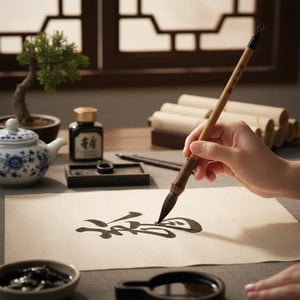
A Brushstroke Across Eras: The Enigmatic World of Zhao Yuan
Zhao Yuan, a name whispered among connoisseurs of Chinese painting, remains an elusive figure despite the enduring beauty of his landscapes. Born in Yingcheng (modern-day Yingxian County, Shandong Province) sometime during the late Yuan dynasty (1368-1407), he lived through a period of immense upheaval and transition – the fall of the Mongol-led Yuan and the establishment of the Ming. Little is definitively known about his life; dates of birth and death are lost to time, adding an air of mystique to his artistic legacy. He was known by the courtesy name Shanzhang (善长) and adopted the sobriquet Danlin (丹林), names that offer glimpses into a personality perhaps valuing skill and a cultivated spirit. His life unfolded primarily in Suzhou, a burgeoning center for art and culture, where he found himself amidst a vibrant community of scholars and painters grappling with new aesthetic ideals. This context profoundly shaped his artistic development, positioning him as a crucial link between the traditions of the Yuan masters and the evolving styles of the early Ming.Echoes of Tradition: Influences and Artistic Development
Zhao Yuan’s art is deeply rooted in the literati painting tradition, but it wasn't born in isolation. He stands as a compelling example of an artist synthesizing diverse influences into a uniquely personal style. His most significant debt is undoubtedly to Wang Meng (1308-1383), one of the last great masters of the Yuan dynasty. Like Wang Meng, Zhao Yuan embraced a dense, complex compositional structure characterized by layered mountains, gnarled trees, and meticulously rendered details. However, while Wang Meng often imbued his landscapes with a sense of dramatic power and spiritual intensity, Zhao Yuan’s work tends towards a more refined elegance and lyrical quality. Qingchuan Songbie (Farewell at Qingchuan) exemplifies this – the scene is not overwhelming but invites quiet contemplation. Beyond Wang Meng, echoes of earlier masters like Fan Kuan (c. 937-1020), renowned for his monumental landscapes and powerful brushwork, can also be detected in Zhao Yuan’s treatment of rock formations and atmospheric effects. He also drew inspiration from Yan Wengui (active late 14th century) whose influence is visible in the delicate rendering of architectural elements within his paintings. This careful blending of styles demonstrates a sophisticated understanding of art history and a deliberate effort to forge his own path.The Landscapes of Contemplation: Major Works and Techniques
Although Zhao Yuan’s surviving oeuvre is relatively small, it showcases a remarkable consistency in style and quality. His most celebrated works include Qingchuan Songbie (Farewell at Qingchuan) and Hexi Caotang (Grassland Cottage at Hexi). These paintings are not merely depictions of scenery; they are imbued with poetic meaning, reflecting the literati ideal of expressing inner feelings through nature. Qingchuan Songbie, for instance, depicts a farewell scene by a riverbank, rendered with exquisite detail and subtle emotional nuance. The composition is carefully balanced, drawing the viewer’s eye through layers of mountains, trees, and figures. Zhao Yuan's technique is characterized by precise brushwork, delicate washes, and a masterful use of ink tonality. He employed a variety of brushstrokes – dry strokes for texture, wet strokes for atmosphere, and fine lines for detail – to create a sense of depth and realism. His color palette is typically restrained, favoring muted tones that enhance the overall mood of tranquility and contemplation. The meticulous attention to detail in his architectural renderings—pavilions, bridges, and dwellings—reveals a keen observational skill and an appreciation for the beauty of human craftsmanship integrated within the natural world.Historical Significance: A Bridge Between Dynasties
Zhao Yuan’s significance lies not so much in groundbreaking innovation but rather in his ability to synthesize and refine existing traditions during a pivotal moment in Chinese art history. He served as a crucial bridge between the expressive, often dramatic styles of the late Yuan masters like Wang Meng and the more restrained, elegant aesthetics that characterized the early Ming dynasty. As the Yuan collapsed, many artists sought new ways to express their feelings about the changing political landscape. Zhao Yuan’s paintings, while not overtly political, reflect a sense of quiet resilience and a longing for harmony in a turbulent world. He embodies the literati ideal of finding solace and meaning in nature, even amidst chaos. His work helped pave the way for later Ming artists who would further develop the tradition of landscape painting, emphasizing individual expression and poetic sensibility. While his personal life remains shrouded in mystery, Zhao Yuan’s artistic legacy continues to inspire awe and admiration, reminding us of the enduring power of art to transcend time and circumstance.Q&A
Zhao Yuan 작가의 작품을 감상할 수 있는 3D 갤러리는 어디인가요?
가상 방문이 가능합니다: Zhao Yuan의 3D 갤러리 페이지에서 3D 갤러리를 통해 작가의 작품들을 만나보실 수 있습니다.
Zhao Yuan의 다른 이름이나 별칭에는 무엇이 있나요?
Zhao Yuan은(는) Zhao Yuan (Painter), Shanzhang Zhao Yuan, Danlin Zhao Yuan, Zhao Yuan Of Yingcheng, 善长赵元라는 이름으로도 활동하고 있습니다.
특정 색상 팔레트의 Zhao Yuan 작품은 어디에서 찾아볼 수 있나요?
특정 색상 팔레트의 Zhao Yuan 작품을 찾으시려면, 작가의 컬러 팔레트별로 보기 페이지를 이용해 보세요.