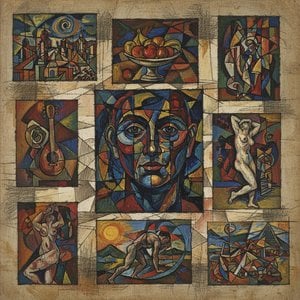
Yvonne Thomas: A Pioneer of Abstract Expressionism
Born in the vibrant coastal city of Nice, France, in 1913, Yvonne Thomas’s artistic journey was one shaped by both European heritage and a profound embrace of American innovation. Initially immigrating to the United States with her family in 1925, she quickly established herself as a significant figure within the burgeoning Abstract Expressionist movement, though often operating outside the traditionally recognized narratives of that era. Her life’s work—a captivating blend of Cubist influences and deeply personal abstraction—offers a compelling glimpse into a woman navigating the complexities of artistic expression in a male-dominated field.
Thomas' early training laid a crucial foundation for her distinctive style. She began her formal studies at Cooper Union in New York City, absorbing the principles of classical art while simultaneously encountering the avant-garde currents circulating within the city’s art scene. This period was followed by intensive study at the Art Students League, where she honed her technical skills under the tutelage of esteemed instructors like Vaclav Vytlacil and Dmitri Romanovsky. A pivotal experience occurred during her time at the Ozenfant School of Fine Art, where she studied directly with Amandé Ozenfant, a key figure in the Purist movement—a lineage that profoundly influenced her early explorations of geometric abstraction.
However, it was her involvement with the Subject of the Artist school in 1948 that truly catalyzed her artistic evolution. This experimental environment, led by Robert Motherwell, Mark Rothko, William Baziotes, and David Hare, provided a unique space for artists to collaborate and develop their individual voices. Thomas’s time at this influential gathering exposed her to groundbreaking techniques and philosophies, fostering a willingness to break from traditional representational approaches. Notably, she found herself in the exclusive company of luminaries such as Willem de Kooning, Arshile Gorky, Adolph Gottlieb, Hans Hofmann, Lee Krasner, Robert Motherwell, Barnett Newman, Jackson Pollock, Richard Pousette-Dart, and Mark Rothko – a constellation of artistic giants who shaped the course of 20th-century art. This exposure to such diverse perspectives undoubtedly broadened her creative horizons.
The Ninth Street Exhibition and Early Recognition
In 1951, Yvonne Thomas’s work gained significant recognition through inclusion in the prestigious *Ninth Street Exhibition of Paintings and Sculpture*, a landmark event that showcased the emerging talents of New York's avant-garde. This exhibition, known for its commitment to supporting women artists, marked a turning point in Thomas’s career, establishing her as a serious contender within the contemporary art world. Remarkably, she was one of only a handful of female artists selected to participate in all five iterations of the *Ninth Street* shows—a testament to the enduring value and visibility of her work.
Following this pivotal moment, Thomas continued to refine her artistic practice, exhibiting regularly at galleries like Hendler Gallery (in 1954), Tanager Gallery (in 1956), and Esther Stuttman Gallery (in 1960). Critics consistently praised her distinctive approach, noting her deliberate use of form and color. Sam Feinstein, for example, described her paintings as “soft, curvilinear brushings harmonized into a pictorial lyricism,” while Howard Devree recognized her “personal color harmonies.” These accolades underscored the growing appreciation for Thomas’s unique vision.
A Legacy in Collections and Beyond
Yvonne Thomas's artistic legacy extends beyond individual exhibitions. Her work is now held within prestigious institutions, including the National Gallery of Art (Washington D.C.), the Riverside Museum (New York City), and the Seattle Art Museum, ensuring that her contributions to modern art will continue to be appreciated for generations to come. Furthermore, her papers are archived at the Archives of American Art, providing invaluable insights into her creative process and artistic development.
Beyond her institutional holdings, Thomas’s influence can also be seen in the work of other artists who were part of her circle during the 1940s and 50s. Her participation in the Subject of the Artist school, alongside figures like Robert Motherwell and Mark Rothko, demonstrates a shared commitment to exploring abstract forms and emotional expression. Her inclusion in the 2016 exhibition *Women of Abstract Expressionism* further cemented her place within this historically significant movement, acknowledging her vital role in shaping its trajectory.
Even more recently, in 2023, Thomas’s work was featured in “Action, Gesture, Paint: Women Artists and Global Abstraction 1940-1970” at the Whitechapel Gallery in London, highlighting her contributions to a broader international context. Yvonne Thomas passed away in Aspen, Colorado, in 2009, leaving behind a rich and enduring body of work that continues to inspire and challenge viewers today.
Q&A
Yvonne Thomas 작가의 작품을 감상할 수 있는 3D 갤러리는 어디인가요?
Yvonne Thomas의 3D 갤러리는 작가의 작품들을 가상 3D 갤러리로 감상할 수 있는 페이지입니다.
Yvonne Thomas의 작품을 색상별로 모아둔 곳은 어디인가요?
Yvonne Thomas의 컬러 인덱스에서는 작가의 작품들을 색상별로 모아 보실 수 있습니다.
Yvonne Thomas은(는) 어느 시대의 작품을 남겼나요?
Yvonne Thomas은(는) Modern 시대에 활동했습니다. 이 시기는 역사적 맥락 속에서 작가의 예술적 위치를 보여줍니다.
Yvonne Thomas의 다른 이름이나 별칭에는 무엇이 있나요?
Yvonne Thomas은(는) Yvonne Navello, إيفون توماس, Ивонн Томас라는 이름으로도 활동하고 있습니다.