A Life of Ink and Antiquity
Born in 1811, Wu Yun lived a life shaped by the quiet study of the past and the heavy responsibilities of official service. Though he was known to many as an official, his heart often resided in the textures of ancient stone and bronze. Growing up in Guian, Zhejiang, or perhaps She County, Anhui, he developed an early fascination with history. As a young boy, while reading accounts of the Han dynasty, he found himself struck by the details of ritual vessels, showing a depth of curiosity that would define his later years.
His path was not always smooth. For many years, he faced the frustrations of the imperial examination system, only achieving the degree of xiucai at the age of thirty-two. This period of waiting allowed him to turn toward other disciplines. He studied under the painter Zhu Ang, learning the fundamental laws of painting, and became a dedicated collector of seals, rubbings, and books. His interests were broad, ranging from the study of bronze vessels to the intricate mechanics of Han dynasty crossbows.
The Hand of the Scholar
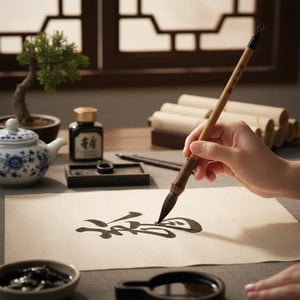
Wu Yun’s artistic practice was deeply connected to his identity as a calligrapher and seal engraver. He did not separate the act of writing from the act of painting; instead, he allowed them to flow from the same source of inspiration. His calligraphy was modeled after the vigorous, square style of Yan Zhenqing, characterized by an unadorned and archaic strength. When he turned to painting, his movements were spontaneous, reflecting a spirit that sought to capture the essence of a scene rather than mere decoration.
His work often featured landscapes that felt as though they were born from the very ink used to create them. In pieces such as Reading at the Secluded Pine Studio, one can see his ability to balance weight and space. His technical skill extended to the delicate art of seal carving, where he used a knife to capture an ancient charm in small, precise compositions. He lived through turbulent times, including the upheavals of the Nian and Taiping armies, which caused much of his vast collection of paintings and seals to be lost or scattered.
A Legacy in Stone and Paper
In his later years, Wu Yun moved to Shanghai, where he worked alongside members of the Shanghai school. He lived under various studio names, such as the Two Lei Studio and the Two Hundred Lanting Studio, the latter named after his deep devotion to the rubbings of Wang Xizhi’s Preface to the Orchid Pavilion. Even after resigning from public office due to personal difficulties, he remained a figure of interest in the art circles of his time.
His contributions were not limited to the brush alone. He left behind significant written works, including volumes on the study of ancient seals and examinations of bronze vessels. His life was a continuous effort to preserve and understand the physical remnants of previous eras. Through his collections and his art, he maintained a connection to the traditions of the Song and Yuan dynasties, ensuring that the weight of history remained present in the hands of those who followed.