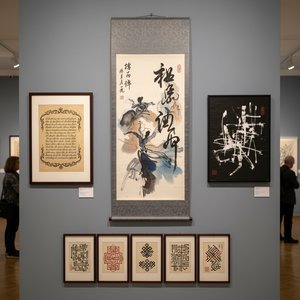
A Life Etched in Ink: The World of Yang Yisun
Yang Yisun (1813-1881), a name perhaps unfamiliar to many outside the circles of dedicated Chinese art scholars, represents a pinnacle of achievement within the tradition of *seal script calligraphy*. He wasn’t merely a calligrapher; he was a scholar-official deeply immersed in the revival of classical forms, a collector with discerning taste, and an artist who imbued his work with both technical mastery and profound personal meaning. Born into a family of modest means in Anhui province, Yang Yisun's early life foreshadowed little of the artistic renown that would later define him. He passed the imperial examinations, securing a position within the government bureaucracy – a path typical for aspiring intellectuals of his era. However, it was not official duties but an insatiable passion for antiquity and calligraphy that truly consumed him.The Revivalist’s Path: Influences and Early Development
Yang Yisun emerged during a period of burgeoning interest in epigraphy – the study of ancient inscriptions – fueled by the scholarly pursuits of the Qing dynasty. The Jiaqing Emperor's promotion of orthodox Confucianism created an environment ripe for re-examining historical models, and Yang Yisun wholeheartedly embraced this movement. He wasn’t content with simply copying past masters; he sought to *understand* the underlying principles that governed their brushwork, the very spirit of the characters themselves. His early studies focused on the bronze inscriptions of the Zhou dynasty, particularly those found on ritual vessels. These archaic forms, known as *zhuanshu*, captivated him with their solemnity and inherent power. He believed they held a direct connection to the origins of Chinese culture, embodying a purity lost in later, more stylized scripts. Influenced by epigraphers like Luo Zhenyu, Yang Yisun dedicated himself to meticulously recreating these ancient characters, not as mere reproductions but as living expressions of historical consciousness.Mastering the Seal: Technique and Artistic Philosophy
Yang Yisun’s technical skill was exceptional. He possessed an uncanny ability to replicate the textures and nuances of bronze inscriptions using brush and ink on paper. However, his artistry extended far beyond mere imitation. He understood that *zhuanshu* wasn't simply about form; it was about rhythm, balance, and the expressive potential of line. His calligraphy is characterized by a remarkable solidity – each character feels grounded, substantial, yet imbued with a subtle energy. The brushwork is deliberate, controlled, but never rigid. He employed a variety of ink tones, creating depth and visual interest within each inscription. More importantly, Yang Yisun believed that calligraphy should reflect the inner state of the artist. His work wasn’t simply decorative; it was a form of self-cultivation, a means of expressing his moral principles and philosophical beliefs. He often inscribed poems and prose passages alongside his *zhuanshu* compositions, further enriching their meaning and context.A Legacy in Stone and Ink: Major Achievements
While Yang Yisun produced numerous works throughout his career – paintings, poetry, and extensive collections of rubbings from ancient inscriptions – he is best known for his *seal script calligraphy*. His compositions were highly sought after by collectors and connoisseurs. He was commissioned to create inscriptions for steles (stone tablets) in temples and gardens, ensuring that his artistry would endure beyond his lifetime.- The Chung Young Yang Museum Collection: Today, the most comprehensive collection of Yang Yisun’s work resides at the Chung Young Yang Museum in Seoul, South Korea, founded by his descendants. This museum provides invaluable insight into the breadth and depth of his artistic achievements.
- Rubbing Expertise: His meticulous rubbings from ancient bronze vessels are considered benchmarks for accuracy and artistry, providing scholars with crucial resources for studying epigraphy.
- Influence on Later Generations: Yang Yisun’s dedication to the revival of *zhuanshu* inspired a generation of calligraphers to re-examine classical forms. His work helped to elevate the status of seal script calligraphy within the broader landscape of Chinese art.
Historical Significance: A Bridge Between Past and Present
Yang Yisun’s significance lies not only in his technical prowess but also in his role as a cultural bridge. He lived during a period of significant social and political upheaval, yet he remained steadfastly committed to preserving the traditions of the past. His work represents a conscious effort to reconnect with China's ancient heritage, offering a sense of continuity and stability in a rapidly changing world. By mastering *zhuanshu*, Yang Yisun didn’t simply recreate historical forms; he breathed new life into them, imbuing them with his own unique artistic vision. He stands as a testament to the enduring power of calligraphy – not just as a form of aesthetic expression but as a profound reflection of cultural identity and personal integrity. His legacy continues to inspire artists and scholars today, reminding us of the importance of honoring our past while forging new paths for the future.Q&A
Yang Yisun의 작품을 분위기별로 찾아볼 수 있나요?
Yang Yisun의 무드 룸에서는 작가의 작품들을 분위기별로 만나보실 수 있습니다.
미술 사조별로 분류된 Yang Yisun의 작품은 어디에서 볼 수 있나요?
Yang Yisun 작가의 작품을 예술 사조별로 모아둔 모든 미술 사조 페이지에서 해당 작가가 활동했던 사조를 확인하실 수 있습니다.
Yang Yisun가 그린 모든 주제를 한눈에 볼 수 있는 개요가 있나요?
Yang Yisun의 주제별 작품 모음는 작가의 작품들을 주제별로 찾아볼 수 있는 페이지입니다.
Yang Yisun의 작품은 얼마나 인기가 있나요?
이 사이트에서 Yang Yisun의 작품에 관한 통계를 확인할 수 있는 방문 통계 페이지를 만나보세요.