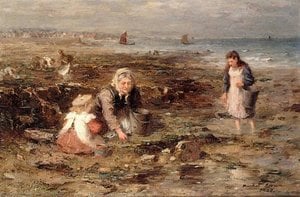
The Luminous Legacy of William Marshall Brown
In the quiet, salt-sprayed corners of the European coastline, where the rhythmic pulse of the tide meets the steady toil of humanity, lies the heart of William Marshall Brown’s artistic vision. A Scottish master of the Royal Scottish Academy, Brown (1863–1936) possessed a rare ability to transform the mundane labors of rural life into scenes of profound, luminous serenity. His work does not merely observe; it breathes with the atmosphere of the landscapes he frequented, particularly the sun-drenched shores of Holland, Belgium, and France. Through his eyes, we witness a world where the boundaries between nature and human existence are blurred by a soft, Impressionist light, creating a timeless tapestry of coastal tranquility.
Brown’s journey into the mastery of light began in the historic studios of Edinburgh. Studying at the RCA School of Art and Design, he was shaped by instructors who emphasized a rigorous dedication to realism, yet encouraged an expressive exploration of color. This foundational period instilled in him a technical discipline that would later allow him to execute complex atmospheric effects with breathtaking ease. His election into the Royal Scottish Academy in 1894 served as a definitive milestone, signaling his arrival as a significant voice within the Scottish artistic community and providing him the platform to share his evocative visions with a wider audience.
A Symphony of Light and Coastal Life
The essence of Brown’s oeuvre is found in his intimate portrayals of genre scenes—moments of everyday life captured with a sense of reverence. He was particularly drawn to the lives of fisherfolk, documenting the quiet industry of those who gathered mussels along sandy shores or hauled heavy nets onto the beach. These subjects were more than mere topical interests; they represented a deeper, symbolic connection between humanity and the natural world, echoing the Victorian ideals of pastoral harmony and moral virtue. In his hands, the act of gathering shellfish becomes a meditative dance with the sea.
Technically, Brown was a virtuoso of the Impressionist tradition. He achieved a remarkable sense of depth and luminosity by layering thin, delicate glazes of oil paint, a method that allowed light to appear as if it were emanating from within the canvas itself. This technique is nowhere more evident than in his celebrated works:
- Mussel Gatherers: A captivating study of rural Holland, where the artist masterfully renders the gritty textures of sand and the weathered, resilient faces of the workers.
- A Breton Washing Pool: A 1930 masterpiece that transports the viewer to the French coast, capturing a solitary woman amidst the rhythmic tides, her figure anchored by tradition and grace.
- Two Fishergirls: An exquisite example of his ability to use evocative light to create a sense of timeless, serene beauty.
- Fishing Girls: A charming depiction of women collecting shellfish, showcasing his signature soft light and intricate textural details.
Historical Significance and Enduring Charm
Beyond the technical brilliance of his brushwork, William Marshall Brown’s significance lies in his ability to evoke emotion through stillness. While many of his contemporaries sought the dramatic or the avant-garde, Brown found power in the quietude of a coastal meadow or the gentle movement of a boat drifting upon a calm bay. His paintings serve as historical windows into a way of life that was intimately tied to the seasons and the tides—a world of manual labor and natural rhythm that felt increasingly distant even during his own lifetime.
Today, Brown’s work remains a cherished cornerstone for collectors of 19th and early 20th-century art. His ability to capture the fleeting quality of light—the way it glints off wet sand or softens the edges of a distant horizon—ensures that his paintings continue to offer a sense of peace to the modern viewer. He remains a definitive figure of the Impressionist movement, leaving behind a legacy of beauty that celebrates the enduring, harmonious bond between the human spirit and the vast, indifferent majesty of the sea.
Q&A
William Marshall Brown의 작품을 분위기별로 모아둔 곳은 어디인가요?
William Marshall Brown의 무드 룸에서는 작가의 작품들을 분위기별로 만나보실 수 있습니다.
키워드로 William Marshall Brown의 작품을 찾아볼 수 있나요?
William Marshall Brown의 작품은 아티스트의 키워드별 탐색 페이지에서 키워드별로 찾아보실 수 있습니다. 각 키워드를 통해 관련 작품들을 모아 감상하실 수 있습니다.
William Marshall Brown 작가의 작품을 감상할 수 있는 가상 박물관에 방문할 수 있나요?
William Marshall Brown의 작품은 작가의 3D 갤러리 페이지 내 3D 갤러리에서 감상하실 수 있습니다.
William Marshall Brown 작가는 어떤 사조의 작품 활동을 했나요?
William Marshall Brown의 작품은 작가의 모든 미술 사조 페이지에서 사조별로 만나보실 수 있습니다.