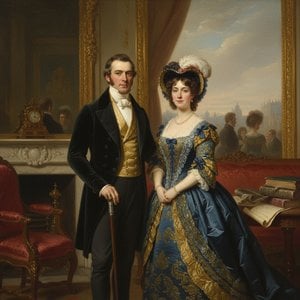
A Life in Portraiture
William John Watkeys lived through a transformative era of the nineteenth century, a period when the quiet dignity of a sitter was often captured through the careful application of oil and brush. Born in 1800, he moved through a world of shifting social structures, finding his place as a painter whose work reflected the faces and figures of his time. His life, which concluded in 1873, was defined by this steady engagement with the human form and the specific identities of those who sat before him.
His practice was rooted in the tradition of portraiture, a discipline requiring both technical precision and a certain psychological stillness. He did not seek to distort reality but rather to document it, providing a visual record of the individuals who shaped the local landscape. His presence in the art world was marked by this commitment to the likeness, capturing the essence of his subjects with a measured hand.
The Subjects of His Brush
The records of his output reveal a focus on the people of his era, often documenting figures of local significance or personal connection. His work provides a window into the social fabric of the early to mid-1800s, preserving the likenesses of those who might otherwise have faded from memory. Some of the notable subjects and works associated with his career include:
- John Thomas, Pengwern (1833)
- Ann of Swansea (1834)
- Ann of Swansea (1835)
In these works, one finds the intersection of individual character and the formal requirements of the portrait. His ability to render a specific person—such as the figure known as Ann of Swansea—ensures that his contribution to the visual history of the period remains tangible. He worked during a time when the portrait was a primary means of asserting identity and status.
Historical Presence
Watkeys remains a figure of interest for those studying the regional art history of Wales. His works have found their way into significant collections, including the National Library of Wales in Aberystwyth and the Swansea Museum. These placements suggest that his depictions held a value that transcended the immediate moment of their creation, moving from private homes into the public consciousness. He remains a painter of the specific, a man who used his craft to anchor the ephemeral faces of the nineteenth century into the permanence of oil on canvas.
Q&A
William John Watkeys 작가는 어떤 사조의 작품 활동을 했나요?
William John Watkeys 작가의 작품을 예술 사조별로 모아둔 모든 미술 사조 페이지에서 해당 작가가 활동했던 사조를 확인하실 수 있습니다.
키워드별로 분류된 William John Watkeys의 작품은 어디에서 볼 수 있나요?
특정 주제의 William John Watkeys 작품을 찾으려면 키워드별로 작품이 분류된 작가의 키워드별 탐색 페이지를 이용해 보세요.
William John Watkeys의 작품을 색상별로 정렬해서 볼 수 있나요?
William John Watkeys의 작품은 작가의 컬러 인덱스 페이지에서 색상별로 감상하실 수 있습니다.
William John Watkeys의 작품을 매체별로 찾아볼 수 있나요?
모든 매체별 페이지에서는 William John Watkeys의 작품을 기법별로 모아볼 수 있습니다.