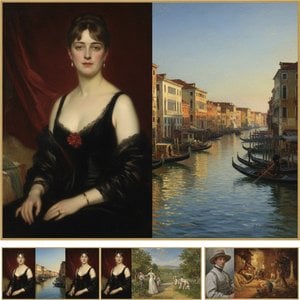
William John Thomson RSA (1771-1845)
Early Life and Education
William John Thomson was born on October 3rd, 1771, in Savannah, Chatham County, Georgia, to Scottish parents, Alexander Thomson and Mary Elizabeth Spencer. His family migrated to England during the American War of Independence. He received his artistic training in London, though specific details regarding his formal education remain scarce. This period laid the foundation for his future career as a versatile artist.
Artistic Development and Style
Thomson initially gained recognition for his skill in creating silhouettes, a popular art form during the late 18th and early 19th centuries. He quickly expanded his repertoire to include portrait miniatures and full-scale portraits. His style evolved over time, demonstrating an ability to adapt to changing artistic tastes. While rooted in traditional techniques, he incorporated elements of contemporary British painting.
Exhibitions and Recognition
Thomson first exhibited at the prestigious Royal Academy of Arts in 1795, marking a significant step in his career. He continued to exhibit regularly there and at the British Institution between 1809 and 1829 while residing in London at various addresses including Charles Street, Craven St, and The Strand. In 1808 he was considered for election to the Royal Academy. His work gained him a reputation as a skilled portraitist and miniaturist.
Move to Scotland and Later Life
In 1812, Thomson relocated to his ancestral homeland of Scotland, settling in Edinburgh. He married Helen J Colhoun in 1797 and later Anne McCulloch (d.1855) around 1817; these marriages produced seven children. In Edinburgh, he became a prominent figure in the artistic community, residing at addresses like York Place and Northumberland Avenue. He held various official positions within Scottish art circles.
Major Works and Themes
Thomson’s oeuvre encompasses portraits, miniatures, landscapes, and genre paintings. Some of his notable works include Northern Lights and Presentation teapot. His portraiture often captured the likenesses of prominent Scottish figures, reflecting the social landscape of the time. He also explored scenic views and everyday life in his landscapes and genre scenes.
Influences and Legacy
While specific artistic influences are not extensively documented, Thomson’s work demonstrates an awareness of prevailing British portraiture styles of the period. His sister, Catherine Thomson, was later the stepmother of author Elizabeth Gaskell, suggesting a connection to literary circles. He became a key figure in 19th-century British art and particularly within the Scottish artistic landscape.
Historical Significance
William John Thomson RSA played an important role in documenting the lives of his contemporaries through portraiture. His work provides valuable insights into the social and cultural history of Scotland during the early 19th century. Though not as widely celebrated as some of his peers, he remains a significant figure for scholars studying British art and Scottish artistic heritage.
질의응답
William John Thomson Rsa 작가는 어떤 색상을 가장 자주 사용했나요?
William John Thomson Rsa의 팔레트 지놈는 작가의 작품 세계를 구성하는 컬러 프로필을 보여주는 페이지입니다.
키워드로 William John Thomson Rsa의 작품을 찾아볼 수 있나요?
William John Thomson Rsa의 키워드별로 페이지에서는 작가의 작품들을 키워드별로 모아볼 수 있습니다.
William John Thomson Rsa 작가는 어떤 사조에 참여했나요?
William John Thomson Rsa의 작품은 작가의 모든 사조 페이지에서 사조별로 둘러보실 수 있습니다.