Kuhn’s early life was rooted in a working-class family near the Brooklyn docks, exposing him to vibrant yet rough waterfront experiences.
Despite a natural inclination towards drawing, his initial career path diverged from art, involving work as a bicycle repair shop owner and a professional bike racer.
He began selling drawings at age fifteen, adopting the signature “Walt.”
Formal artistic training commenced in 1893 at the Brooklyn Polytechnic Institute.
European Studies and Artistic Development
In 1899, Kuhn ventured to California with limited funds, working as an illustrator for WASP Magazine.
Recognizing the need for broader artistic exposure, he traveled to Paris in 1901.
He briefly studied at the Académie Colarossi before moving to Munich and studying under Heinrich von Zügel of the Barbizon School.
His European travels included sketching trips in the Netherlands and visits to museums in Venice, where he encountered Impressionism and Post-Impressionism for the first time.
Return to America and Early Career
Kuhn returned to New York in 1903, working as an illustrator for local journals.
He held his first exhibition at the Salmagundi Club in 1905, establishing himself as both a cartoonist and painter.
His illustrations appeared in Life Magazine, and he created the comic strip “Whisk” (1909-1911) for the New York World.
He briefly taught at the New York School of Art but disliked the experience.
Marriage to Vera Spier followed, and they had a daughter, Brenda Kuhn.
The Armory Show and its Impact
A Defining Moment: Kuhn played a crucial role in organizing the 1913 Armory Show – America’s first large-scale introduction to European Modernism.
Kuhn served as the executive secretary and was tasked with securing participation from European artists. He, Davies, and Walter Pach toured Europe in 1912 to achieve this.
The Armory Show attracted over 200,000 attendees and generated $44,000 in sales, exceeding all expectations.
Robert Hughes noted Kuhn’s “talent for promotion” which was instrumental to the show's success.
Later Career and Artistic Style
Post-Armory Show, Kuhn advised lawyer and collector John Quinn in building his modern art collection.
His work initially reflected European Modernist influences (e.g., Raoul Dufy, André Derain), but later evolved towards a more representational style while retaining bold colors and textures.
He taught at the Art Students League of New York after recovering from a serious illness in 1925.
Kuhn completed a commission for the Union Pacific Railroad, designing the club car “The Little Nugget.”
Historical Significance and Legacy
Kuhn’s role in the Armory Show was transformative, opening American audiences to new artistic ideas.
He navigated a complex art world caught between European Modernism and emerging American regionalist movements.
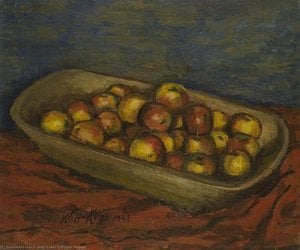
His paintings – particularly his depictions of circus performers and still lifes – are celebrated for their vibrant color, energetic brushwork, and unique perspective.
Died: 1949, leaving behind a legacy as a pivotal figure in the development of American Modernism.
Q&A
Walt Kuhn은(는) 어느 시대의 작품을 남겼나요?
Walt Kuhn은(는) Modern 시대에 활동했습니다. 이 시기는 역사적 맥락 속에서 작가의 예술적 위치를 보여줍니다.
Journey through the raw emotion of Abstract Expressionism. From Pollock's drips to Rothko's color fields, explore 10 iconic masterpieces and their stories. Find museum-quality art reproductions for your space at WahooArt.com. Discover all masterpieces on WahooArt.com.