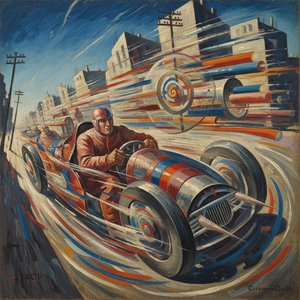
Tullio Crali: A Dalmatian Vision of Speed and the Sky
Born in Igala, Montenegro, in 1910 – a region steeped in both natural beauty and a history of conflict – Tullio Crali’s life and art were inextricably linked to his homeland. Though he spent much of his career in Milan, his Dalmatian roots profoundly shaped his artistic vision, particularly his fascination with speed, aerial mechanics, and the dynamic interplay between man and machine. A self-taught painter who joined the Futurist movement relatively late in 1929, Crali developed a unique style that blended realistic depiction with the radical aesthetic principles of the era. His work isn’t simply about depicting airplanes; it's about capturing the *experience* of flight – the disorientation, the exhilaration, and the overwhelming sense of perspective shift.
Crali’s early life provided a fertile ground for his artistic inclinations. Growing up in Zara (now Zadar) and later Gorizia, he was exposed to both the rugged beauty of the Adriatic coast and the burgeoning industrialization of Italy. A student at the local technical institute at fifteen, he stumbled upon Futurism through Giacomo Balla and Enrico Prampolini – artists already pushing the boundaries of representation. This encounter ignited a passion that would define his career, leading him to embrace painting as a means of expressing the dynamism and energy of the modern world.
The Birth of Aeropittura
Crali’s entry into Futurism coincided with the movement's fervent exploration of new artistic mediums. In 1928, he experienced flight for the first time – a pivotal moment that directly informed his art. Inspired by Marinetti’s manifesto, *Perspectives of Flight*, Crali quickly became involved in what was termed “aeropittura” or “aerial painting.” This innovative approach sought to capture the shifting perspectives and dizzying sensations of flying through visual means. The manifesto declared that "The changing perspectives of flight constitute an absolutely new reality that has nothing in common with the reality traditionally constituted by a terrestrial perspective" – a sentiment perfectly reflected in Crali’s work.
His early aeropittura pieces, such as *Aerial Squadron* (1929) and *Aerial Duel*, depicted military aircraft with a striking realism. However, Crali quickly moved beyond mere representation, striving to convey the subjective experience of flight. He collaborated with other prominent Futurists like Benedetta, Depero, and Prampolini on this groundbreaking movement, participating in the first aeropittura exhibition in Paris in 1932. This period saw a shift towards more abstract representations, utilizing dynamic lines and fragmented forms to mimic the disorientation of aerial combat.
Realism and the Pilot’s Perspective
As the 1930s progressed, Crali's style evolved, moving away from purely abstract depictions. He began to incorporate elements of realism, aiming to communicate the visceral experience of piloting an aircraft to the viewer. *Nose Dive on the City* (1939) is perhaps his most iconic work, a masterful example of this approach. The painting captures the dizzying perspective of a pilot executing a dive, with buildings rendered in distorted, overlapping planes – a visual representation of disorientation and speed.
Crali’s artistic endeavors extended beyond aeropittura. He actively participated in the Quadrennial Exhibitions in Rome (1935, 1939, and 1943) and the Venice Biennale (1940), showcasing his diverse talents and engaging with the broader art world. His involvement in film production during this period further demonstrated his interest in exploring new forms of visual communication.
Post-War Innovation and “Sassintesi”
Following World War II, Crali relocated to Turin and then Milan, continuing to promote Futurist ideals despite the movement’s decline. In 1959, he introduced "sassintesi" – a radical artistic concept utilizing natural materials like pebbles and stones to create evocative compositions. This marked a significant departure from his earlier work, reflecting a desire to reconnect with nature while retaining the dynamism of Futurism. His *Sassintesi* exhibition in Milan in 1961 showcased this innovative approach.
Crali’s legacy extends beyond his individual artworks. He played a crucial role in preserving and promoting Futurist principles, organizing events and disseminating the movement's ideas throughout Italy. His archive, donated to the Museo di arte moderna e contemporanea di Trento e Rovereto, provides invaluable insight into his life and artistic development. Tullio Crali died in Milan in 2000, leaving behind a body of work that continues to fascinate with its unique blend of realism, dynamism, and a profound exploration of the human experience within the context of speed and technology.
Q&A
Tullio Crali의 작품을 색상별로 찾아볼 수 있나요?
Tullio Crali의 작품은 작가의 컬러 인덱스 페이지에서 색상별로 감상하실 수 있습니다.
Tullio Crali의 작품을 연도순으로 어디에서 볼 수 있나요?
Tullio Crali의 작품 연표를 확인해 보세요: 작품 연대기 페이지에서 작품들을 제작 날짜순으로 보실 수 있습니다.
Tullio Crali의 작품들은 어떤 분위기를 담고 있나요?
아티스트의 무드 룸 페이지에서는 Tullio Crali의 작품들을 분위기에 따라 큐레이션된 형태로 만나보실 수 있습니다.
주제별로 Tullio Crali의 작품을 찾아볼 수 있나요?
Tullio Crali의 주제별 작품 모음는 작가의 작품들을 주제별로 찾아볼 수 있는 페이지입니다.