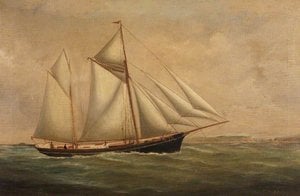
Thomas Chidgey: A Master of Somerset’s Maritime Landscape
The world of 19th-century British art often focuses on grand narratives – royal portraits, sweeping landscapes, and meticulously rendered historical scenes. Yet, within this established framework, a quieter, more intimate story unfolds through the work of Thomas Chidgey (1855–1926), a Somerset-based painter who dedicated his life to capturing the essence of his coastal home. Chidgey wasn’t striving for fame or fortune; instead, he possessed an unwavering passion for depicting the working lives and the ever-changing moods of the sea around Watchet and other ports in West England. His legacy lies not in monumental canvases but in a remarkable collection of paintings – primarily watercolors and oils – that offer a remarkably detailed and poignant glimpse into a vanishing world of sailing ships, bustling harbors, and the rhythms of maritime existence.
Born in 1855, Chidgey’s early life remains somewhat shrouded in mystery. Records suggest he was apprenticed to a shipbuilder in Watchet, a vital port town on the Bristol Channel, an experience that undoubtedly shaped his artistic sensibilities and instilled within him a deep understanding of shipbuilding techniques and the lives of those involved. This practical knowledge is immediately apparent in his paintings – the rigging of a vessel isn’t merely sketched; it's rendered with astonishing accuracy, reflecting a genuine appreciation for the mechanics of sailing. He began exhibiting his work locally from around 1880, quickly gaining recognition for his ability to capture light and atmosphere with remarkable subtlety. His style evolved over time, moving from looser, more impressionistic renderings to increasingly detailed and meticulously observed depictions, yet always retaining a strong sense of place and a profound connection to the subject matter.
The Language of the Sea
Chidgey’s paintings are not simply representations of ships; they are imbued with a deep understanding of the sea itself. He wasn't interested in dramatic storms or heroic rescues – though he occasionally depicted them – but rather in the quieter, more contemplative aspects of maritime life. His subjects frequently include small fishing boats returning to harbor after a long day at sea, laden with their catch; schooners patiently awaiting their turn in port; and the subtle shifts in light and color as the sun rises and sets over the water. He masterfully employed watercolor techniques – layering washes of color to create atmospheric effects and capturing the shimmering reflections on the waves – alongside oil paints for richer detail and texture, particularly when depicting the hulls of ships. His use of color is remarkably restrained, relying heavily on muted blues, greens, and greys to evoke the prevailing weather conditions and the overall mood of each scene.
A key element in Chidgey’s work is his ability to convey a sense of time and place. His paintings aren't romanticized fantasies; they are rooted in the realities of everyday life. He meticulously documented the details of Watchet harbor – the weathered facades of the warehouses, the bustling activity of the docks, the faces of the fishermen – creating a vivid portrait of a community deeply connected to the sea. The Schooner ‘Edith’, for example, painted around 1900, is not just a depiction of a ship; it’s a snapshot of a specific moment in time, capturing the activity and atmosphere of Watchet harbor with remarkable precision.
Influences and Artistic Development
While Chidgey's work stands apart as distinctly British, his artistic development was undoubtedly influenced by several key movements. The Pre-Raphaelites, with their emphasis on detail and narrative, can be seen in the meticulous rendering of objects and figures within his paintings. Furthermore, the Impressionists’ focus on capturing fleeting moments of light and atmosphere resonated with Chidgey's approach to depicting the sea. However, unlike many Impressionist painters who sought to capture a generalized impression of nature, Chidgey remained firmly rooted in the specific details of his local environment. He was less concerned with abstract representation than with conveying a sense of authenticity and immediacy.
Over time, Chidgey’s style evolved subtly but consistently. Early works are characterized by looser brushstrokes and brighter colors, while later paintings demonstrate a greater control over detail and a more restrained palette. Despite these stylistic shifts, his core artistic principles – his deep understanding of the sea, his meticulous observation skills, and his commitment to capturing the essence of Somerset’s maritime landscape – remained constant throughout his career.
Legacy and Historical Significance
Thomas Chidgey's contribution to British art is often overlooked, overshadowed by more prominent figures. Yet, his paintings offer a unique and valuable record of a disappearing world – a world where sailing ships were the lifeblood of coastal communities and where the rhythms of maritime life dictated the pace of daily existence. His work serves as a poignant reminder of the importance of preserving local heritage and documenting the lives of ordinary people. Today, Chidgey’s paintings are held in several collections, including the Gloucester Museums Service Art Collection, and continue to be admired for their technical skill, atmospheric quality, and profound sense of place. He is now recognized as a significant regional artist who captured the spirit of Somerset's maritime past with remarkable sensitivity and detail, leaving behind a rich legacy of paintings that offer a lasting connection to a bygone era.
질의응답
Thomas Chidgey의 작품 중 조회수가 가장 높은 것은 무엇인가요?
Thomas Chidgey 작가 작품에 관한 통계 정보는 작가의 통계 페이지에서 확인하실 수 있습니다.
Thomas Chidgey의 작품들은 어떤 분위기를 담고 있나요?
아티스트의 무드 룸 페이지에서는 Thomas Chidgey의 작품들을 분위기에 따라 큐레이션된 형태로 만나보실 수 있습니다.
Thomas Chidgey의 작품 세계는 시간이 흐름에 따라 어떻게 변화했나요?
Thomas Chidgey의 예술적 여정은 연대기 페이지에서 시기별로 펼쳐집니다. 이곳에서는 작가의 활동 시기를 장(chapter)으로 나누어 작품들을 연대순 타임라인 형태로 한눈에 확인할 수 있습니다.