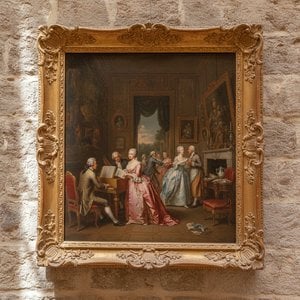
Talbot Hughes: A Victorian Painter of Costume and Romantic Idealism
Talbot Hughes (1869 – 1942) stands as a singular figure in British art history—a painter deeply invested in both artistic technique and the meticulous study of historical dress, creating works that resonate with an enduring fascination for Victorian aesthetics. Born into a family steeped in artistic tradition, Hughes’s father, William Hughes, was himself a still-life artist, fostering within him a foundational appreciation for observation and detail. His brother, Sir Herbert Hughes-Stanton, pursued landscape painting, providing another contrasting perspective on visual representation that undoubtedly shaped Hughes's artistic sensibilities. Hughes began his artistic journey at the remarkably young age of seventeen, exhibiting at the Royal Academy—a prestigious institution that would remain central to his career until 1913. This early exposure cemented his commitment to capturing the grandeur and elegance of the Victorian era, a period he meticulously documented through canvases infused with Romantic ideals and informed by the stylistic influence of Jean-Louis Ernest Meissonier, the celebrated French classicist painter known for his dramatic historical scenes. Hughes’s artistic vision prioritized not merely depicting subjects but elevating them—presenting idealized feminine beauty alongside explorations of passionate love narratives. Hughes's oeuvre spanned diverse genres, from allegorical and figurative compositions to meticulously rendered historical portraits and theatrical designs. He possessed an extraordinary ability to translate visual concepts into tangible form, achieving remarkable precision in portraying fabrics, textures, and surfaces – a skill particularly evident in his detailed depictions of costumes. This dedication to craftsmanship was further underscored by Hughes’s extensive collection of over 750 historical costumes and accessories, which served as invaluable studio props and fueled his artistic inspiration. Recognizing the significance of preserving these artifacts, he generously donated items to institutions like St Hugh's College and Dublin City Gallery The Hugh Lane, contributing to the broader understanding of Victorian fashion history. Hughes’s contributions to the Royal Academy included notable works such as “Temptation” (1899), “Fate Leads the Willing, and the Unwilling Drags” (1900) and “The Road of Love” (1900)—each demonstrating his mastery of Romantic painting techniques. Critiques from contemporaries like Marion Hepworth Dixon highlighted Hughes’s exceptional handiwork and his ability to convey emotion through nuanced visual storytelling. His artistic endeavors garnered considerable acclaim, culminating in an offer of £5,000 by an American department store for the sale of his entire costume collection—a testament to his enduring legacy as both a painter and collector. Talbot Hughes remains a compelling figure whose art continues to captivate audiences with its beauty, precision, and evocative portrayal of Victorian culture.Q&A
Talbot Hughes 작가의 작품을 감상할 수 있는 3D 가상 투어가 있나요?
Talbot Hughes의 작품은 작가의 3D 갤러리 페이지 내 3D 갤러리에서 감상하실 수 있습니다.
Talbot Hughes의 작품을 연도순으로 어디에서 볼 수 있나요?
Talbot Hughes의 작품 연표를 확인해 보세요: 작품 연대기 페이지에서 작품들을 제작 날짜순으로 보실 수 있습니다.
Talbot Hughes 작가의 작품 관련 통계 정보는 어디에서 확인할 수 있나요?
이 사이트에서 Talbot Hughes의 작품에 관한 통계를 확인할 수 있는 방문 통계 페이지를 만나보세요.